XIRCON & HEAVY XIRANITE OVERFLOW BLUEPRINT
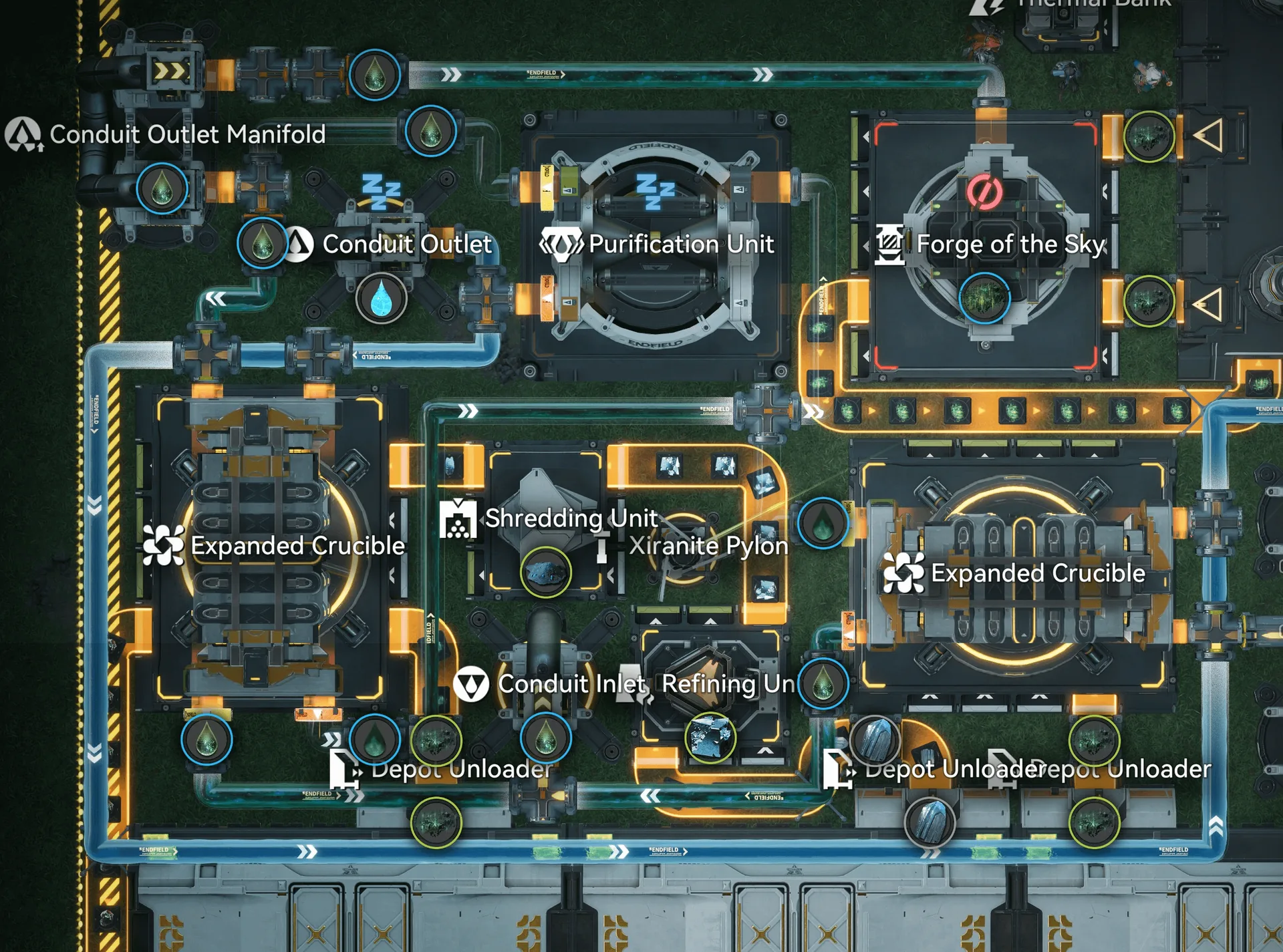
Table of Contents
If you run the standard Xircon plus Heavy Xiranite production line in Wuling, you have almost certainly hit the wall: one half of the line caps out, and the other half dies with it. Xircon production and Heavy Xiranite production are welded together by their shared effluent loop, so the moment Xircon or Heavy Xiranite reaches max stack, the whole thing seizes. Until now the only fix was babysitting the depot, trading the excess to Outposts before either side filled up. That is fine if you log in daily, but it punishes anyone who wants to take a week off and come back to a factory that is still humming.
This guide walks through a redesigned blueprint that breaks the co-dependency for good. It uses a Manifold Conduit plus Merger overflow buffer so the two output lines can cap independently and the line goes safely dormant instead of deadlocking. We will cover why the stock layout jams, exactly how the overflow rewires it, the ratios involved, and the sharing code so you can drop it straight into your base.
TL;DR - Key Points
- The stock Xircon + Heavy Xiranite line is co-dependent — one side hitting max stack stalls the other through the shared Inert Xircon Effluent loop.
- Root cause: the Purification Node sits in series between both lines, so a clog anywhere backs up everywhere.
- The fix: extract Xircon Effluent from both Expanded Crucibles, pool it through a Conduit + Manifold Conduit, and feed the overflow to the Forge of the Sky.
- Mergers force alternation so the Purification Node never clogs, and the buffers (500 units each) absorb the difference.
- Xircon production is untouched — it still pulls its 2 units of Xircon Effluent per craft, it just gets fed from a shared pool now.
- Either side can max out independently. If everything caps, the line goes dormant and self-restarts when you draw a stack down.
- Ultra compact: the whole build sits inside a single Xiranite Pylon’s range.
- Sharing code (US/EU):
EFO01iOe70EIU524472U4(blueprint[Xircon+H.Xirani], 16x22 grid).
Related read: Version 1.2 Meta: Zhuang Fangyi & Factory Optimization covers the sewage rework and Expanded Crucible basics this build assumes you already have running.
The Stock Layout: How Xircon and Heavy Xiranite Normally Connect
Before fixing anything, it helps to be precise about what the common setup actually does, because the deadlock is baked into its topology.
You run two Expanded Crucibles. Both take Water and Xiranite to brew Liquid Xiranite, then combine that Liquid Xiranite with Sewage to output two things at once: Xircon Effluent (the useful product) and Inert Xircon Effluent (the waste byproduct).
The two crucibles differ in one detail:
- Crucible 1 needs its Sewage piped in from an external source.
- Crucible 2 generates its own Sewage internally, because it is also running the Xircon recipe (Ferrium Powder plus Xircon Effluent yields Xircon, and that craft produces Sewage as a side output).
To make the ratios line up, you feed the Xircon Effluent from Crucible 1 into Crucible 2 so Crucible 2 has the 2 units of Xircon Effluent it needs per Xircon craft.
That leaves the Inert Xircon Effluent waste from both crucibles. You have two ways to deal with it:
- Treatment Units simply destroy it. Wasteful, and most veterans skip this.
- A Purification Node converts the Inert Xircon Effluent back into usable Xircon Effluent (plus Water), which you then route to a Forge of the Sky to craft Heavy Xiranite.
That second path is the smart one, and it is also exactly where the trap is.
Why the Two Lines Deadlock Each Other
Here is the thing that makes the stock build so frustrating: the Purification Node sits in series between Xircon production and Heavy Xiranite production. Everything flows through one bottleneck, so a backup anywhere propagates in both directions.
Walk through the two failure cases:
| Trigger | What backs up | Result |
|---|---|---|
| Xircon and/or batteries hit max stack | Crucible 2 stops crafting Xircon, so it stops consuming, but it keeps making Inert Xircon Effluent until that clogs. The Purification Node stops receiving feed. | Heavy Xiranite production dies. |
| Heavy Xiranite hits max stack | The Forge of the Sky stops pulling, so Purified Xircon Effluent backs up into the Purification Node, then Inert Xircon Effluent backs up into both crucibles. | Xircon production dies too. |
In both directions, capping one product strangles the other. The lines are not independent factories that happen to share a wall; they are a single chained system with a shared choke point.
The only “solution” the community had was manual: keep trading Xircon, batteries, and Heavy Xiranite to your Outposts so nothing ever reaches max stack. That works, but it is a chore, and it directly conflicts with the way a lot of us want to play, which is to build a factory that runs untouched for days. For more on why the Purification Node behaves this way, the Purification Node sewage-to-Xircon analysis breaks down its exact conversion ratio and throughput ceiling.
One failure this blueprint cannot cover is the region-wide version, because its cause sits upstream of both lines. If you come back to empty Thermal Banks and a dark base, why a fully built Wuling factory shuts itself down traces the cuprium and sewage chain that starves Xircon in the first place, and covers which fix to run.
The Core Idea: Pool the Effluent, Overflow the Rest
The redesigned line. Xircon Effluent from both Expanded Crucibles and the Purification Node pools through the Conduit and Manifold Conduit, with the surplus overflowing to the Forge of the Sky.
The redesign changes one assumption. In the stock build, Crucible 2 keeps its own Xircon Effluent internally for the Xircon craft. In the new build, you extract the Xircon Effluent from Crucible 2 as well, exactly like you already do with Crucible 1.
Now both crucibles dump their Xircon Effluent into a shared Conduit, which is linked to a Manifold Conduit mounted just above it. The Manifold Conduit feeds Xircon Effluent back down into Crucible 2 for the Xircon recipe. You also route the Xircon Effluent produced by the Purification Node into the same pool.
The net effect on Xircon production is zero. Crucible 2 still receives its 2 units of Xircon Effluent per craft and still combines them with Ferrium Powder exactly as before. The difference is that the effluent now comes out of a shared buffer rather than a dedicated internal line.
That shared buffer is the whole trick, because it lets you build an overflow system on top of it.
How the Manifold Conduit + Merger Overflow Works
The overflow technique relies on standard fluid-routing behavior that has been around since the sewage update. (If the underlying behavior is unfamiliar, the Talos-II pipe mechanics breakdown explains merging and priority routing in detail.) The blueprint applies it like this:
The Manifold Conduit has two output sides. One side carries fewer (or zero) Mergers; the other carries more Mergers. The low-Merger side (the bottom path in the layout) is the priority route back to Crucible 2. The high-Merger side (the top path) leads to the Forge of the Sky.
Fluid prefers the path of least resistance, so it fills the low-Merger side first. Once that side clogs, because Crucible 2 only pulls what it needs, the excess is forced onto the high-Merger side and over to the Forge. Since you are also injecting the Purification Node’s Xircon Effluent into the pool, you produce more Xircon Effluent than Xircon production alone consumes, so this overflow happens continuously and on purpose.
The excess does not vanish. It first accumulates as a buffer:
| Buffer | Capacity |
|---|---|
| Conduit | 500 units |
| Manifold Conduit | 500 units |
Only after both 500-unit buffers fill does the surplus overflow toward the Forge of the Sky to become Heavy Xiranite. This buffering is what decouples the timing of the two lines: short-term mismatches get soaked up, and only the genuine surplus crosses over.
Why the Purification Node Stops Clogging
The cleverest part of the design is what the Mergers do for the Purification Node, the original villain of the deadlock.
A Merger forces both of its input sides to alternate. It will not let one side dominate the pipe; it pushes one unit from each side in turn. Because the Purification Node’s Xircon Effluent enters the pool through a Merger, the Node is guaranteed an outlet on every cycle. Its output literally cannot back up, because the Merger keeps forcing its share into the pipe alongside everything else.
The same logic handles the Water that the Purification Node emits as a second output. Routing it through a Merger against the Conduit’s flow keeps that line moving too, so the Node never stalls on its water side either.
This is the structural fix. In the stock build the Node was a passive in-series valve that could be choked from either end. In the overflow build it is an active participant that the Mergers refuse to let clog.
Behavior Under Every Max-Stack Scenario
The point of the rebuild is predictable behavior when products cap. Here is what actually happens in each case:
- Xircon and/or the batteries it feeds hit max stack. Crucible 2 stops crafting Xircon and stops pulling Xircon Effluent from the pool. With nothing draining the low-Merger side, all the Xircon Effluent overflows to the Forge of the Sky. You end up with far more Xircon Effluent than a single Forge needs, so you can even split some off toward another use.
- Heavy Xiranite hits max stack. The Forge stops pulling, so the overflow side fills. The buffers top out, and both Expanded Crucibles simply stop producing more Xircon Effluent. Crucially, nothing backs up into the Purification Node, because the Mergers keep its line flowing.
- Everything hits max stack at once. The entire production line goes dormant. No clog cascade, no manual intervention. It restarts on its own the moment you draw down any of the capped stacks.
That last behavior is the goal: controlled clogging. The factory parks itself safely and wakes up when there is room to work, which is exactly what you want from a build you intend to leave alone.
The Ratios at a Glance
For planning purposes, these are the relationships the blueprint preserves. The exact per-minute throughput scales with your facility levels and Wuling regional development, but the ratios are what matter for wiring it correctly.
| Stage | Inputs | Outputs |
|---|---|---|
| Liquid Xiranite (both crucibles) | Water + Xiranite | Liquid Xiranite |
| Effluent craft (both crucibles) | Liquid Xiranite + Sewage | Xircon Effluent + Inert Xircon Effluent |
| Xircon craft (Crucible 2) | Ferrium Powder + 2 Xircon Effluent | Xircon (+ Sewage byproduct) |
| Purification (Node) | Inert Xircon Effluent | Xircon Effluent + Water |
| Heavy Xiranite (Forge of the Sky) | Overflow Xircon Effluent | Heavy Xiranite |
The shared pool means you no longer hand-balance the Crucible-1-to-Crucible-2 effluent handoff. You pour every Xircon Effluent source into one Conduit and let the Merger priority sort out who gets fed first and what overflows.
Setup by Player Type
Not everyone needs this, so be honest about which camp you are in before you tear down a working line.
The daily active trader. If you already log in every day and dump excess to your Outposts, the stock line works fine and this rebuild is a quality-of-life upgrade rather than a necessity. Worth doing if you dislike the chore, optional otherwise.
The max-stack, leave-it-alone builder. This is who the blueprint is for. If your philosophy is “build it, cap it, forget it,” the overflow design is close to mandatory. It is the only way to let both products sit at max stack without one killing the other, and it means you can ignore the line for as long as you like.
The space-constrained Wuling base. Because the whole thing fits inside a single Xiranite Pylon’s range, it is genuinely compact. If you are fighting the building cap, that density matters. For the broader context on Heavy Xiranite output and Forge of the Sky capacity, see the AIC Factory Update: Wuling Expansion coverage.
If this overflow line is only one part of a larger multi-zone build, the Wuling and Valley IV modular factory blueprint maps the eight connected production modules, their zone assignments, and shared resource flows.
Common Mistakes and Pitfalls
A few ways this build goes wrong if you rush it:
- Looping pipes the old way. The instinct from the stock build is to keep effluent internal to Crucible 2. Don’t. The entire fix depends on extracting it into the shared pool. Half-converting leaves you with the original deadlock.
- Getting Merger counts backwards. The low-Merger side must be the priority feed to the crucible, and the high-Merger side the overflow to the Forge. Swap them and the Forge starves while the crucible drowns.
- Forgetting the Purification Node’s Water output. The Node emits Water as well as Xircon Effluent. If you leave the Water line un-Merged, it can stall the Node from the side you weren’t watching.
- Falling back on Treatment Units. Destroying Inert Xircon Effluent throws away free Heavy Xiranite. The whole point is to recycle it through the Node into the overflow.
- Undersizing your buffers. The two 500-unit buffers are what absorb the timing mismatch. Skipping a buffer to save space reintroduces the very stalls you are trying to eliminate.
The Blueprint Code
Here is the in-game Share Blueprint screenshot, which doubles as verification of the layout, grid size, and code.
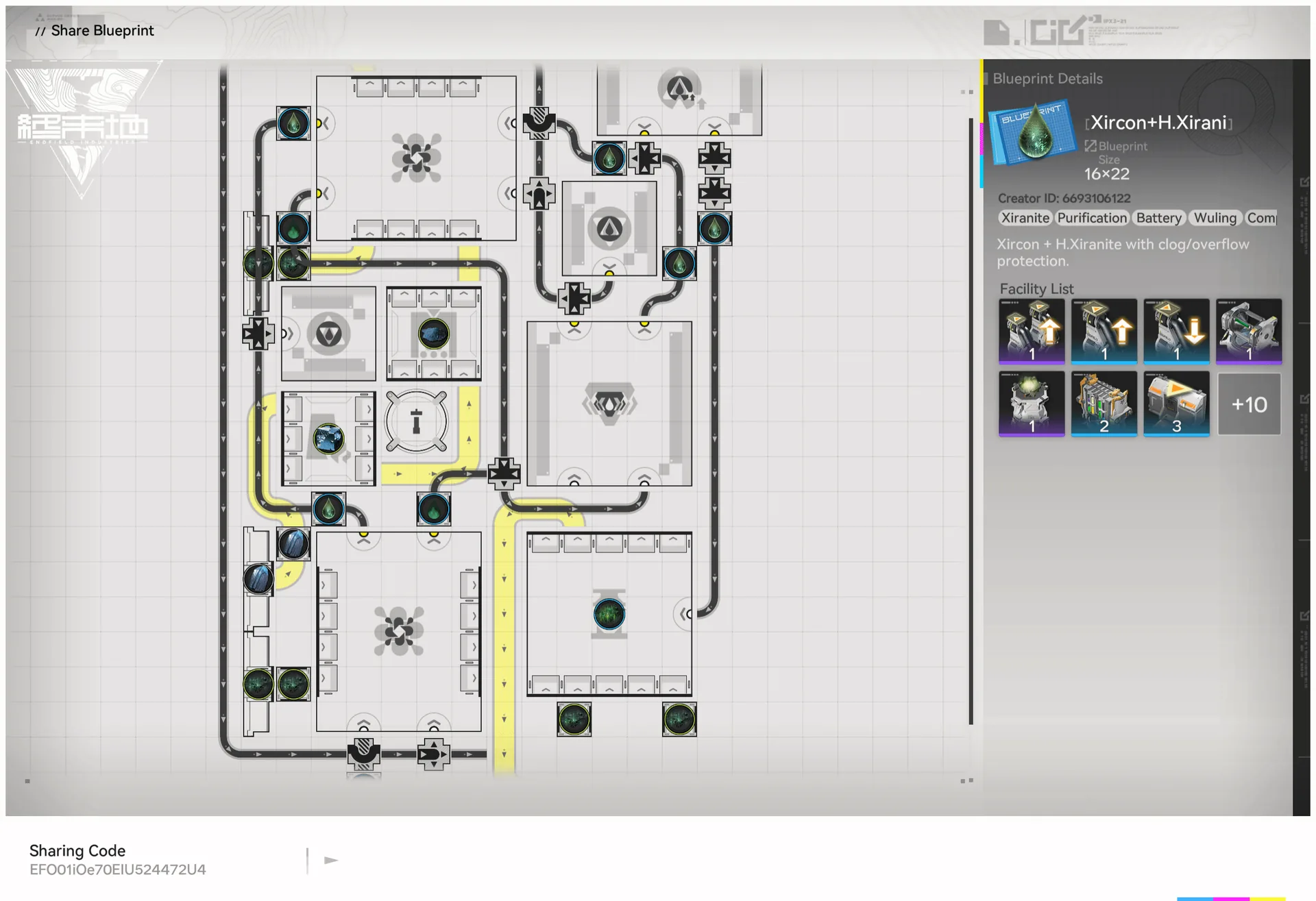
Blueprint “Xircon+H.Xirani”, 16x22 grid, tagged Xiranite / Purification / Battery / Wuling. Description: “Xircon + H.Xiranite with clog/overflow protection.”
The sharing code for the US/EU servers:
[Xircon+H.Xirani]EFO01iOe70EIU524472U4Paste it into the blueprint import screen, place it inside a single Xiranite Pylon’s range, and connect your external Sewage feed and your Xiranite, Water, and Ferrium Powder inputs.
Watch List: What Could Change This
A couple of things on the horizon could shift how valuable this build is:
- The 1.4 AIC overhaul and gas products. The 1.3 livestream teased the biggest AIC rework yet, including gas mechanics and a Xiranite and Cuprium expansion. New recipes or a rumored inter-zone fluid-transfer building could change how effluent gets routed entirely, and might make a dedicated overflow loop either obsolete or even more powerful.
- Forge of the Sky capacity. If a future patch raises the Forge cap again, the overflow side gains more headroom to consume surplus, which only makes this design stronger. Whether running a spare Forge is worth it at all is the open question the Purification Facility worth-it analysis digs into.
- Building-cap pressure. Wuling’s protocol capacity is the silent constraint on every late build. The compactness of this layout is a feature today; if the cap rises, you may have room to scale it horizontally instead of relying purely on overflow.
Final Read
The co-dependency deadlock was never a numbers problem; it was a topology problem. The stock line chains two products through one in-series choke point, so capping either one chokes the whole thing. The overflow blueprint fixes the topology: it pools every Xircon Effluent source into a buffered shared line, uses Merger alternation to keep the Purification Node from ever clogging, and routes only the genuine surplus to Heavy Xiranite. The result is two products that can cap independently and a factory that parks itself safely instead of deadlocking.
If you are the kind of player who wants to build it once and walk away, this is the design to copy. Drop in the code, wire your inputs, and stop babysitting your depot.
FAQ
Does extracting Xircon Effluent from Crucible 2 reduce Xircon output? No. Crucible 2 still receives its 2 units of Xircon Effluent per craft. It just pulls them from the shared pool instead of keeping them internal, so the craft rate is unchanged.
Why use a Manifold Conduit instead of a normal Conduit? The Manifold Conduit gives you two output sides to build the priority-versus-overflow split, and it adds a second 500-unit buffer. A plain Conduit alone cannot create the overflow behavior.
What do the Mergers actually do here? A Merger forces its two input sides to alternate, pushing one unit from each in turn. That guarantees the Purification Node always has an outlet, which is why its effluent and water never back up and clog the line.
Will this work if I only have one Forge of the Sky? Yes. In fact, when Xircon production is capped, you will produce more Xircon Effluent than a single Forge can consume, so you can split the surplus toward something else if you want.
Do I still need to trade excess to my Outposts? No. That is the entire point. Both products can sit at max stack and the line goes dormant instead of jamming, so manual depot management becomes optional.
How long does it take to “fill up” before overflow starts? The two 500-unit buffers (Conduit and Manifold Conduit) take time to fill before surplus crosses to the Forge. Expect a warm-up period after first placing the build; this is normal and only happens once.
Is this safe to leave running for days? Yes. The worst case is full dormancy when everything caps, and it self-restarts the moment you draw any stack down. There is no clog cascade to clean up.
Which server is the code for?
The shared code EFO01iOe70EIU524472U4 (blueprint [Xircon+H.Xirani]) is for the US/EU servers.
What if I am still on the stock Treatment Unit setup? Switch the Inert Xircon Effluent over to a Purification Node first, then rebuild the effluent routing as described. Treatment Units just delete the byproduct, throwing away the Heavy Xiranite this design recovers.
Does it fit in a tight Wuling base? Yes. The full build sits inside the range of a single Xiranite Pylon, which is unusually compact for a dual-product line.
Endfield Hub is a fan-made resource and is not affiliated with Hypergryph or Yostar.
Take a Break
Available on desktop