CONTINGENCY CONTRACT: TEST CRITERIA META
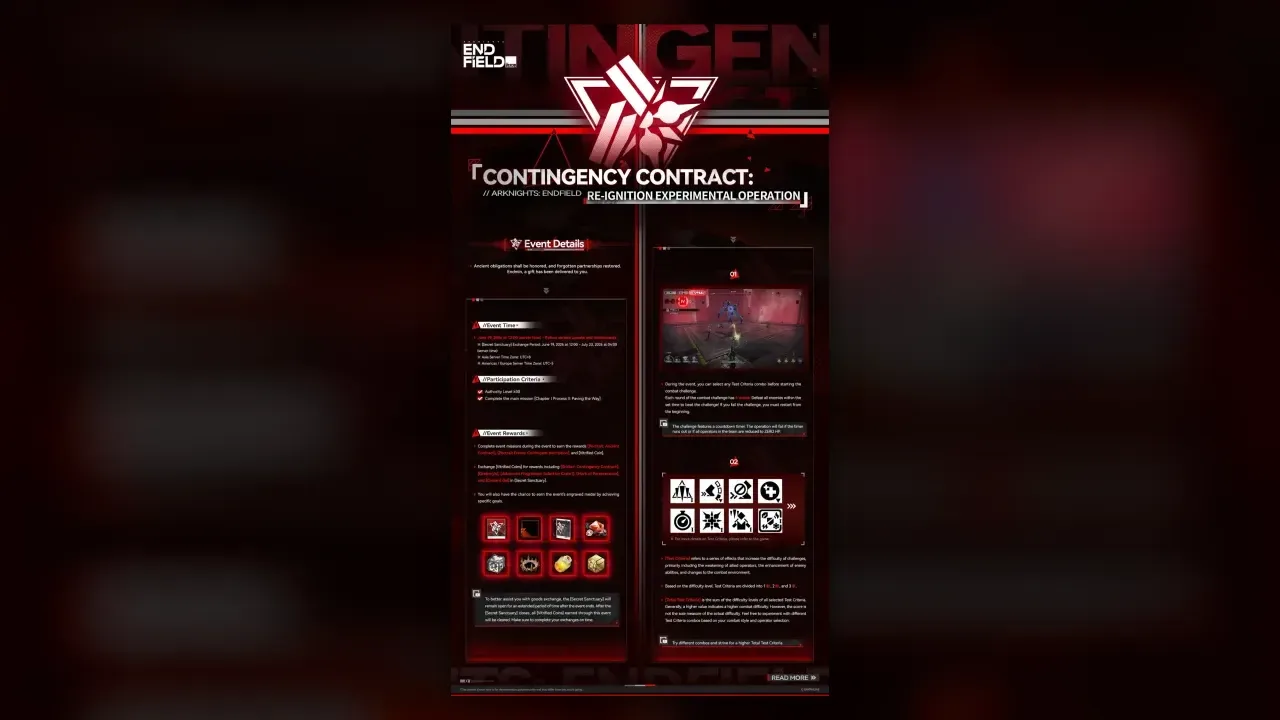
Table of Contents
Contingency Contract: Re-Ignition Experimental Operation opens June 19, 2026 at 12:00 (server time), the first full Contingency Contract event in Arknights: Endfield after months of livestream teases and speculation. The official announcement infographic finally puts hard mechanics behind the hype: the risk-stacking system Endfield borrows from the original Arknights is built around Test Criteria, your difficulty is measured as a single Total Test Criteria number, and a brand-new Sharing Code feature lets you trade entire difficulty loadouts with friends in one click. If you have been waiting to know exactly what CC asks of your roster and how the reward economy works, this is the post that turns the infographic into a plan.
Below is the complete mechanical breakdown of the launch announcement. Every date, every reward, the Test Criteria scoring model, the Contract Missions cadence, and the Secret Sanctuary exchange deadline you cannot afford to miss. For the design-theory backdrop, our Contingency Contract deep-dive analysis covers how the system translates from tower defense into Endfield’s real-time combat. Now that the event is live, our Re-Ignition launch-day strategy guide walks through the first-session priorities, the new Sanctuary Rating, and the engraved medal.
TL;DR: Key Points
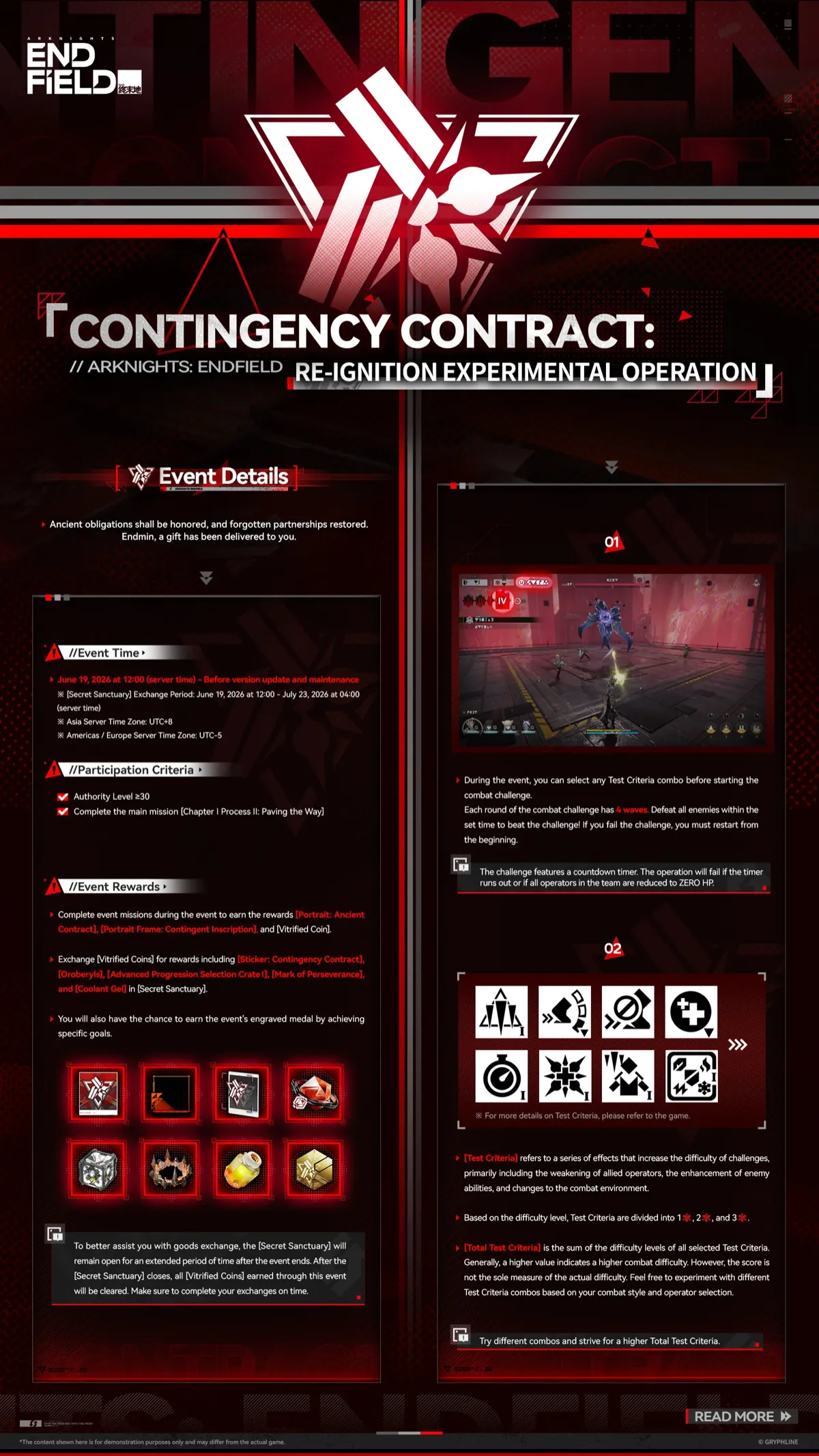
- Opens June 19, 2026 at 12:00 (server time), Asia (UTC+8), Americas/Europe (UTC-5); the event launches before the version update and maintenance.
- Low entry bar. You only need Authority Level ≥30 and completion of the main mission Chapter I Process II: Paving the Way to participate.
- Test Criteria are the risk modifiers. Each is rated 1☆, 2☆, or 3☆, weakening your operators, buffing enemies, or warping the combat environment.
- Total Test Criteria is your difficulty score, the sum of every Criterion you stack; higher generally means harder, but it is not the sole measure of real difficulty.
- A new Test Criteria set dropped June 26, 2026 at 12:00 (now live): five new criteria that escalate the meta one week into the event, covered in our Phase 2 breakdown.
- Combat is 4 waves on a countdown timer, clear every wave before time runs out; you fail if the timer expires or your whole team hits 0 HP, and a failed run restarts from the beginning.
- 7 Cycle Missions over the event. One new Cycle Mission unlocks every 3 days at 04:00, alongside Test Criteria Missions and Phase Missions.
- Vitrified Coins buy the real loot, exchange them in the Secret Sanctuary for Oroberyls, an Advanced Progression Selection Crate I, Mark of Perseverance, Coolant Gel, and cosmetics. The Sanctuary stays open after the event, then coins are cleared.
When Re-Ignition Opens and Closes
The event goes live on June 19, 2026 at 12:00 (server time), and the announcement is explicit that this happens before the next version update and maintenance, so CC arrives as a standalone event layered on the current build, not bundled into a patch drop.
The Secret Sanctuary exchange shop, where your Vitrified Coins actually convert into rewards, runs on its own clock: June 19, 2026 at 12:00 through July 23, 2026 at 04:00 (server time). That gives you roughly a five-week window, and crucially the Sanctuary stays open for a stretch after the combat event itself winds down so you can finish spending.
| Server | UTC Offset | June 19 Local Launch |
|---|---|---|
| Asia Server | UTC+8 | 12:00 noon (Beijing/Singapore/Taipei) |
| Americas / Europe Server | UTC-5 | 12:00 noon (Eastern Time) |
Mark July 23 at 04:00 in your calendar as the hard stop. Once the Secret Sanctuary closes, all unspent Vitrified Coins and exchange items are cleared. There is no carryover and no late-claim grace period.
How to Unlock Re-Ignition
The participation gate is refreshingly low for an endgame mode:
- Authority Level ≥30. This is your account-level requirement, comfortably within reach for anyone past the early campaign.
- Complete the main mission [Chapter I Process II: Paving the Way], an early story beat, not a late-game wall.
That low bar is deliberate. Unlike the original Arknights CC, which assumed a deep endgame roster, Endfield’s Re-Ignition is built so that even relatively new Endministrators can enter. The difficulty scaling lives entirely in the Test Criteria you choose to stack, not in the entry requirements, so the mode self-selects challenge rather than locking out players by progression.
Combat Structure: Four Waves on the Clock
Before each combat challenge, you select your Test Criteria combo, then drop into the fight. The core loop is straightforward but unforgiving:
- Each round of the combat challenge has 4 waves. You must defeat all enemies within the set time to clear it.
- A countdown timer runs the whole encounter. The operation fails if the timer runs out or if all operators in your team are reduced to 0 HP.
- Failure means a full restart. There is no checkpoint between waves, if you wipe on wave 4, you start again from wave 1.
This is the first place your Test Criteria choices bite. A modifier that shaves your damage output or buffs enemy HP does not just make the fight “harder” in the abstract. It directly threatens the timer. The clock is the real boss of CC. Many losses in this mode are not death-by-HP but death-by-timeout, where a team that can kill everything simply cannot kill it fast enough under the stacked penalties.
What Test Criteria Actually Are
Test Criteria are the heart of the mode, the Endfield equivalent of the original Arknights “Risk” tags. Each Criterion is a discrete effect that increases challenge difficulty, and the announcement groups them into three broad categories:
- Weakening allied operators, reduced damage, lowered healing, disabled mechanics, or capped sustain.
- Enhancing enemy abilities, bonus HP, higher ATK, faster spawns, or new enemy behaviors.
- Changing the combat environment, hazards, terrain effects, and global rule changes that reshape the fight.
Every Test Criterion carries a star rating that reflects how punishing it is:
| Rating | Meaning | Typical Effect |
|---|---|---|
| 1☆ | Minor difficulty bump | Small stat shifts, light penalties |
| 2☆ | Moderate challenge | Meaningful operator weakening or enemy buffs |
| 3☆ | Heavy modifier | Mechanic bans, severe stat swings, environment hazards |
You mix and match these freely before each challenge. The star rating is your at-a-glance read on how much a given Criterion will cost you, but as we will see, the headline score it feeds into is only part of the story.
Total Test Criteria: The Score That Drives the Meta
When you stack Criteria, the game sums their difficulty values into a single number: your Total Test Criteria. This is the score the entire mode revolves around, reward tiers, set unlocks, and the social leaderboard all key off it.
Total Test Criteria is the sum of the difficulty levels of all selected Test Criteria. Generally, a higher value indicates a higher combat difficulty — but the announcement is careful to note the score is not the sole measure of actual difficulty.
That caveat is the most important strategic note in the whole infographic. Two loadouts can share the same Total Test Criteria and feel wildly different depending on which Criteria you picked relative to your team. A 3☆ “elemental damage reduction” Criterion is nearly free if you are running an off-element team, and brutal if it nukes your main carry’s element. The number is identical; the real difficulty is not.
| Loadout (example) | Total | Why the Score Lies |
|---|---|---|
| 3☆ + 3☆ + 2☆ | 8 | High score, but if both 3☆ dodge your team’s weaknesses, it plays easy |
| 2☆ + 2☆ + 2☆ + 2☆ | 8 | Same score, four modifiers, more surface area to brick your rotation |
| 3☆ (your element banned) + 1☆ | 4 | Low score, but the element ban alone can hard-wall the wrong roster |
The practical takeaway: build your Total Test Criteria around your roster, not the leaderboard. Pick the Criteria your team is structurally immune to, push the number as high as those “free” modifiers allow, and only then start eating Criteria that actually hurt. This is the exact build-flexibility muscle the recent Trial of Swordmancy combat mode was training you for, the team you stress-tested there is the team you bring here.
Criteria Sets, Locked Criteria, and the June 26 Escalation
Test Criteria are not all available at once. They are organized into regional Criteria Sets, and you unlock additional Sets by clearing challenges at a higher Total Test Criteria. In other words, the mode gates its hardest modifiers behind proof that you can already handle the milder ones. You earn the right to make the fight harder.
On top of that, some Test Criteria are Locked Criteria that cannot be selected by default. To access them, you must select the specified Key Criteria first, a dependency system where taking one designated modifier unlocks a related, usually nastier, one.
The escalation is built into the calendar: a new set of Test Criteria will be introduced on June 26, 2026 at 12:00 (server time) (UTC+8 Asia, UTC-5 Americas/Europe). That is one week after launch, and it is the signal that CC is meant to be revisited, the launch-week ceiling is not the event ceiling. Clear what you can in week one, then come back after June 26 when the new Set arrives to chase a higher Total Test Criteria. That Set is now live: Phase 2 added five new criteria worth up to +9 selectable risk (detailed in our Phase 2 breakdown), which pushed the documented ceiling to a Risk 52 clear.
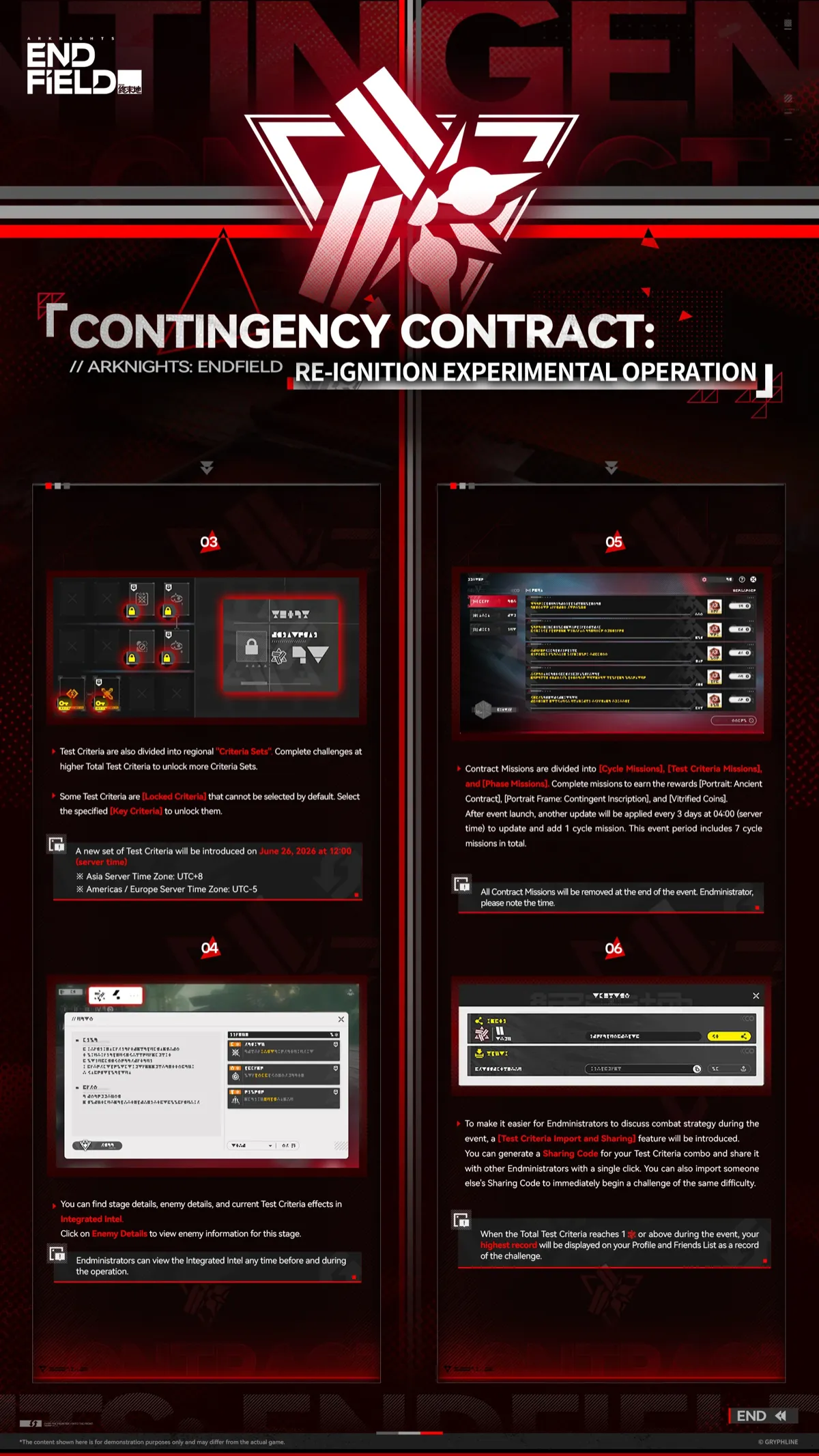
The second announcement page covers the back-half systems: regional Criteria Sets and Locked/Key Criteria unlocks, the Integrated Intel scouting panel, the Cycle/Test Criteria/Phase Contract Missions, and the new Test Criteria Sharing Code feature.
Integrated Intel: Scout Before You Commit
You are not flying blind into these fights. The mode exposes a planning panel called Integrated Intel, where you can review:
- Stage details, the layout and structure of the encounter.
- Enemy details, click Enemy Details to pull up exactly which enemies the stage will throw at you.
- Current Test Criteria effects, a readout of every modifier currently applied and what it does.
Critically, you can open Integrated Intel any time before and during the operation. That means you can scout the enemy composition, pick Test Criteria that exploit your roster’s strengths against those specific enemies, and double-check a modifier’s exact wording mid-fight if something feels off.
Treat Integrated Intel as a mandatory pre-fight step, not an optional menu. The difference between a clean clear and a timeout is often just knowing which enemy archetype you are about to face, and choosing your Criteria accordingly.
Contract Missions: Cycle, Test Criteria, and Phase
The reward grind is structured around Contract Missions, split into three types:
- Cycle Missions, the recurring backbone of the event, drip-fed over time.
- Test Criteria Missions, objectives tied to clearing at specific Total Test Criteria values.
- Phase Missions, milestone goals across the event’s run.
The cadence is the key detail. After the event launches, an update applies every 3 days at 04:00 (server time) that adds one new Cycle Mission, and the event includes 7 Cycle Missions in total. That maps to a roughly three-week active mission window.
| Mission Type | What It Tracks | Cadence |
|---|---|---|
| Cycle Missions | Recurring event objectives | +1 every 3 days at 04:00, 7 total |
| Test Criteria Missions | Clearing at target Total Test Criteria | Available across the event |
| Phase Missions | Event milestone goals | Available across the event |
Completing Contract Missions earns the headline cosmetics and the event currency: Portrait: Ancient Contract, Portrait Frame: Contingent Inscription, and Vitrified Coin. There is also an Engraved Medal on offer for achieving specific goals.
One warning the announcement makes explicit: all Contract Missions are removed at the end of the event. Anything you have not completed disappears with them, so the every-three-days drip is not something to binge at the finish line. Log in across the event to keep the Cycle Missions from piling up uncleared.
Vitrified Coins and the Secret Sanctuary Exchange
The actual loot lives in the Secret Sanctuary, the event’s exchange shop, where you spend the Vitrified Coins you earn from Contract Missions. The exchange list is the real reason to grind:
| Reward | Why It Matters |
|---|---|
| Oroberyls | Premium currency: the headline value pickup for most players |
| Advanced Progression Selection Crate I | Targeted operator progression materials |
| Mark of Perseverance | Progression/upgrade material |
| Coolant Gel | Crafting/gear material for your industrial base |
| Sticker: Contingency Contract | Cosmetic exclusive to the event |
Prioritize by scarcity. Oroberyls and the Advanced Progression Selection Crate I are the high-value, account-progressing pulls, clear those first. The cosmetics (Sticker, Portrait, Portrait Frame) are nice-to-have flexes but will not move your roster forward; grab them once the materials are secured.
Remember the deadline: the Secret Sanctuary closes July 23, 2026 at 04:00 (server time), after which all remaining Vitrified Coins are cleared. The Sanctuary intentionally outlasts the combat event so you have buffer time to spend, use it, but do not assume it is permanent.
Sharing Codes: CC Goes Social
The genuinely new feature in Re-Ignition is Test Criteria Import and Sharing, built to make CC a community conversation rather than a solo grind.
- Generate a Sharing Code for any Test Criteria combo with a single click and send it to other Endministrators.
- Import someone else’s Sharing Code to instantly load the exact same difficulty loadout and jump into a matching challenge.
This solves the classic CC problem of “what risks did you run for that clear?”, instead of screenshotting a modifier list, you paste a code and you are playing the identical fight. Expect community spreadsheets and Discord threads full of “verified clear” codes within days of launch.
There is also a prestige hook: once your Total Test Criteria reaches a high enough threshold during the event, your Sharing Code is displayed on your Profile and Friends List as a record of the challenge you conquered. It is Endfield’s version of a CC leaderboard flex, a public marker of how deep you pushed.
Strategy by Player Type
Re-Ignition’s low entry bar means it serves very different players. Here is how to approach it depending on where you sit.
New / Early Endministrator (just hit Authority 30)
- Enter at minimum Total Test Criteria first. Clear the baseline challenge to confirm your team and rotation work before stacking anything.
- Pick 1☆ Criteria that dodge your weaknesses. Use Integrated Intel to read the enemies, then add only modifiers your team barely notices.
- Chase Contract Mission completion, not the leaderboard. The Vitrified Coins from missions are where your real reward value is, the Oroberyls do not care how high your Total was.
Mid-Game Player (established roster, some flex)
- Build your Total around “free” Criteria. Element bans against off-element enemies, mechanic restrictions you do not rely on, push the number with modifiers that cost your specific team nothing.
- Race the timer, not the HP bars. Most mid-game losses are timeouts. Prioritize burst and clear speed over survivability once you know you can survive.
- Spend Vitrified Coins on materials first. Oroberyls → Advanced Progression Selection Crate I → Mark of Perseverance, then cosmetics.
Endgame / Veteran (deep, flexible roster)
- Treat June 26 as the real start. The launch-week Criteria Sets are the warm-up; the new Set on June 26 is where the high Total Test Criteria ceiling opens up.
- Hunt Key Criteria → Locked Criteria chains. The nastiest modifiers are gated behind Key Criteria, map those dependencies to maximize your score efficiently.
- Publish your Sharing Codes. Once your Total clears the display threshold, your codes become community reference clears. Share the loadouts that make hard Criteria manageable.
Common Mistakes to Avoid
Re-Ignition is generous on entry but punishes a handful of specific errors.
- Chasing Total Test Criteria for the number’s sake. The announcement explicitly warns the score is not the sole measure of difficulty. A “lower-score, team-hostile” loadout can be far harder than a “high-score, team-friendly” one.
- Skipping Integrated Intel. Going in without scouting enemy details means picking Criteria blind. Always read the stage before you commit modifiers.
- Ignoring the timer. CC is a clear-speed check disguised as a difficulty check. Teams that brute-force HP but lack burst will time out on stacked Criteria.
- Hoarding Cycle Missions. They are removed at event end. The every-three-days drip means seven Cycle Missions stack up if you binge, log in across the run.
- Letting Vitrified Coins expire. The Secret Sanctuary clears all coins on July 23 at 04:00. Spend on Oroberyls and materials well before the deadline.
- Forgetting the second Criteria Set. Players who clear everything in week one and walk away miss the June 26 escalation entirely, and the higher Total it enables.
What to Watch After Launch
Several details are not in the launch infographic and will be pinned down by the community in week one.
- The exact Total Test Criteria threshold for Profile display. The announcement confirms there is a score gate for showing your Sharing Code publicly, but not the number. Expect it datamined or confirmed quickly.
- The full Test Criteria list and star values. We know the categories and the 1☆–3☆ scale; the complete modifier roster (and which are Locked behind Key Criteria) will surface on launch day.
- Exact Vitrified Coin costs and Contract Mission payouts. The reward types are confirmed; the prices and per-mission coin yields are not. A spending-priority spreadsheet will follow within days.
- The June 26 Criteria Set is now live. Phase 2 added five new Test Criteria (Time Limit III, Flash Freeze, Re-Construct I and II, Encumbered) worth up to +9 selectable risk, which pushed the documented ceiling to a Risk 52 clear. See the Phase 2 Test Criteria breakdown for each effect and risk value.
- Whether Sharing Codes drive a “verified clear” culture. If the community standardizes on shared codes, CC’s social layer could become its most durable feature, a precedent for future events.
Final Read
Re-Ignition Experimental Operation is Endfield’s first real Contingency Contract, and the announcement delivers on the promise: a build-your-own-difficulty mode with a low entry bar, a clean scoring model in Total Test Criteria, and a genuinely fresh social layer in Sharing Codes. The low Authority 30 gate signals intent, Hypergryph wants everyone to enter, then lets the Test Criteria system separate the casual clear from the prestige run.
The trap is the score. Total Test Criteria looks like the goal, but the infographic itself tells you it is not the true measure of difficulty. The players who do best in this mode will be the ones who scout with Integrated Intel, stack the Criteria their roster shrugs off, and race the timer rather than chasing a leaderboard number. The Secret Sanctuary deadline of July 23 and the every-three-days Cycle Mission drip mean this is a log-in-across-the-event grind, not a finish-line binge.
Enter on June 19. Clear the baseline first. Build your Total around your team. Spend your Vitrified Coins on Oroberyls and materials before the Sanctuary closes, and come back June 26 for the second Criteria Set. For the broader strategic philosophy behind CC’s horizontal-investment demands, our endgame CC prep guide covers how to ready a roster that can flex into any modifier combination, and our Contingency Contract team comps and reaction meta breakdown names the specific operators and lanes that exploit the Test Criteria board.
Frequently Asked Questions
When does Contingency Contract: Re-Ignition open? June 19, 2026 at 12:00 server time (UTC+8 for Asia, UTC-5 for Americas/Europe), before the next version update and maintenance. The Secret Sanctuary exchange runs through July 23, 2026 at 04:00.
What do I need to participate? Authority Level ≥30 and completion of the main mission Chapter I Process II: Paving the Way. The entry bar is intentionally low, the difficulty lives in the Test Criteria you choose, not the unlock requirements.
What are Test Criteria? Difficulty modifiers you stack before each challenge. They weaken your operators, enhance enemies, or change the combat environment, and each is rated 1☆, 2☆, or 3☆ based on how punishing it is.
What is Total Test Criteria? The sum of the difficulty values of every Test Criterion you select. It is the mode’s headline score, but the announcement explicitly warns it is not the sole measure of actual difficulty, since some Criteria barely affect the right team while others hard-wall the wrong one.
How does the combat work? Each round is 4 waves on a countdown timer. You must defeat all enemies before time expires. You fail if the timer runs out or your whole team hits 0 HP, and a failed run restarts from the beginning.
What are Locked Criteria and Key Criteria? Some Test Criteria cannot be selected by default (Locked Criteria). To access them, you must first select a specified Key Criterion, a dependency system that gates the nastiest modifiers behind related ones.
When does the second Test Criteria set arrive? It arrived June 26, 2026 at 12:00 server time, one week after launch, and is now live. Phase 2 added five new criteria (Time Limit III, Flash Freeze, Re-Construct I and II, Encumbered) that raised the documented ceiling to a Risk 52 clear. See the Phase 2 breakdown for the full effects and risk values.
What can I buy with Vitrified Coins? In the Secret Sanctuary: Oroberyls, an Advanced Progression Selection Crate I, Mark of Perseverance, Coolant Gel, and the Sticker: Contingency Contract cosmetic. Prioritize Oroberyls and the progression crate. All unspent coins are cleared when the Sanctuary closes July 23 at 04:00.
What are Sharing Codes? A new feature that lets you generate a code for your Test Criteria combo and share it in one click, or import someone else’s code to instantly load the same difficulty. Reach a high enough Total Test Criteria and your code displays on your Profile and Friends List.
How many Contract Missions are there? The event includes 7 Cycle Missions, with one new Cycle Mission added every 3 days at 04:00 server time, alongside Test Criteria Missions and Phase Missions. All Contract Missions are removed at the end of the event, so don’t leave them uncleared.
Take a Break
Available on desktop