TRIAL OF SWORDMANCY: DAILY COMBAT MODE
Table of Contents
Trial of Swordmancy opens June 12, 2026 at 12:00 (server time) as the second permanent player-driven combat mode in Arknights: Endfield, the first being Umbral Monument. The pitch is short and unusual: you do not choose a stage, you draw a hand of Dataplates, the Dataplates decide which enemies show up, and the same draw decides what you walk away with. Three Rewarded Trial attempts per day, an unlimited Free Trial fallback, a once-per-three-days deck rotation, and a limited-window event called Trial Algorithmics sitting on top of it, the whole loop is built to be the daily you actually look forward to instead of the daily you tab away from.
Below is the full mechanical breakdown of the launch infographic, the strategy implications for each player archetype, and the Trial Algorithmics event window you cannot afford to miss while Sketches of Lost Heirlooms is live. For broader 1.3 patch context, our Sketches of Lost Heirlooms livestream recap covers Mi Fu, Camille, Contingency Contract, and the QoL pass that lands alongside this mode.
TL;DR: Key Points
- Opens June 12, 2026 at 12:00, Asia server (UTC+8), Americas/Europe server (UTC-5); the mode is permanent, not a limited event.
- Two unlock gates, complete the Deep Vaulted Steel side mission, then the Trial of Swordmancy mission to activate the Trial Arena.
- Dataplates decide everything, draw up to 5 Dataplates per round before each Trial; the final total Battle Points drives both enemy composition and reward tier.
- Data Overflow above 10 BP lowers your rewards and makes the Trial harder, going over is a double penalty, not a high-roll.
- Dataplate Deck rotates every 3 days, deck size and enemy composition reshuffle on every reset, so the meta moves on a 72-hour clock.
- Rewards Doubling activates before the third draw, up to 2 uses per day at higher operations levels, successful Trials with it active double your payout.
- 3 Rewarded Trial attempts per day, then unlimited Free Trial Mode with reduced enemy drops after a soft cap (resets 04:00 next day).
- Trial Algorithmics event runs only while Sketches of Lost Heirlooms is live, claim its exclusive rewards before the version closes or they are gone.
When Trial of Swordmancy Opens
The mode goes live on June 12, 2026 at 12:00 (server time) and remains permanently available thereafter. That single line on the announcement infographic is doing a lot of heavy lifting. It confirms this is not a 1.3-only event, it is the second permanent player-driven combat mode in the game, and it lands neatly in the gap between the Mi Fu Phase 1 banner (June 5) and the Camille Phase 2 banner (June 26).
Server timezones matter because the daily reset and the soft drop cap on Free Trial Mode are server-aligned:
| Server | UTC Offset | June 12 Local Launch Time |
|---|---|---|
| Asia Server | UTC+8 | 12:00 noon (Beijing/Singapore/Taipei) |
| Americas / Europe Server | UTC-5 | 12:00 noon (Eastern Time) |
Set a calendar reminder if you want the first launch-day cycle of Dataplate Deck for fresh mechanics testing. The first deck snapshot stays in place for three days, which is your first window to map what every Dataplate actually summons before the deck rolls.
Two Side Missions Gate the Mode
The infographic lists two unlock requirements, and the wording matters:
- Deep Vaulted Steel, the side mission that unlocks the Wuling, Sword Vault Dale explorable area. You should already have this in motion if you have been working through 1.3 content; if you have not yet started, our 1.3 version update overview walks the side mission track.
- Trial of Swordmancy, a separate side mission that activates the Trial Arena facility and officially unlocks the mode.
Treat these as sequential. The Trial of Swordmancy mission is the one that hands you the Trial Arena entrypoint; Deep Vaulted Steel is the area gate. If you can only spend one evening clearing prerequisites on launch day, clear the Trial of Swordmancy mission second so you walk directly into the Arena.
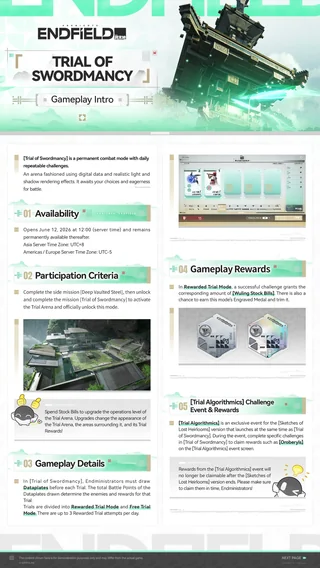
The official Trial of Swordmancy launch infographic covers the headline launch facts on one page, server windows, unlock missions, daily attempt count, reward types, and the version-limited Trial Algorithmics event.
How Dataplates Drive the Mode
Dataplates are the load-bearing mechanic of the entire mode. Before each Trial begins, Endministrators draw a hand of up to 5 Dataplates. Each Dataplate has its own Battle Points value, and the final sum of Battle Points across all drawn Dataplates determines two things at once:
- Which enemies appear in your Trial
- What rewards you earn if you successfully complete that round
Think of it as a draft phase that is also a difficulty slider. Every Dataplate you take onto the table buys you both fight content and reward content, the same draw decides both. There is no “easy stage, big rewards” cheese; if you want the heavier payout, you accept the heavier fight.
This is the design hinge that separates Trial of Swordmancy from Umbral Monument. Umbral Monument hands you a fixed encounter and rewards you for optimizing your build against known enemy patterns. Swordmancy hands you a hand of curated chaos and rewards you for building flexibility, the same operator roster has to handle different enemy mixes round to round because the deck contents change.
What Endministrators see on the draw screen
The mode shows a draw interface with the current hand on the left and the remaining deck contents on the right. The right-side panel is critical. It tells you exactly how many Dataplates remain in the active deck and which enemy types they still represent, so you can plan your draws around what is left rather than blind-drawing into a bad matchup.
Use the deck-contents panel every single Trial. Players who skip it are flying blind on a mode where the entire reward curve hinges on Battle Point management.
The Battle Points Sweet Spot: and Data Overflow
Every Dataplate Deck includes Dataplates ranging from 1 to 5 Battle Points. The reward curve scales with the total BP you bring into a Trial, more BP, harder fight, bigger payout. So naively you would just stack the highest BP Dataplates and brute-force the rewards ceiling.
The trap is Data Overflow.
Data Overflow happens when the total Battle Points across your drawn Dataplates exceeds 10. When it triggers, the amount of Trial Rewards you earn is lowered, and the Trial itself becomes more difficult.
This is a double penalty. You take a harder fight and you get paid less for it. It is the inverse of a high-roll, going over 10 BP is a worse outcome than landing on or below 10, even though the fight is harder.
The implicit “sweet spot” is therefore a total Battle Point sum at or near 10, but never above. This is the central decision you make every Trial: do you draw a fifth Dataplate to push your BP higher (and risk overflow), or do you stop the draw at four cards because the math is already favorable?
A sample of the decision math:
| Draw Result | Total BP | Reward Tier | Difficulty | Verdict |
|---|---|---|---|---|
| 2 + 3 + 2 + 1 | 8 | Mid | Manageable | Safe stop |
| 3 + 3 + 2 + 2 | 10 | Maximum (no overflow) | Hardest non-overflow | Optimal |
| 4 + 3 + 2 + 1 + 1 | 11 | Reduced (Overflow) | Hardest + bonus difficulty | Should have stopped at 10 |
| 1 + 1 + 1 + 1 | 4 | Low | Trivial | Stack more before stopping |
The mode rewards Endministrators who can read the deck-contents panel and stop one card early when the numbers say to stop. It punishes Endministrators who draw out of habit. For the full bust-math decision tables, Rewards Doubling sequencing, and the optimal daily loop, see our dedicated Dataplate draw strategy guide.
The Dataplate Deck and Its 3-Day Reset
The full deck of Dataplates is not static. The mode resets the entire deck every three days, and the reset changes two variables simultaneously:
- The size of the deck (number of total Dataplates available)
- The enemy types assigned to each Dataplate (so which monsters a specific BP value summons rotates)
This is the meta-rotation mechanic of the mode. A composition that crushed a Cryo-heavy deck during one 3-day window may struggle the next window if the rotation lands on a Heat-heavy or Stagger-resistant mix. The mode is built around your ability to re-plan your draws every three days, not to lock in a single “Trial team” forever.
Treat the first 24 hours of any new deck as a scouting window. Burn an attempt or two reading the deck-contents panel before you commit your Rewards Doubling uses for the cycle.
Rewards Doubling and the Forfeit Loop
Two related side mechanics shape how aggressively you can chase the maximum payout on any given day.
Rewards Doubling
Endministrators can activate Rewards Doubling before making the third Dataplate draw. Successfully completing a Trial with Rewards Doubling active doubles the Trial Rewards you earn from it. Daily Rewards Doubling attempts scale with your operations level, up to a maximum of 2 per day.
This is the high-leverage button on the mode. Two doubled Trials per day is functionally a free 100% reward boost on the two best draws of the day, if you save the activations for hands where you are confident you can clear the Trial. Activating it on a hand you cannot win is the most expensive mistake the mode allows.
Forfeit and the soft-limit window
If you do not like your current draw, you can forfeit the Trial. The forfeit rule is structured to give you a small comfort window before it starts eating your daily attempts:
- The first 3 forfeits of the day do not count toward your daily limit.
- After the third forfeit, every subsequent forfeit consumes a daily Rewarded Trial attempt.
In practice, the forfeit window means you can mulligan three bad opening draws per day without consequence. Use it to redraw away from low-BP hands that cannot reach the 10-point sweet spot, or away from enemy compositions your current team genuinely cannot handle. Do not use it to chase a perfect draw, burning attempts beyond the third forfeit is a strict net loss.
Rewarded Trial Mode vs Free Trial Mode
The mode is split into two tiers based on whether the Trial counts against your daily reward pool:
| Mode | Daily Limit | Rewards | Notes |
|---|---|---|---|
| Rewarded Trial Mode | 3 attempts per day | Full Engraved Medal + Wuling Stock Bills | The primary reward path; doubles with Rewards Doubling |
| Free Trial Mode | Unlimited (with soft drop cap) | No Wuling Stock Bills; enemy drops only | Active after Rewarded attempts are exhausted |
Free Trial Mode rules
After you use your three daily Rewarded Trial attempts, you can keep challenging in Free Trial Mode. Free Trial gives you unlimited attempts, but the trade-offs are real:
- No Wuling Stock Bills drop from successful Free Trial clears, the headline currency of the mode is locked behind the 3-attempt Rewarded tier.
- Enemy drops are heavily reduced after a certain number of Free Trial clears in a single day. The infographic does not give an exact threshold for the soft cap, so the safe assumption is to treat your first few Free Trials as the high-yield portion of the unlimited window.
- The soft drop cap resets at 04:00 (server time) the following day, lining up with the global daily reset.
Free Trial Mode is the “I want to keep playing the mode for the gameplay loop, even after my rewards are dry” answer. It is not a stealth farm route, the soft drop cap is real and the Wuling Stock Bills tap is closed regardless of how many runs you log.
Trial Algorithmics: The Limited Event Sitting On Top
There is a separate limited-time event layered on top of the permanent mode called Trial Algorithmics. The event is exclusive to Trial of Swordmancy and lives entirely inside the Sketches of Lost Heirlooms version window.
What the event is
During the event window, completing specific challenges inside Trial of Swordmancy unlocks claimable rewards on the dedicated Trial Algorithmics event screen. The challenge structure layers an extra objective track on top of the normal mode loop, Endministrators who run Trial of Swordmancy daily are already farming the event simply by playing.
Why the deadline matters
The infographic is explicit: rewards from Trial Algorithmics will no longer be claimable after Sketches of Lost Heirlooms closes. Whatever you do not claim before the version-update maintenance is locked out.
This is the load-bearing reason to engage with Trial of Swordmancy in the first week of launch rather than the last week. The permanent mode is permanent. Its rewards roll forever, but the event sitting on top has a hard cutoff. Players who treat the launch as a future-month problem and arrive at the end of the patch with unclaimed Algorithmics rewards will not get a second chance until the next event (if any).
Strategy by Player Type
The mode rewards different play patterns depending on where you are on the Endfield investment curve.
Casual / Daily Player (3 Rewarded attempts only)
- Spend both Rewards Doubling activations on your two best draws of the day. Bank them for the second and third Trial after you have scouted the deck on Trial 1.
- Never push past 10 BP. Use the deck-contents panel to know when to stop drawing. Data Overflow erases the gains of an aggressive draw.
- Treat Trial Algorithmics as your weekly checklist. Knock out challenge objectives during your normal three daily runs. Do not skip.
Mid-Game F2P (some Rewarded, some Free Trial)
- Burn the 3 Rewarded attempts first, then run Free Trial as long as the enemy drops are still meaningful. Stop when the soft cap kicks in.
- Use forfeits aggressively for the first three draws of each day. Your goal is to land on a 10-BP hand at minimum on every Rewarded run.
- Pre-plan deck rotations. When the 3-day deck reset hits, spend your first cycle reading the new deck. Save Rewards Doubling for cycle 2 once you know what is in the deck.
Endgame / Whale (full clear engagement)
- Maximize the operations level requirement for the second Rewards Doubling activation. The second daily double is worth ~50% of the day’s headline rewards stacked on top of the doubled first run.
- Use Trial of Swordmancy as a build-flexibility testing ground. This is the mode where bench operators get a real combat test, pull the underused 6★ off the shelf and see how they handle a non-curated enemy mix.
- Front-load all Trial Algorithmics rewards in the first half of the patch. Do not let any event reward sit unclaimed past the Camille banner close.
Returning Player
- Run Deep Vaulted Steel and Trial of Swordmancy as your first two side missions back in the game. Both unlock major 1.3 content (Sword Vault Dale + Trial Arena).
- Skip Rewards Doubling for the first week. Your roster needs scouting time before you spend the limited activations on hands you might not clear.
- Trial Algorithmics rewards are still claimable, do not let the version-window deadline sneak past you while you are catching up on the main story.
Common Mistakes to Avoid
The mode is generous in raw uptime, three Rewarded attempts plus unlimited Free Trial is a lot of daily playtime, but it is unforgiving on a small set of specific decisions.
- Drawing past 10 BP “just to see.” Data Overflow lowers your rewards and raises the difficulty. There is no scenario where pushing past 10 is correct.
- Activating Rewards Doubling on Trial 1 of the day. Save it for Trial 2 and Trial 3 after you have scouted the active deck contents. Doubling a Trial you fail is the worst outcome the mode allows.
- Forfeiting past the third free mulligan. Forfeits 4+ consume your daily Rewarded attempts. Once you have used your three free forfeits, take the hand you have.
- Ignoring the deck-contents panel. The remaining deck list on the right side of the draw screen tells you exactly what BP values are left to come. Players who skim past it are guessing at the math instead of doing it.
- Treating Free Trial Mode as a farm route. It is a gameplay-loop sink, not a reward sink. Wuling Stock Bills do not drop and enemy drops drop off after the soft cap.
- Not claiming Trial Algorithmics rewards. They expire when Sketches of Lost Heirlooms closes. Check the event screen weekly.
- Locking your composition to one team. The 3-day deck reset rotates enemy types. A single static team will brick on whichever rotation your roster is poorly equipped for.
What to Watch After Launch
The mode launches June 12, but several things are still uncertain and worth watching across the first few cycles of play.
- Exact Wuling Stock Bills payout per BP tier. The infographic frames the reward curve qualitatively. Expect community spreadsheets within the first week to map BP → reward exactly so you can confirm where the 10-BP sweet spot actually sits.
- Whether Data Overflow is a hard ceiling at 10 BP or a graduated penalty. “11 BP is just barely overflow, 15 BP is severe overflow” would change how aggressively players draw. Either reading is consistent with the launch language.
- Engraved Medal vs. Wuling Stock Bills ratio. Both currencies drop from successful Rewarded Trials; the ratio they drop at controls whether the mode is primarily a medal grind or a stock bill grind.
- The Free Trial Mode soft cap exact threshold. The infographic says “a certain number” of clears, the community will reverse-engineer this in week 1.
- Trial Algorithmics reward list. The full reward table is not in the launch infographic. Expect Hypergryph to publish the event details closer to or on June 12.
- Cross-mode synergy with Contingency Contract. CC’s Re-Ignition Experimental Operation opens June 19, and the build flexibility tested in Trial of Swordmancy directly transfers to CC’s Test Criteria meta, the mode you practice in this week becomes the team-building muscle you need next week.
Final Read
Trial of Swordmancy is the daily content slot Endfield needed. Umbral Monument rewards build optimization against fixed patterns; Swordmancy rewards build flexibility against curated chaos. The two are complementary, running both gives you both a focused tier list of “best-in-slot per encounter” and a rotating stress test of “can your roster actually handle anything.”
The mechanical layer is more interesting than it looks at a glance. Battle Points, Data Overflow, the 3-day deck rotation, Rewards Doubling, and the 3-forfeit window combine into a daily puzzle that is short enough to fit in a coffee break but deep enough that the optimal play changes on every reset. The Trial Algorithmics event sitting on top gives the launch window real urgency, the permanent mode is permanent, but the version-limited rewards are not.
Open it on launch day. Scout the first deck before you spend your Rewards Doubling activations. Stop drawing at 10 BP. Claim your Algorithmics rewards before Sketches of Lost Heirlooms closes. The mode does the rest.
Frequently Asked Questions
When does Trial of Swordmancy open? June 12, 2026 at 12:00 server time (UTC+8 for Asia, UTC-5 for Americas/Europe). The mode is permanent after launch.
What do I need to unlock the mode? Two side missions, Deep Vaulted Steel (which also unlocks the Sword Vault Dale area) and Trial of Swordmancy (which activates the Trial Arena). Both are part of the 1.3 Sketches of Lost Heirlooms content track.
How many Trials can I run per day? Three Rewarded Trial attempts per day plus unlimited Free Trial Mode (with reduced enemy drops after a soft cap that resets at 04:00 server time).
What is the 10 Battle Point sweet spot? The reward curve scales with the total Battle Points across your drawn Dataplates. Going over 10 total BP triggers Data Overflow, which lowers your rewards and raises difficulty. So 10 BP exactly is the maximum reward tier you can safely target.
When can I activate Rewards Doubling? Before your third Dataplate draw of a given Trial. Successfully completing the Trial with it active doubles the rewards. You get up to 2 Rewards Doubling uses per day at higher operations levels.
Do forfeits use up my daily attempts? The first 3 forfeits per day do not count. From the fourth forfeit onward, each forfeit consumes a Rewarded Trial attempt. So you have a generous mulligan window for opening draws.
What does the Dataplate Deck reset every 3 days? Both the size of the deck and the enemy types assigned to each Dataplate reshuffle on reset. This is the meta-rotation mechanic of the mode. Your team-building has to flex with the rotation.
What is Trial Algorithmics? A limited-time event tied to the Sketches of Lost Heirlooms version. Completing specific challenges inside Trial of Swordmancy unlocks event-exclusive rewards. The event ends when the version closes, unclaimed rewards are lost. Check our 1.3 update overview for the full Sketches of Lost Heirlooms event calendar.
Should I run Free Trial Mode after my Rewarded attempts are gone? Only for gameplay enjoyment or build testing. Free Trial Mode does not drop Wuling Stock Bills, and enemy drops decay heavily after a soft cap. It is not a farming route.
How does this compare to Umbral Monument? Umbral Monument is fixed-encounter, build-optimization-focused. Trial of Swordmancy is curated-chaos, build-flexibility-focused. Both are permanent player-driven modes; run both. For Umbral context, see our Umbral Monument Inorganic Construct guide and Searing Scars guide.
Take a Break
Available on desktop