SKETCHES OF LOST HEIRLOOMS DEV INSIGHTS
Table of Contents
Gryphline just published one of the most detailed behind-the-scenes documents Arknights: Endfield has put out since launch. Shared through r/Endfield under the title “The heirlooms of the past have resurfaced,” the Sketches of Lost Heirlooms Development Insights article pulls together game designers, artists, level designers, narrative designers, and cinematic designers to explain exactly how Version 1.3 got made. This is not a trailer breakdown or a datamine. It is the dev team walking through their own design documents, in their own words, on why Contingency Contract works the way it does, why Sword Vault Dale looks the way it does, and how Mi Fu and Camille went from a one-line pitch to finished characters.
We already covered the livestream reveal in our Version 1.3 release recap, and the full patch breakdown lives in our 1.3 version update overview. This post is different. It is a read of the retrospective, the part where the people who built the patch tell you why they made the calls they made, which choices they are still not happy with, and what that means for where Endfield’s design is headed next.
TL;DR: Key Points
- Contingency Contract was built around “not relying entirely on execution.” Most Contracts can be countered through team composition, not just mechanical skill, and reward material rewards at the low end of the difficulty curve.
- Sword Vault Dale’s art direction is a deliberate mashup: Huangshan mountain reference plus a colossal modern sword monument, built to blend Wuxia and Xianxia aesthetics with Wuling’s existing sci-fi tech language.
- Endfield’s “boxed maps” fall into three repeatable blueprints: linear exploration (Sword Vault Dale), central-return (Aburrey Quarry, Watchtower Reservoir Station), and wide-linear (Wuling City).
- The first version of Etchspace Salvage’s six-map layout was too complex. The team simplified routes and added a main quest per region after players got lost.
- Mi Fu’s design deliberately contrasts standardized Watchguard gear with hidden Qingbo Stockade details, and her boxing-based fighting style was chosen to add a modern edge to an otherwise traditional look.
- The “One Above All” cutscene was built around Chang Cheh’s 1969 wuxia film Have Sword Will Travel, with its stylized silhouette sequence directly inspiring Mi Fu’s showdown with Zhuang Fangyi.
- Camille’s vampire wings were not part of the original plan. They were added mid-production after the team decided the fire-bat visual needed a stronger combat silhouette.
- The “Philip” scene was the team’s first attempt at combat-level cutscene production quality, and it hid a quiet Easter egg: the vines near Camille’s first-meeting spot only bloom after you finish his full story.
What This Dev Insights Article Actually Is
The title card for Gryphline’s Sketches of Lost Heirlooms Development Insights, shared to the community via r/Endfield.
Since Sketches of Lost Heirlooms launched, the dev team says it has been watching “tons of discussions about the new maps, events, and operators,” and specifically called out Contingency Contract runs as a highlight of the post-launch conversation. Rather than another patch-notes recap, Gryphline framed this piece as a genuine design retrospective: game designers, artists, level designers, narrative designers, and cinematic designers each answer questions about specific decisions they made during Version 1.3’s production.
That format matters because it is rare for a live-service game to publish this much internal reasoning at once. Community reaction in the thread was mixed on tone (more on that in the Common Mistakes section below), but the volume of concrete detail, down to specific reference films and specific map iteration failures, is unusually candid for an official post-launch write-up.
The article is split into three parts: Contingency Contract, Stages and Maps, and Mi Fu and Camille. We’ll go through each in the order the dev team presented them.
Contingency Contract, By Design
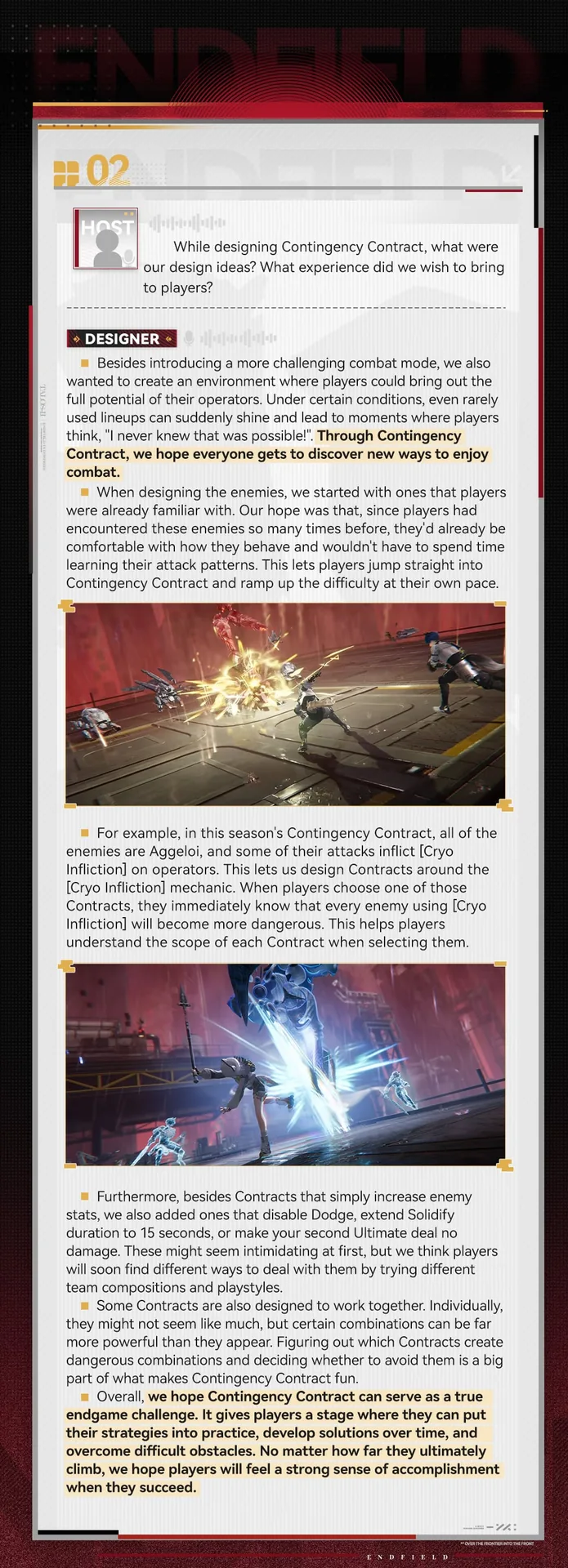
Aggeloi enemies in this season’s Contingency Contract apply Cryo Infliction, letting the mode’s modifiers build around a single readable mechanic.
Contingency Contract has been the most requested endgame system since before Endfield launched, and the designers say it was their “natural first choice” for bringing that legacy Arknights mode into a real-time ARPG. Two design principles came up repeatedly:
- “Not relying entirely on execution” is a guiding rule. While some Contracts do reward mechanical skill, the team says most can be countered through pre-battle team composition instead. That is a deliberate accessibility choice: it keeps the mode from becoming a pure reflex check.
- Enemy design started from familiarity, not novelty. The team reused enemies players already know well specifically so nobody has to learn new attack patterns just to engage with the mode. This season’s Contracts, for example, are built entirely around Aggeloi enemies that inflict Cryo Infliction, so picking a Contract immediately tells you what kind of danger you are opting into.
The designers were also candid about which modifiers are meant to be genuinely disruptive: disabling Dodge, extending Solidify duration to 15 seconds, and making a second Ultimate deal no damage all showed up as named examples. Some Contracts are explicitly designed to combo with each other, meaning the real skill test in Contingency Contract is reading which modifier stacks are dangerous together, not just clearing any single one. For a deeper systems-level breakdown of what CC means for Endfield’s endgame structure, see our Contingency Contract analysis.
There is a lighter side too: the team confirmed a hidden Easter egg in the Contingency Contract battle BGM (a vocal version of the theme plays mid-fight), and addressed the community meme around the phrase “hope everyone has guts,” which apparently originated when a translator showed the line to a coworker the night before release and could not stop laughing at it.
Sword Vault Dale’s Wuxia Art Direction
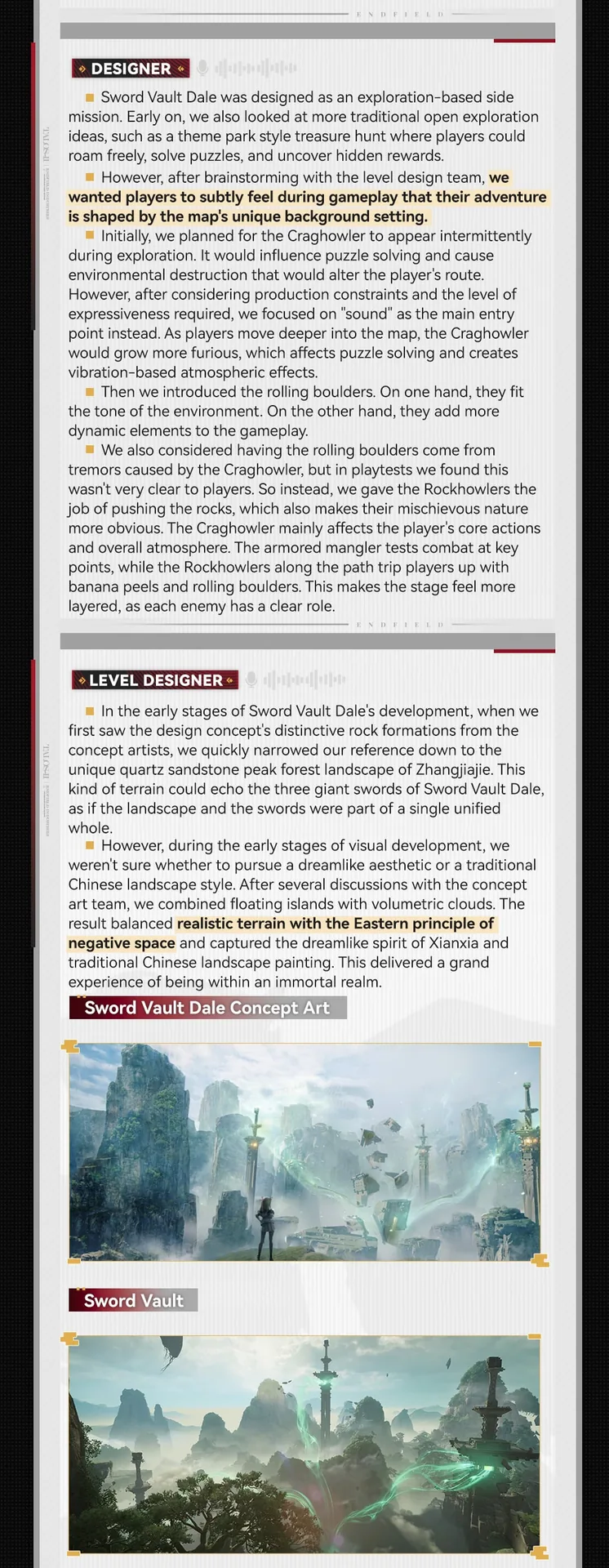
Concept art for Sword Vault Dale. The art team used Huangshan as an atmospheric reference point, then added a modern sword monument as the area’s central landmark.
Sword Vault Dale is the clearest visual departure Endfield has taken from Wuling’s industrial-tech identity, and the artists confirmed that was intentional. The stated goal was “a modern take on traditional Chinese Wuxia aesthetics,” built around a few concrete choices:
- Huangshan as the atmospheric reference, combined with a Wuxia and Xianxia foundation, plus a massive modern sword monument rising alongside the mountains as the area’s defining landmark.
- Volumetric clouds across all platforms, used to create dynamic mist and lighting that reinforces the feeling of a secluded, slowly-revealing world.
- A narrative structure that starts as a treasure hunt and unfolds into a story about legacy. Unlike Sword Forge, which is about forging weapons, Sword Vault Dale is framed around laying down arms and guardianship, hence the “Heirloom Hunt” narrative thread that gives the update its name.
- Zhangjiajie’s quartz sandstone peak formations as the specific real-world reference for the area’s rock structures, chosen because the shape could visually echo Sword Vault Dale’s three giant swords.
The level design team also admitted they went back and forth between a fully dreamlike aesthetic and a more grounded traditional Chinese landscape style before settling on a blend of floating islands and volumetric clouds, which they describe as balancing “realistic terrain with the Eastern principle of negative space.”
The Three Boxed-Map Blueprints Endfield Keeps Reusing
The level design team broke down Endfield’s “boxed maps” (their term for instanced, self-contained exploration zones) into three recurring structural types. This is one of the more useful parts of the article if you want to predict what a future area’s exploration loop will feel like before you ever set foot in it.
| Layout Type | Description | Example Maps |
|---|---|---|
| Linear exploration | A single guided path from entrance to final boss, with side branches for optional content | Sword Vault Dale |
| Central-return | Players fan out from a central hub area and loop back to it after clearing each branch | Aburrey Quarry, Watchtower Reservoir Station |
| Wide-linear | A broad, less restrictive structure with multiple entry points into a shared space | Wuling City |
The designers flagged Aburrey Quarry specifically as their favorite example of the central-return structure, since players traverse a multi-layered space using a large crane, and even the final boss room connects directly back to the starting point, so the whole map “comes full circle.” They also said future boxed maps will keep exploring “wide-linear” structures and new topologies, meaning Wuling City’s format is not a one-off.
The Level-Design Playbook Behind Every Map
Beyond layout type, the level design team listed four principles they say guide every boxed map going forward, each illustrated with a specific in-game example:
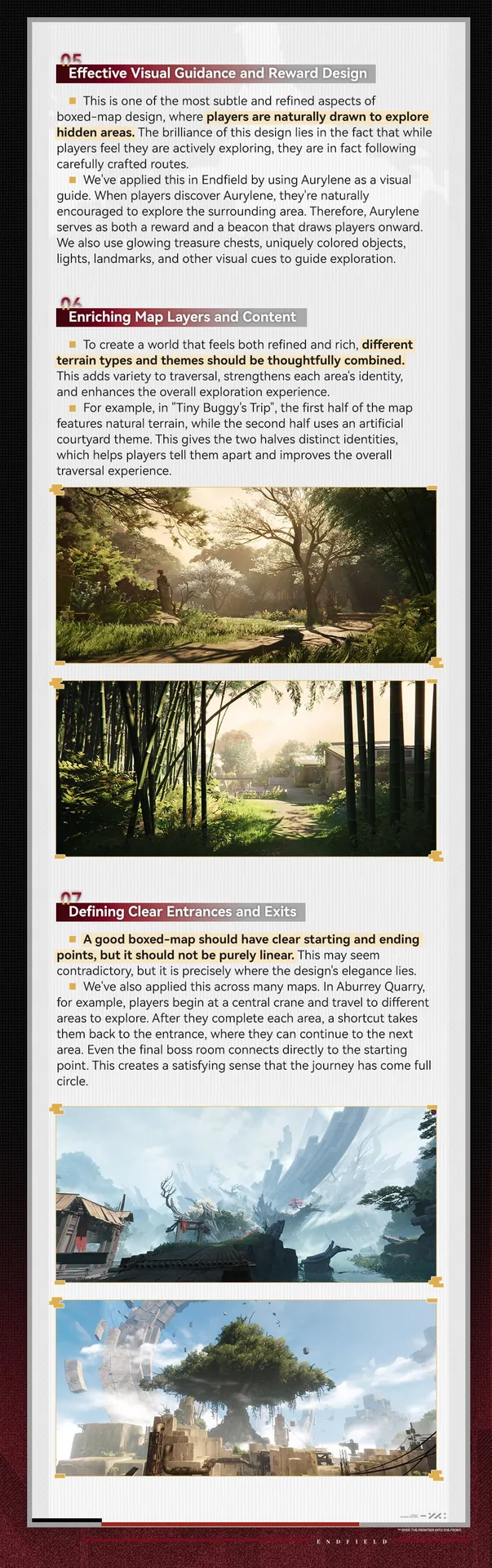
Terrain layering example: natural forest transitioning into a bamboo grove courtyard, used to give the two halves of “Tiny Buggy’s Trip” distinct identities.
- Let maps and terrain tell the story. In “Fording the River,” architecture styled after Wuling City gradually gives way to Qingbo Stockade influences as players move through the level, letting the environment itself communicate the world’s evolution.
- Create a sense of depth through elevation, not just horizontal space. The same level takes players from narrow, dim waterways up to a high vantage point overlooking mist-covered mountains, using the vertical shift for emotional payoff.
- Control spatial rhythm and atmospheric transitions. Moving between semi-open outdoor areas, enclosed cave interiors, and back into open space is treated as a deliberate emotional pacing tool, not just a visual palette cleanser.
- Balance content density so every area feels rewarding, even when the reward is not a treasure chest, but a hidden path, a memorable conversation, or a striking vista.
The team also described using Aurylene as a visual guide: players are naturally drawn toward her, which lets the designers steer exploration routes without resorting to obvious signposting like glowing arrows or forced camera pans.
Etchspace Salvage and Where Map Design Goes Next
The interview gets refreshingly honest about Etchspace Salvage, Endfield’s six-interconnected-map zone. The stated goal was letting players build a genuine “boxed-map” mental model on their first playthrough, complete with unlockable shortcuts, so post-clear farming and delivery runs get faster over time.
That said, the team admitted the first version of the map had overly complex routes and shortcuts, and some areas leaned on environmental puzzles that were too challenging for what the zone needed. The fix was straightforward: simplify route layout, make shortcuts easier to find and unlock, and add a main quest to every region so players always have a clear next objective instead of wandering without direction.
Looking ahead, the designers previewed several concepts still in development:
- Environmental kills and player-triggered layout changes. Future maps may let you alter level layouts through your own actions, tied directly to exploration abilities and specific character themes.
- “Otherworldly spaces.” The level design team specifically named maps filled with massive floating energy towers or more majestic mountain landscapes as directions they want to keep pushing.
- Deeper integration between environment art, narrative, and gameplay, meaning future zones should evolve visually as the story progresses rather than staying static once unlocked.
Mi Fu, From Concept Art to “One Above All”
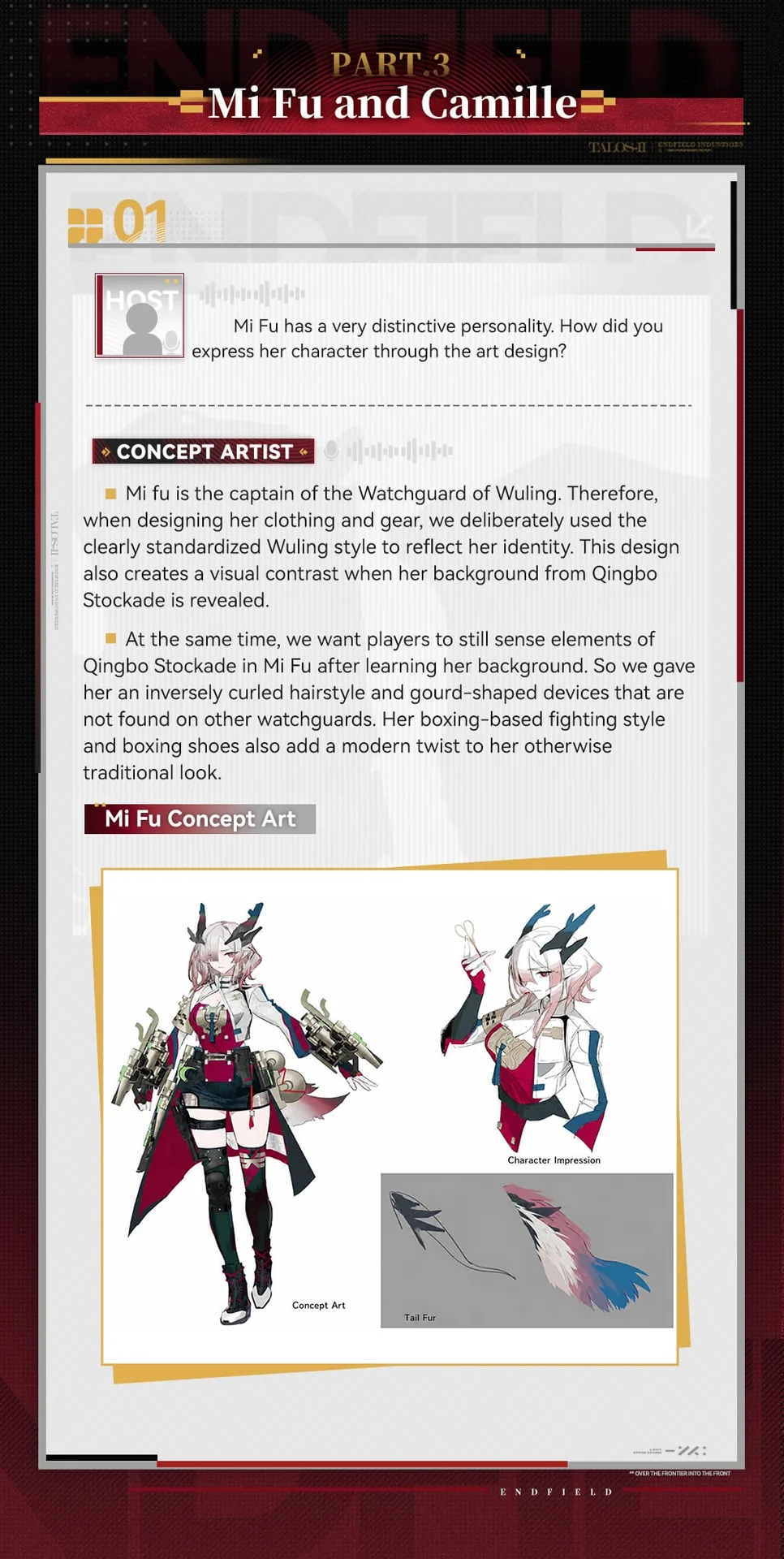
Mi Fu concept art. Her gear intentionally mixes standardized Watchguard-of-Wuling design with hidden references to her Qingbo Stockade background.
Mi Fu is introduced in the article as the captain of the Watchguard of Wuling, and the concept artist explained her design as a deliberate contrast exercise: standardized Watchguard clothing and gear on the surface, with an inversely curled hairstyle and gourd-shaped devices worked in as quiet nods to her actual origins in Qingbo Stockade. Her boxing-based fighting style and boxing shoes were chosen specifically to add a modern edge to what would otherwise read as a purely traditional design.
The article’s most striking reveal covers the “One Above All” cutscene, where Mi Fu spars with Zhuang Fangyi. The cinematic team traced their reference back to a very specific source: Chang Cheh’s 1969 wuxia film Have Sword Will Travel, whose bold color blocking and frozen-silhouette sequences the team says they wanted to prove they could replicate “in 2026.” That reference shaped the cutscene’s opening: Mi Fu staring at an envelope, her fist trembling before she slams it down, followed by a stylized silhouette sequence built around themes pulled straight from the letter, revenge, masks, bamboo forests.
Fighting-style choices were also deliberate: Mi Fu uses Bajiquan and Xingyiquan, while Zhuang Fangyi, a legitimate disciple of Hongshan Tianshi, relies on Taijiquan grappling to overcome strength with softness. If you want the full kit-level read on how Mi Fu performs in actual team compositions rather than cutscenes, our Mi Fu meta analysis covers that separately.
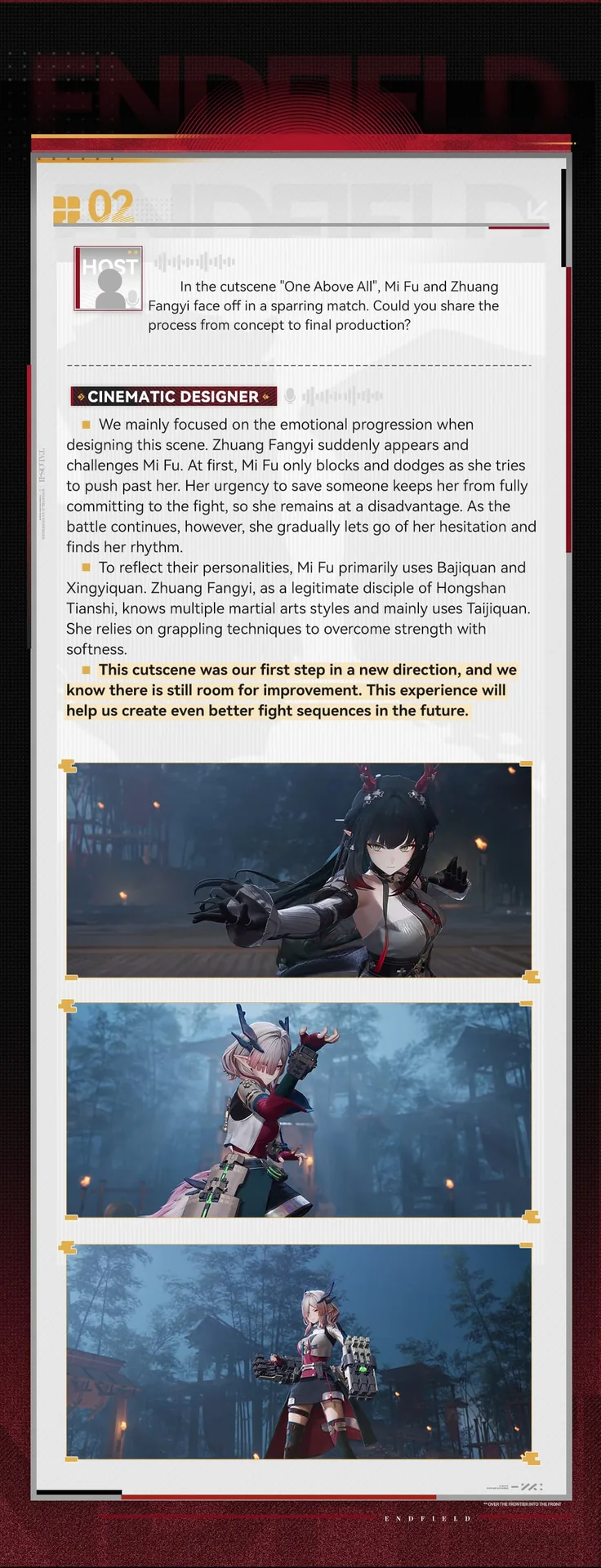
The “One Above All” sparring cutscene, framed with centered and medium-wide shots inspired by Shaw Brothers-era wuxia cinematography.
Camille: The Short Version (We Already Covered the Full Dev Diary)
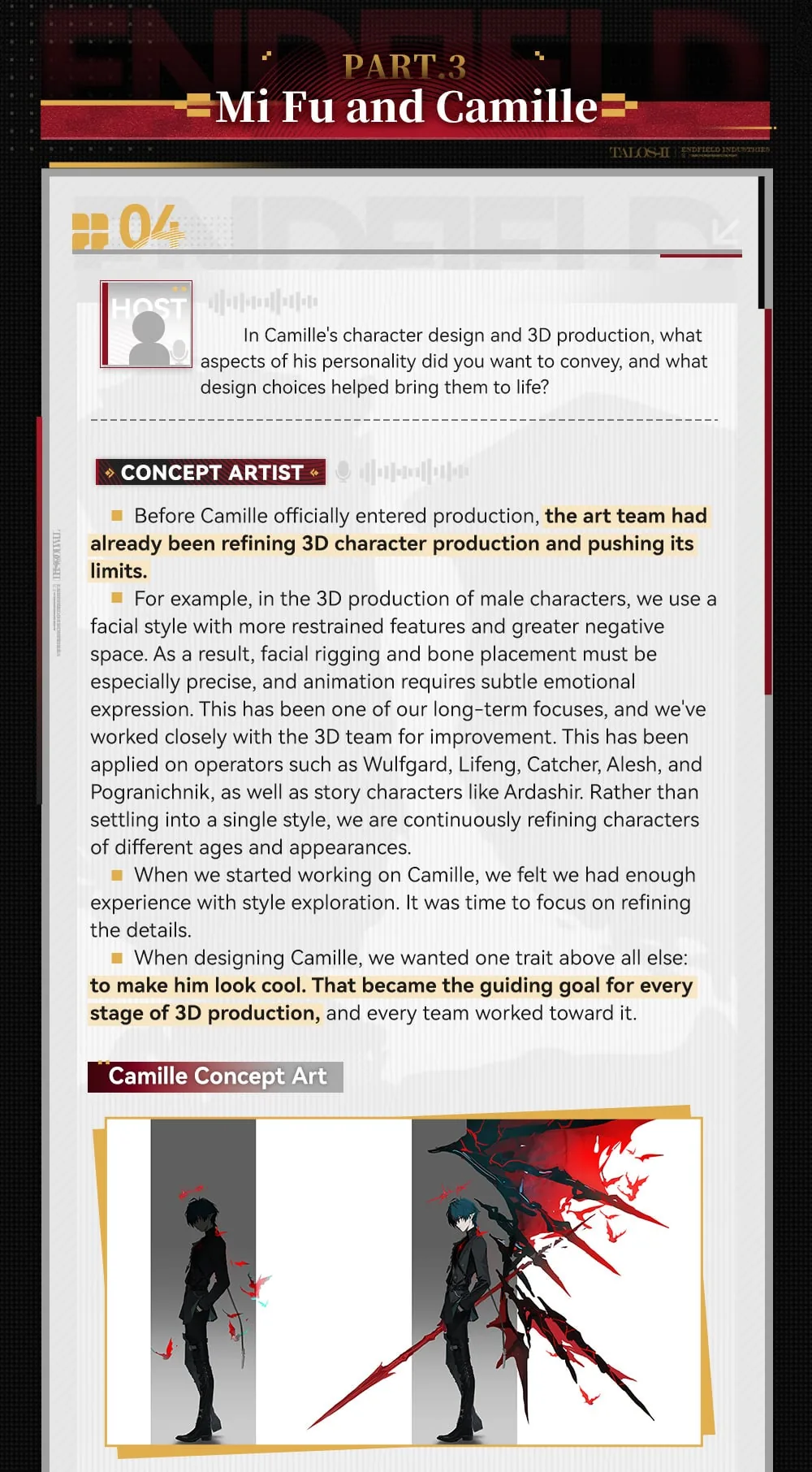
Camille concept art progression. The team’s one guiding directive for every stage of his 3D production: “make him look cool.”
Camille gets his own full installment later in the same Development Insights series, and we already broke that one down in detail in our Camille Dev Logs: Designing the Blood Demon. Rather than re-run the same ground here, the short version: his “Vampire Keeper of Wisdom” brief, the Möbius-strip blood crown, the vampire wings that were not part of the original plan and only got added mid-production for combat silhouette reasons, and the blossoming-vines Easter egg tied to his narrative event are all covered there with the full production quotes.
What is worth flagging in this article specifically is where Camille’s segment sits relative to Mi Fu’s: both characters get the same three-stage treatment (concept art, 3D production, narrative event), and the team frames Camille’s “Philip” cutscene as their first attempt at a narrative cutscene with combat-level production quality, the same bar-raising language used elsewhere in the article for Sword Vault Dale’s environment art. If you want kit-level analysis instead of design history, our Camille kit deep dive covers his actual team-comp role.
By Player Type: What to Actually Take From This
Lore and Story Readers
The Sword Vault Dale narrative framing (“Heirloom Hunt”), Mi Fu’s Qingbo Stockade backstory, and Camille’s brother arc are the sections worth re-reading closely. The article confirms these threads were reworked mid-production specifically to add emotional depth, so expect future character quests to keep leaning on family and legacy themes.
Level Design and Factory-Minded Players
The three-blueprint boxed-map breakdown (linear, central-return, wide-linear) is a genuinely useful predictive tool. If Hypergryph names a future area’s structure in a preview, you can now guess its exploration pacing before you ever load in.
Contingency Contract Regulars
The “not relying entirely on execution” design philosophy confirms CC is meant to stay composition-solvable rather than a pure reflex gate. If you have been struggling with a specific modifier stack, the team’s own framing suggests the intended solution is usually a team-comp adjustment, not more practice.
Returning or Lapsed Players
If you skipped 1.3 entirely, this article is a faster way to catch up on the patch’s design intent than replaying the livestream VOD. Pair it with our 1.3 version update overview for the full content list.
Common Mistakes When Reading Dev Insight Drops Like This
- Treating “we’ll reveal more later” as a confirmed feature list. The article teases environmental kills and layout-altering exploration abilities without committing to a timeline. Do not plan your roster or your patch expectations around unconfirmed mechanics.
- Assuming every cultural reference translates one-to-one. Several community comments in the thread pointed out that specific inspirations (Shaw Brothers cinema, regional wuxia tropes) land differently for players outside the original cultural context. That is a valid read, not a reason to dismiss the reference.
- Ignoring the community pushback embedded in the same thread. Commenters specifically called out that the piece “pats its own back a lot” and wanted more discussion of what did not land well, such as early targeting issues and areas with poor teleport coverage. A dev insight article is marketing-adjacent by nature; treat the self-critical moments (like the Etchspace Salvage route complexity admission) as the most reliable signal.
- Mistaking concept art for a preview of unreleased content. Camille and Mi Fu’s concept art shows design exploration stages, not upcoming skins or alternate forms. Some of the silhouette and grayscale studies shown are early iterations that were already finalized before 1.3 shipped.
Watch List: What These Insights Signal for 1.4 and Beyond
- Every future major version will ship at least one new map, a commitment the team has made separately, so expect the boxed-map blueprint table above to keep getting new entries.
- Player-triggered environmental changes and character-tied exploration abilities were previewed as in-progress systems. Watch for early implementations in 1.4’s Rooted Realm area.
- More combat-quality narrative cutscenes. The team explicitly called the “Philip” scene a first attempt they intend to build on, so expect future character quests to keep raising the cinematic bar rather than reverting to standard-quality cutscenes.
- Continued male-character facial production refinement. The Camille interview references ongoing work across Wulfgard, Lifeng, Catcher, Alesh, Pogranichnik, and Ardashir, suggesting this is a standing art-team initiative rather than a one-character push.
Final Read
What makes this article worth reading in full is not any single reveal, it is the density of specific, falsifiable design reasoning packed into one post. Real film references, a named real-world mountain range, an admitted first-draft failure on Etchspace Salvage’s routing, and a wing design that was not even in the original plan. That is a different kind of transparency than a patch-notes list, and it gives you an actual framework (the three boxed-map types, the “not relying entirely on execution” CC philosophy) you can apply to every future Endfield update, not just this one.
Keep an eye on how the team follows through on the environmental-kill and layout-altering mechanics they teased. That is the thread most likely to define whether Endfield’s exploration design levels up again in 1.4, or stays where Sketches of Lost Heirlooms left it.
FAQ
What is the Sketches of Lost Heirlooms Development Insights article?
It is an official Gryphline retrospective published after Version 1.3’s launch, in which game designers, artists, level designers, narrative designers, and cinematic designers explain the reasoning behind Contingency Contract, Sword Vault Dale, and the Mi Fu and Camille character quests. It was shared to the community through r/Endfield.
Is this the same as the Version 1.3 livestream?
No. The livestream was the pre-launch reveal broadcast covering new operators, weapons, and modes. This article is a post-launch retrospective where the development team explains specific design decisions after seeing player feedback. See our livestream recap for the original reveal coverage.
What are Endfield’s three boxed-map layout types?
Linear exploration (a guided path with a single main route, like Sword Vault Dale), central-return (branching paths that loop back to a hub, like Aburrey Quarry and Watchtower Reservoir Station), and wide-linear (a broad, multi-entry structure, like Wuling City).
Why was Etchspace Salvage’s map redesigned?
The level design team said the first version had overly complex routes, confusing shortcuts, and environmental puzzles that were too demanding for the zone’s purpose. They simplified the layout and added a main quest to each region to give players a consistent objective.
Does this article cover Camille’s design in full?
Only briefly. Camille gets his own dedicated installment in the same Development Insights series, and we cover that one in full in our Camille Dev Logs: Designing the Blood Demon, including the wings that were not part of the original plan and the blossoming-vines Easter egg.
What film inspired the Mi Fu and Zhuang Fangyi cutscene?
Chang Cheh’s 1969 wuxia film Have Sword Will Travel, specifically its bold color blocking and stylized silhouette sequence, was cited directly as the reference for the “One Above All” cutscene’s opening.
Which boxed-map type will a future area probably use?
Check how a preview describes its exploration loop. A single guided path to a final boss suggests linear exploration like Sword Vault Dale, a hub players keep returning to suggests central-return like Aburrey Quarry, and a broad space with several entry points suggests wide-linear like Wuling City.
Does the article confirm any new gameplay mechanics for future patches?
It previews, without committing to a release date, environmental kills, player-triggered changes to level layouts tied to exploration abilities and character themes, and new “otherworldly space” map concepts featuring floating energy towers and larger mountain landscapes.
Why did the community react critically to parts of this article?
Some commenters felt the piece leaned too heavily on self-praise and wanted more discussion of features that did not land well, such as early Contingency Contract targeting issues. That is a fair critique to keep in mind when reading any official retrospective.
Where can I read more about Mi Fu and Camille’s actual combat kits?
Our Mi Fu meta analysis and Camille kit deep dive both break down team compositions and priority builds separately from the narrative and art content covered here.
Source: Gryphline’s official Sketches of Lost Heirlooms Development Insights, shared to the community via r/Endfield.
Take a Break
Available on desktop