AIC GAS SYSTEM PREVIEW: FUELING A NEW ERA
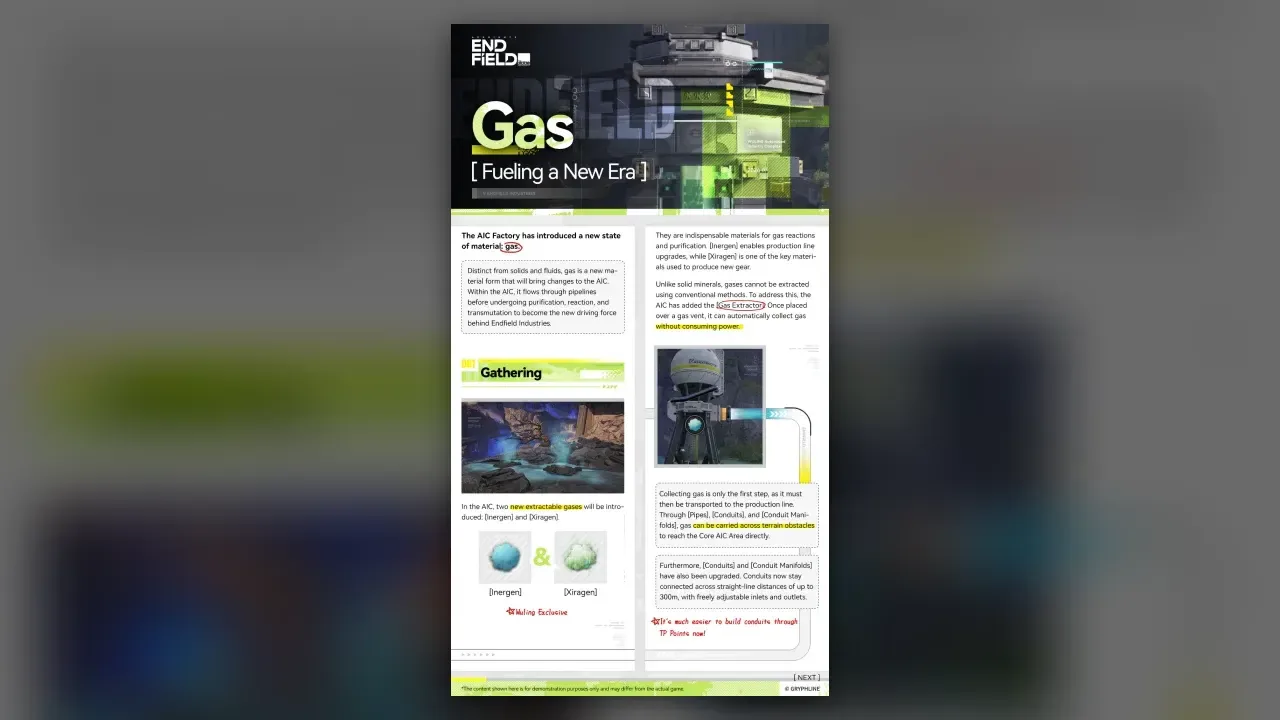
Table of Contents
For as long as we have been building bases in the Automated Industry Complex (AIC), material has come in exactly two forms: solid items riding belts, and fluids pumped through pipes. An official Gryphline preview has now confirmed a third state is on the way, and the whole gas system is built to reshape how you lay out a production line. Gas flows through its own network, gets purified and transmuted like everything else, and even changes the environment around your machines.
This piece walks through every part of the reveal: how you gather the new gases, how you move them across an outpost, and how transmutation, purification, and gaseous environments feed into the new gold-tier gear. If you already understand how liquids behave in Talos-II, you have a head start, because gas reuses a lot of that plumbing. If you do not, our breakdown of pipe throughput and flow control is the best primer before you read on.
TL;DR - Key Points
- Gas is a third material state - it flows through pipelines and is refined via purification, reaction, and transmutation, just like solids and fluids.
- Two new gases arrive, both Wuling-exclusive - Inergen (drives production-line upgrades) and Xiragen (a key ingredient for new gear).
- The Gas Extractor pulls gas for free - place it over a gas vent and it collects automatically with no power draw.
- Conduits got a major buff - straight-line connections now hold up to 300m with freely adjustable inlets and outlets, and route much more cleanly through TP Points.
- Transmutation breaks state boundaries - Fluid-Gas and Solid-Gas Transmuting Units convert eligible materials between states, fed by Liquid Xiranite or Xiragen.
- Gas Mode purification is cheaper - Heavy Xiranite made through gas purification no longer needs the Forge of the Sky or Xircon Effluent, cutting facility count hard.
- Gaseous environments unlock new reactions - Inergen makes a Stable environment, Acridgen makes an Acrid one, and Pyrrolite Gas only forms in Acrid.
- The payoff is Pyrrolite Component and Rift Trekker gear - plus Stable environments that let a single Core AIC Area fit up to 12 Xiranite production lines.
Gas: A Third State of Material
The headline is simple to state and enormous in practice. Distinct from solids and fluids, gas is a new material form that circulates inside the AIC. It travels through pipelines before undergoing purification, reaction, and transmutation to become the new driving force behind Endfield Industries.
What makes this more than a cosmetic addition is that gas is not a dead-end resource. It plugs into the same refinement loop you already use, but with its own extraction gear, its own transport buffs, and a brand new mechanic (gaseous environments) that affects everything nearby. In other words, gas is not a side system bolted onto the factory. It is a new layer that touches gathering, logistics, processing, and endgame gear all at once.
If you have spent any time optimizing ratios, the mental model is familiar: source the raw material, move it efficiently, refine it in stages, and cash it out as a high-value product. Gas simply adds a third parallel track to the two you already run.
Gathering: Gas Extractors, Inergen and Xiragen
Two new extractable gases are being introduced in the AIC, and both are Wuling exclusive:
- Inergen - the enabler. It is used to push production-line upgrades and, later, to create Stable gaseous environments.
- Xiragen - the ingredient. It is one of the key materials used to produce the new gear, and it also feeds the transmutation units.
Together they are described as indispensable materials for gas reactions and purification, so expect to be sourcing both in volume once the system goes live.
The catch is that gases cannot be extracted using conventional mining methods. To solve that, the AIC adds the Gas Extractor. You place it directly over a gas vent and it automatically collects gas, and here is the part worth bolding: it does this without consuming power. For a resource that sits at the front of a long refinement chain, a free, passive tap is a genuinely strong start. You are not budgeting energy just to keep the raw feed flowing.
Moving Gas: Conduits, Manifolds and the 300m Reach
Collecting gas is only the first step. Like any raw feed, it has to reach your Core AIC Area before it is worth anything. Gas is carried through Pipes, Conduits, and Conduit Manifolds, and that network can cross terrain obstacles to deliver gas directly to the core, so a vent tucked away on awkward ground is no longer a dealbreaker.
The bigger news is a buff to the transport gear itself. Conduits and Conduit Manifolds have been upgraded so that a conduit now holds a connection across a straight-line distance of up to 300m, with freely adjustable inlets and outlets. In practice that means far fewer relay structures and much cleaner long-haul routing, and the preview specifically notes it is now much easier to build conduits through TP Points.
If you route a lot of resources by hand today, this is the quality-of-life change that will save you the most build time. The same discipline that governs your fluid lines applies here, so the habits from converger priority and general AIC throughput planning carry straight over to gas.
Transmutation: Breaking the Solid-Fluid-Gas Boundary
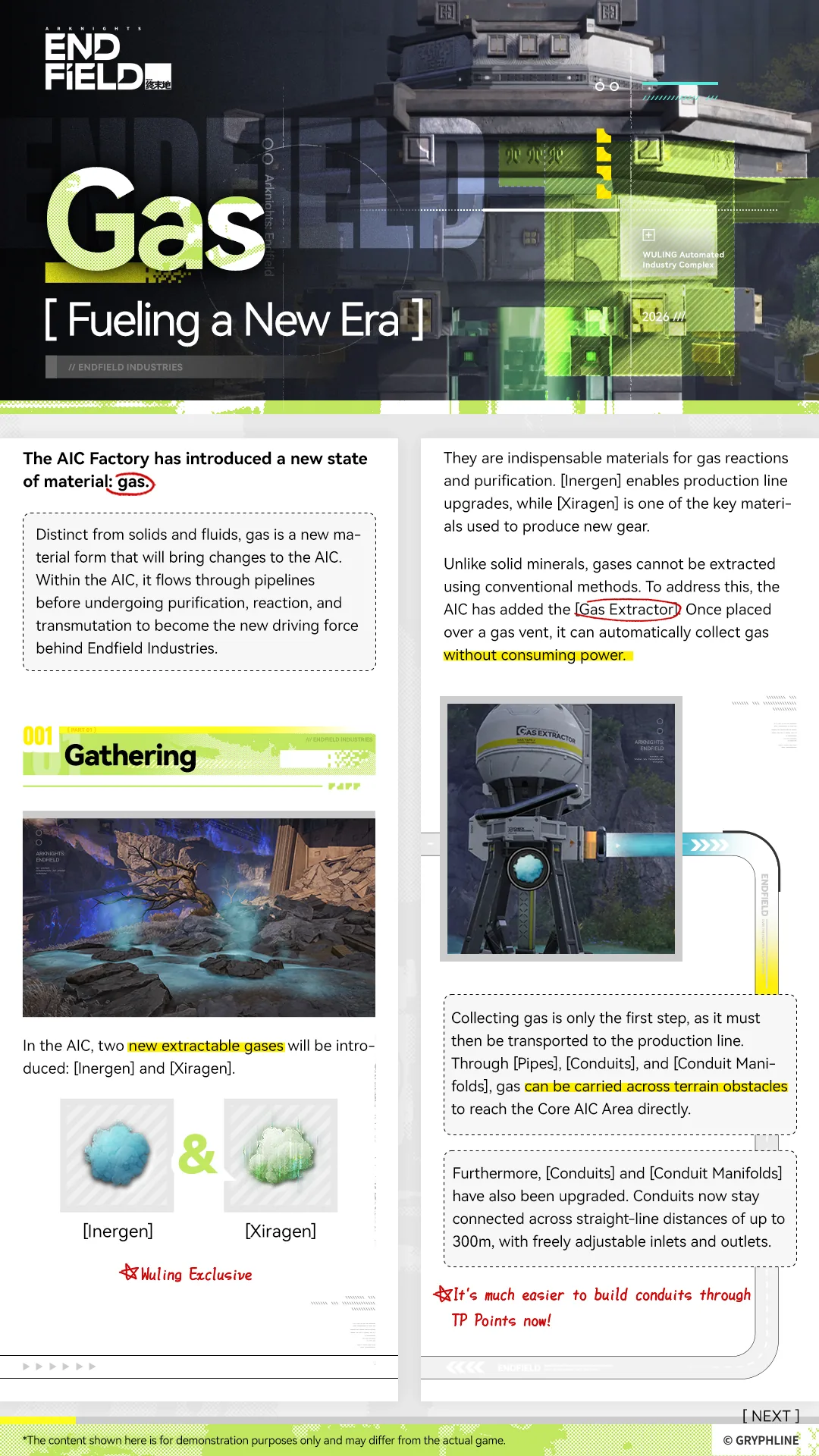
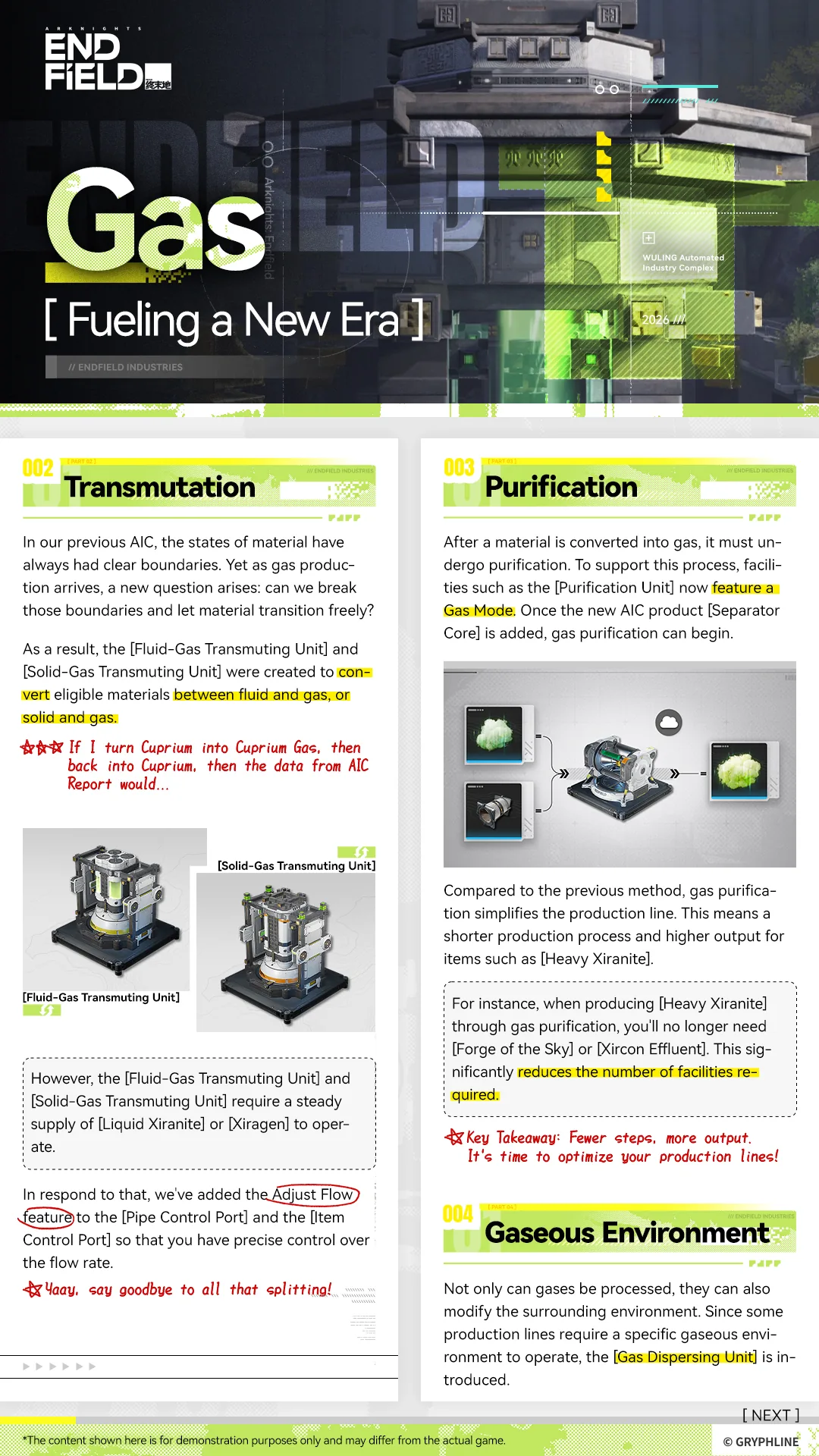
In every AIC we have built so far, the states of material have had hard boundaries. Solids stay solid, fluids stay fluid. Gas raises an obvious question: can we break those boundaries and let material transition freely?
The answer is two new machines. The Fluid-Gas Transmuting Unit and the Solid-Gas Transmuting Unit convert eligible materials between fluid and gas, or between solid and gas. That opens the door to loops that were previously impossible, and the preview even teases the idea of turning Cuprium into Cuprium Gas and back again.
There is a running cost, though. Both transmuting units need a steady supply of Liquid Xiranite or Xiragen to operate, so a transmutation-heavy base has to keep that feedstock topped up or the whole conversion stalls.
To keep those feeds precise, the preview adds an Adjust Flow feature to the Pipe Control Port and the Item Control Port, giving you exact control over flow rate. If you have ever built a fragile chain of splitters just to hit a specific ratio, this is the fix: you dial the rate directly instead of fighting belt geometry.
The Transmutation and Purification stages of the AIC gas system. Official Gryphline preview.
Purification: Gas Mode and Separator Cores
Once a material has been converted into gas, it has to be purified. To support that, facilities such as the Purification Unit now feature a Gas Mode. Add the new AIC product Separator Core, and gas purification can begin.
The reason this matters is efficiency. Compared to the old method, gas purification simplifies the production line: a shorter process and higher output for items such as Heavy Xiranite. The clearest example is Heavy Xiranite itself. Produced through gas purification, it no longer needs the Forge of the Sky or Xircon Effluent, which significantly reduces the number of facilities the line requires.
Here is the before-and-after in plain terms:
| Heavy Xiranite line | Old method | Gas purification |
|---|---|---|
| Forge of the Sky needed | Yes | No |
| Xircon Effluent needed | Yes | No |
| Process length | Longer chain | Shorter chain |
| Output per footprint | Baseline | Higher |
| Key new input | - | Separator Core |
The takeaway the preview spells out is worth repeating: fewer steps, more output. If you have a sprawling Heavy Xiranite setup today, gas purification is your cue to rip it out and rebuild leaner.
Gaseous Environments: Stable vs Acrid
Gas does not just get processed. It can also modify the space around your machines. Some production lines require a specific gaseous environment to operate, and that is where the Gas Dispersing Unit comes in.
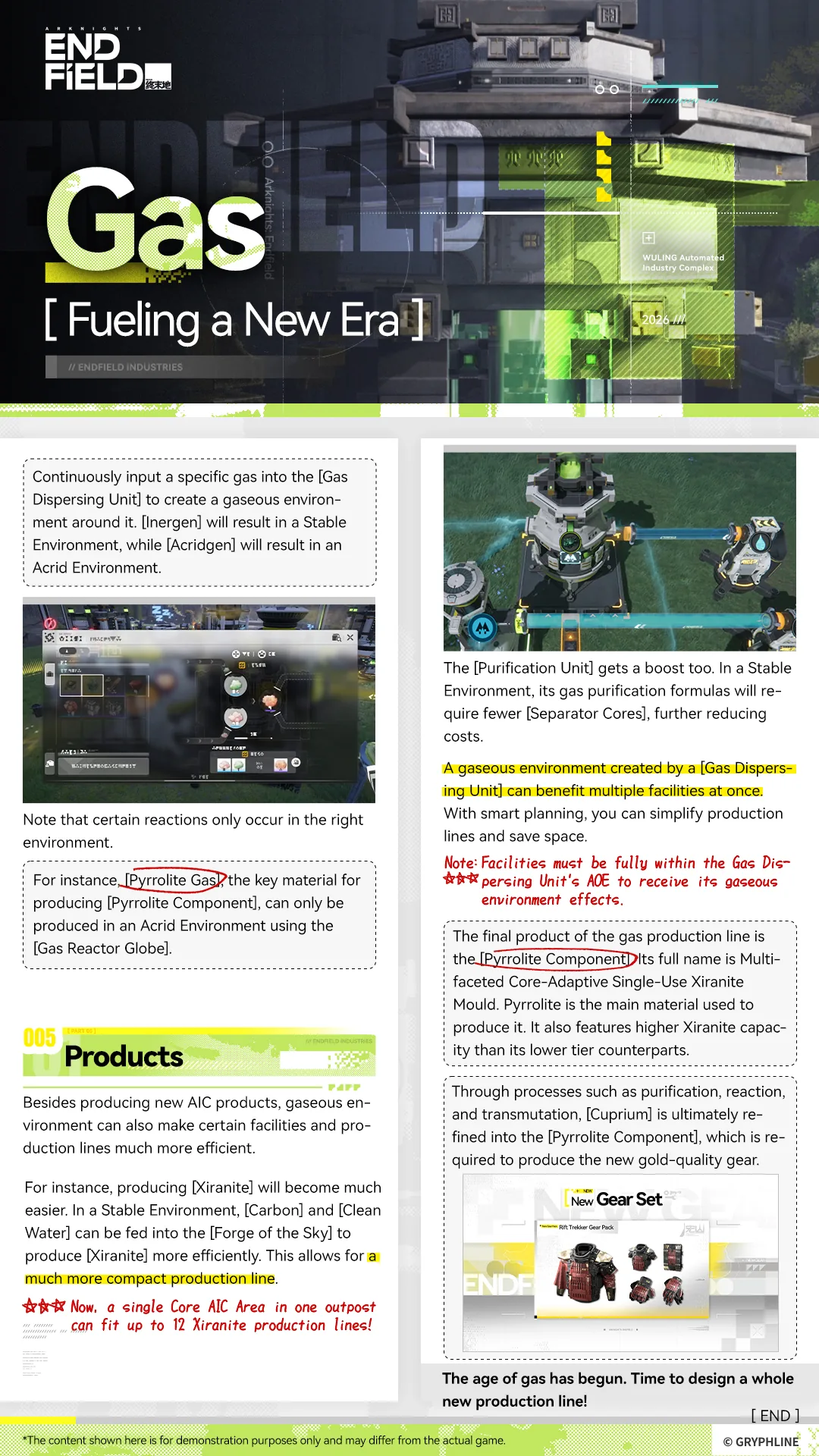
Feed a specific gas into the dispersing unit continuously and it creates an environment in its area of effect. The two confirmed so far:
| Input gas | Environment created | What it unlocks |
|---|---|---|
| Inergen | Stable | Cheaper purification (fewer Separator Cores), more efficient Xiranite |
| Acridgen | Acrid | Pyrrolite Gas via the Gas Reactor Globe |
Certain reactions only happen in the right environment. For instance, Pyrrolite Gas, the key material for producing the Pyrrolite Component, can only be made in an Acrid environment using the Gas Reactor Globe.
A Stable environment pulls in the other direction and lowers your costs. Inside one, the Purification Unit’s gas formulas require fewer Separator Cores, which further reduces the price of every gas purification you run.
The efficiency trick is that a single gaseous environment can benefit multiple facilities at once. With smart planning you cluster machines under one dispersing unit and simplify the whole line while saving space. One hard rule to plan around, though: a facility must be fully inside the dispersing unit’s AOE to receive the environment effect. A machine straddling the edge gets nothing, so tight, deliberate placement matters more than usual here.
Products: Pyrrolite Component and the Rift Trekker Gear
Everything above feeds into one flagship output: the Pyrrolite Component. Its full name is the Multi-faceted Core-Adaptive Single-Use Xiranite Mould, and Pyrrolite is the main material used to produce it. It also carries a higher Xiranite capacity than its lower-tier counterparts, which is exactly what you want in an endgame crafting input.
The full chain reads like a tour of the entire gas system. Through purification, reaction, and transmutation, Cuprium is ultimately refined into the Pyrrolite Component, which is then required to produce the new gold-quality gear, previewed as the Rift Trekker Gear Pack. If you chase best-in-slot gear, this is the reason to care about gas at all.
Gaseous environments also quietly upgrade an old staple. In a Stable environment, Carbon and Clean Water can be fed into the Forge of the Sky to produce Xiranite far more efficiently, which allows for a much more compact production line. The preview’s standout claim: a single Core AIC Area in one outpost can now fit up to 12 Xiranite production lines. That is a density jump that changes how you budget an entire outpost.
The Gaseous Environment and Products stages, ending in the Rift Trekker gear set. Official Gryphline preview.
What Gas Changes By Playstyle
Gas lands differently depending on where you are in the game.
- Early-game bootstrapper - Do not panic. Gas sits behind Wuling progression and a chain of new facilities, so your priority is still stable power and clean material loops. Note where gas vents are, but keep building fundamentals first.
- Mid-game optimizer - This is your patch. The conduit 300m buff, Adjust Flow ports, and Gas Mode purification all exist to make lines leaner. Expect to tear down and rebuild your Heavy Xiranite and Xiranite setups for real footprint savings.
- Endgame gear farmer - Gas is the road to the Pyrrolite Component and the Rift Trekker gold gear. Your focus is a reliable Acrid environment for Pyrrolite Gas plus a Stable environment to cut purification costs, ideally with both dispersing units feeding tightly clustered machines.
Common Mistakes to Avoid
Even in a preview, the failure modes are already visible. A few to keep on your radar:
- Straddling the AOE edge. A facility must be fully inside the Gas Dispersing Unit’s area of effect. Half-in machines get no environment bonus, which quietly kills the efficiency you built the cluster for.
- Starving the transmuting units. Fluid-Gas and Solid-Gas Transmuting Units need a constant supply of Liquid Xiranite or Xiragen. Forget the feedstock and conversion stops cold.
- Mixing up your environments. Pyrrolite Gas only forms in Acrid, while Stable is for cost savings and Xiranite efficiency. Pointing the wrong gas at a line produces nothing.
- Over-building conduits. With 300m reach, most of your old relay structures are now dead weight. Plan the long straight runs the buff enables instead of duplicating short hops out of habit.
- Keeping legacy Heavy Xiranite lines. If you still route through the Forge of the Sky and Xircon Effluent for Heavy Xiranite, you are paying for facilities gas purification makes optional.
Watch List: What Could Still Change
This is a preview, and Gryphline’s own footer is explicit that the content shown is for demonstration purposes only and may differ from the actual game. Treat every specific value as provisional until the patch lands.
A few things worth watching as release approaches:
- Exact rates and ratios. Extractor output, transmutation costs, and Separator Core consumption are the numbers most likely to be tuned before launch.
- Naming. Gas names (Inergen, Xiragen, Acridgen) and product names may shift in the live localization.
- Gating. How deep into Wuling progression gas sits will decide when most players actually touch it.
- Environment stacking. Whether Stable and Acrid zones can overlap or interfere is not spelled out yet, and it matters a lot for compact base design.
We will update this post with confirmed figures once the system goes live.
Final Read
Gas is the most structural AIC change we have seen in a while. It is not a single new machine, it is a full parallel pipeline: a free passive tap at the front, a 300m conduit buff for transport, transmutation that erases the old state boundaries, cheaper Gas Mode purification, and environment zones that reward tight clustering. The reward at the end (the Pyrrolite Component and Rift Trekker gold gear, plus 12 Xiranite lines in one Core AIC Area) is meaningful enough to justify learning all of it.
If you build factories for fun, this is a genuinely exciting sandbox expansion. If you build them for gear, gas is now on the critical path. Either way, the smart move before release is to scout your gas vents and free up the outpost space you will want for a rebuild.
FAQ
What is the gas system in Arknights: Endfield? Gas is a new third state of material in the AIC, alongside solids and fluids. It is gathered from gas vents, moved through conduits, and refined via purification, reaction, and transmutation into new products and gear.
What is the difference between Inergen and Xiragen? Inergen drives production-line upgrades and creates a Stable gaseous environment. Xiragen is a key ingredient for the new gear and feeds the transmutation units. Both are Wuling-exclusive gases.
Does the Gas Extractor use power? No. You place the Gas Extractor over a gas vent and it collects gas automatically without consuming any power, which makes the raw feed effectively free to run.
How far can conduits reach now? Conduits and Conduit Manifolds have been upgraded to hold a straight-line connection of up to 300m, with freely adjustable inlets and outlets. They also route more cleanly through TP Points.
What is a Separator Core? The Separator Core is a new AIC product that enables Gas Mode on the Purification Unit. Once it is supplied, you can run gas purification, which is shorter and higher-output than the old method for items like Heavy Xiranite.
What is the difference between a Stable and an Acrid environment? A Stable environment (from Inergen) lowers purification costs and boosts Xiranite efficiency. An Acrid environment (from Acridgen) is required to produce Pyrrolite Gas in the Gas Reactor Globe. Each is created by feeding the right gas into a Gas Dispersing Unit.
What is the Pyrrolite Component? It is the flagship product of the gas line, formally the Multi-faceted Core-Adaptive Single-Use Xiranite Mould. It has a higher Xiranite capacity than lower-tier moulds and is required to craft the new gold-quality Rift Trekker gear.
Do gaseous environments affect every nearby facility? Only facilities that sit fully inside a Gas Dispersing Unit’s area of effect receive the environment bonus. A single dispersing unit can benefit multiple machines at once, but any facility straddling the AOE edge gets nothing.
Is gas replacing the old factory systems? No. Gas is an additional layer on top of the existing solid and fluid pipelines. Most of your current lines still work, though gas purification makes some legacy setups (like the old Heavy Xiranite chain) worth rebuilding.
Is this content final? No. This is an official Gryphline preview, and the values, names, and mechanics may change before the update ships. We will refresh this post with confirmed numbers at launch.
Take a Break
Available on desktop