ORIGINIUM AND CATASTROPHES EXPLAINED
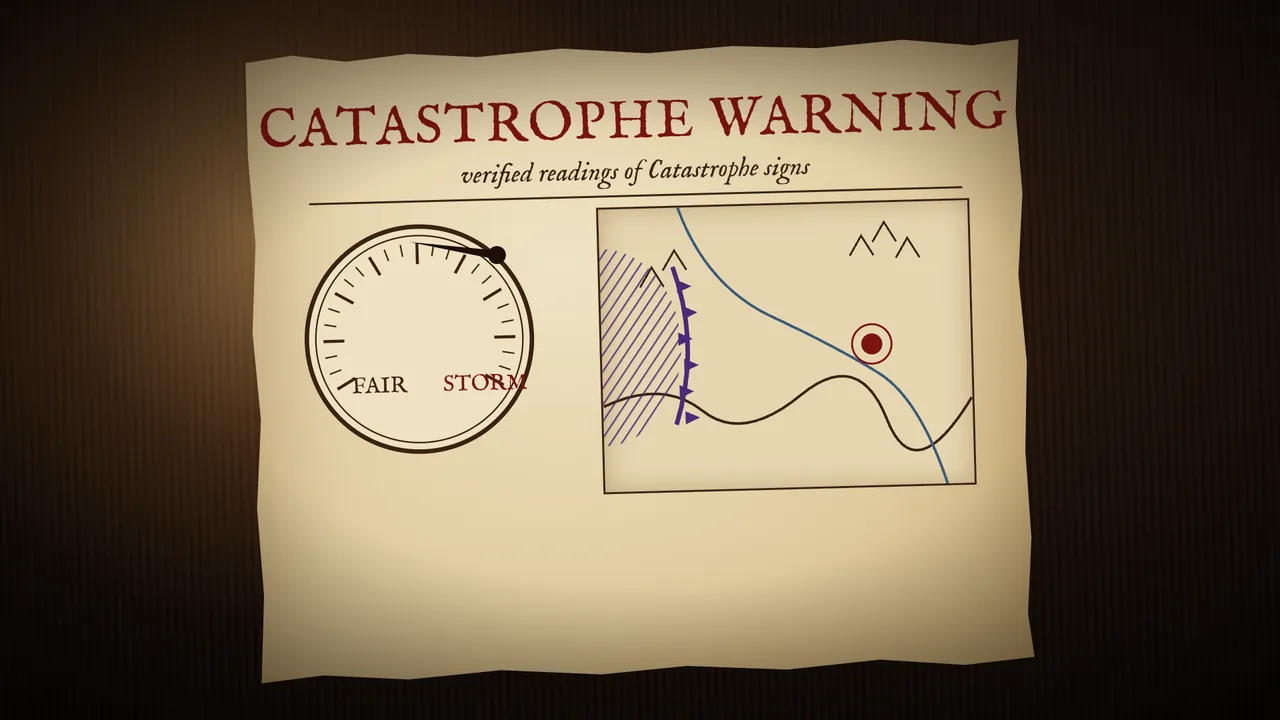
Table of Contents
Catastrophes were Terra’s disasters (storms, blizzards, floods, even meteor showers) that left a black crystal called Originium behind. Talos-II has almost none: CORD greatly reduced them, and the Aggeloi and the Blight took their place.
For most of his life, one man walked toward disasters on purpose. Falken Gravning was a Catastrophe Messenger: he reached towns before the sky destroyed them and told everyone inside to leave. Some thanked him. Others cursed him. At fifty-three he crossed to a new planet, Talos-II, where people said the sky never attacked anyone. This is the story of the thing he was running from, Originium and the Catastrophes, and whether anyone ever really got away from it.
How we checked this. Every quote is the official English text of the original Arknights or Arknights Endfield. Where we connect the two games or read more into a line than it says, we label it as our reading. The images are frames from our own video on this topic, built from official Hypergryph and Gryphline art and our own motion graphics.
Endfield Hub is a fan-made resource and is not affiliated with Hypergryph or Yostar.
Watch it first: the whole story in 19 minutes, from our YouTube channel. Every quote it uses follows below, in full.
TL;DR
- Catastrophes are Terra’s frequent, unpredictable natural disasters: storms, blizzards, floods, meteor showers. Cities survived them by moving, as nomadic cities on giant vehicles.
- Originium is the black crystal a Catastrophe leaves behind. It powers Arts (Terra’s magic) and the Originium engine, the thing that made nomadic cities possible.
- Oripathy is the incurable disease long exposure to Originium causes. It makes Arts stronger and kills faster, and the Infected were feared and hunted.
- Talos-II has almost no Catastrophes. People built permanent cities, and CORD lets them farm Originium in chosen areas. Oripathy is managed with suppressants, not cured.
- The Great Originium Oak powered Valley IV until it was detonated to kill the Giant Aggelos Astarron. Nobody knows how the blast spared the valley.
- Talos-II’s own disasters are the Aggeloi and the Blight, caused by Æther. Humanity crossed space and found a disaster, an energy source and an illness with no cure, under new names.
What Are Catastrophes in Arknights?
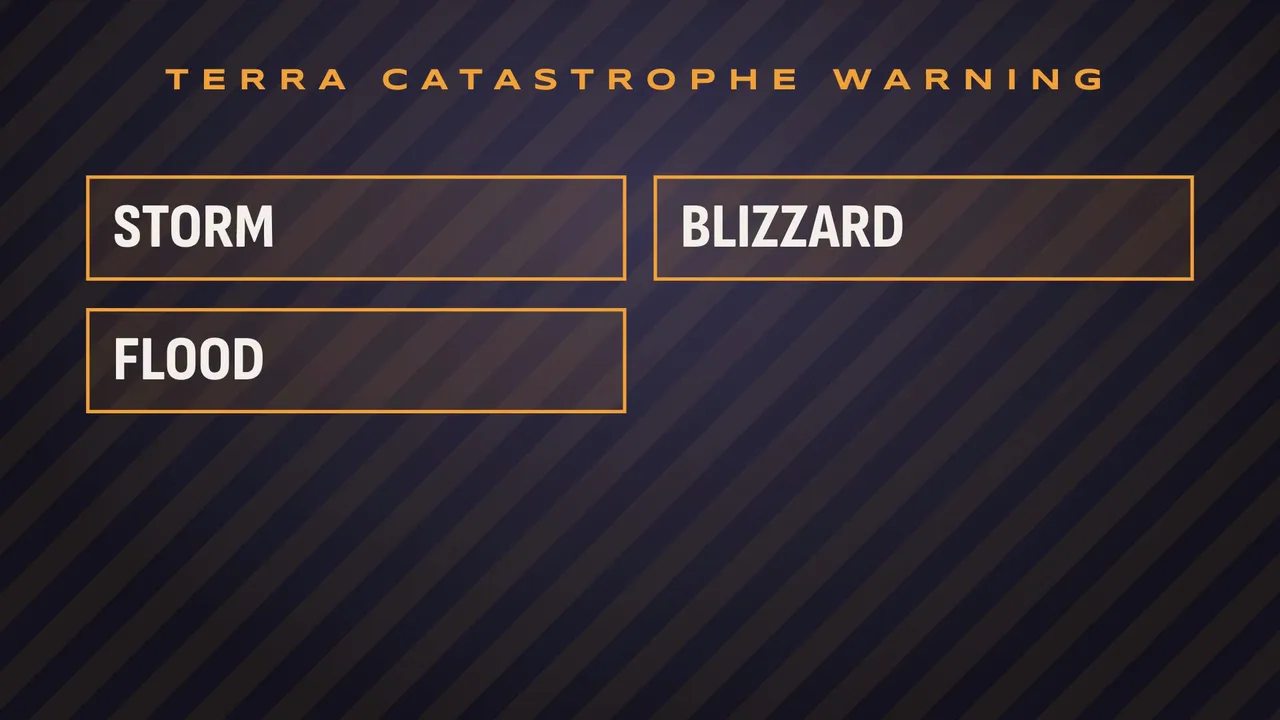
Before Endfield, there was Arknights, set on a world called Terra, and Terra had a kind of disaster with its own name. The game’s glossary defines Catastrophes as “a variety of frequent natural calamities, including but not limited to storms, blizzards, floods and even meteor showers.” What made them different from bad weather was the rhythm: “Catastrophes occur frequently, but also at unpredictable intervals.”
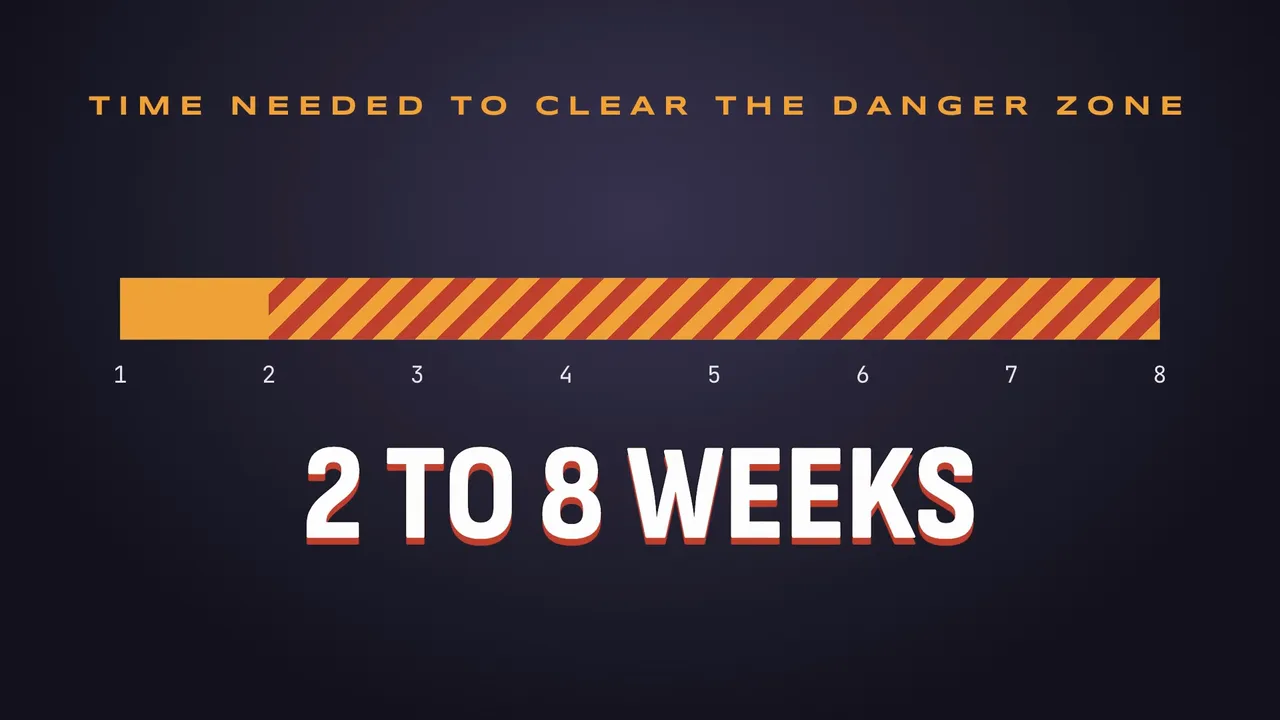
You cannot build a wall against a meteor shower. So, in the glossary’s words, “most civilizations can only hide from Catastrophes by moving the entire cities.” These are nomadic cities: “a city built on a giant vehicle”, streets, homes and factories on treads. When a Catastrophe was coming, the city packed up and drove away. Even then it was slow: “With the help of the Multimethod Catastrophe Prediction System, it only takes 2-8 weeks” to clear the danger zone.
Who were the Catastrophe Messengers?
That warning had to come from somewhere. Falken Gravning “was born in the borders of Kazimierz and started this lonesome career when he was but a young man. With sturdy steps he hiked across mountains and navigated rivers to bring verified data of Catastrophe signs to villages, towns, and cities facing inevitable destruction.”
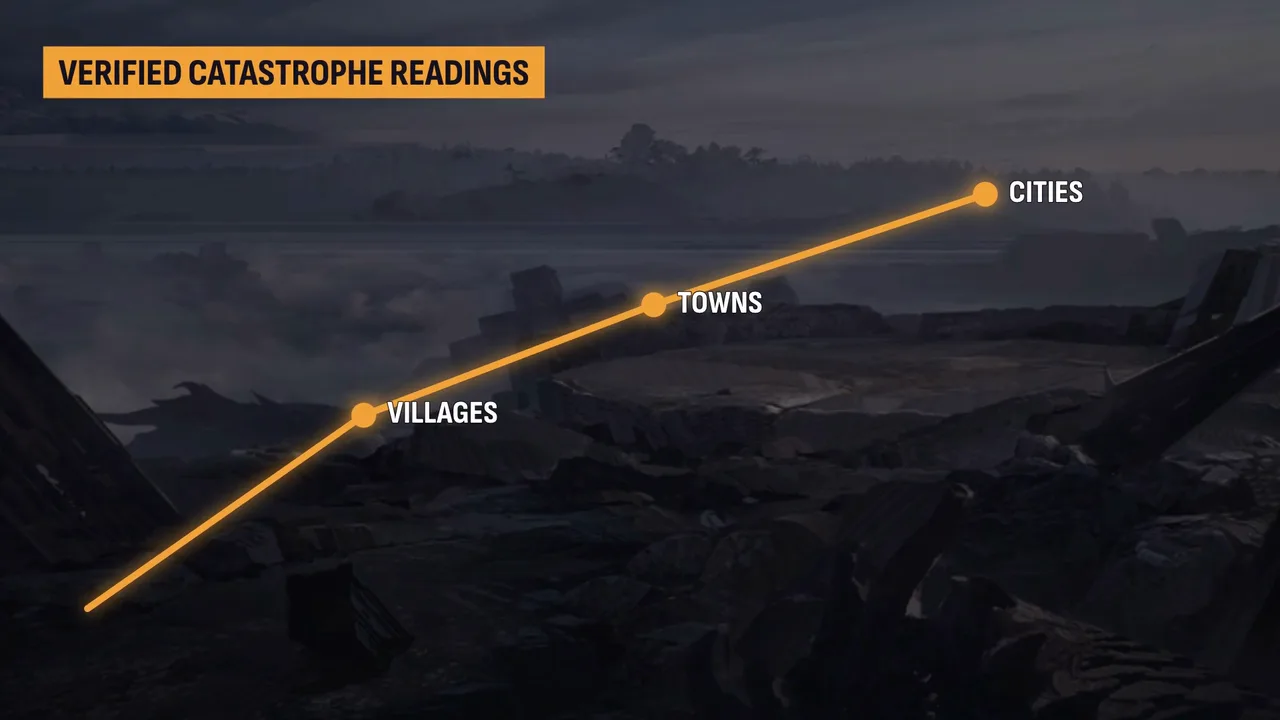
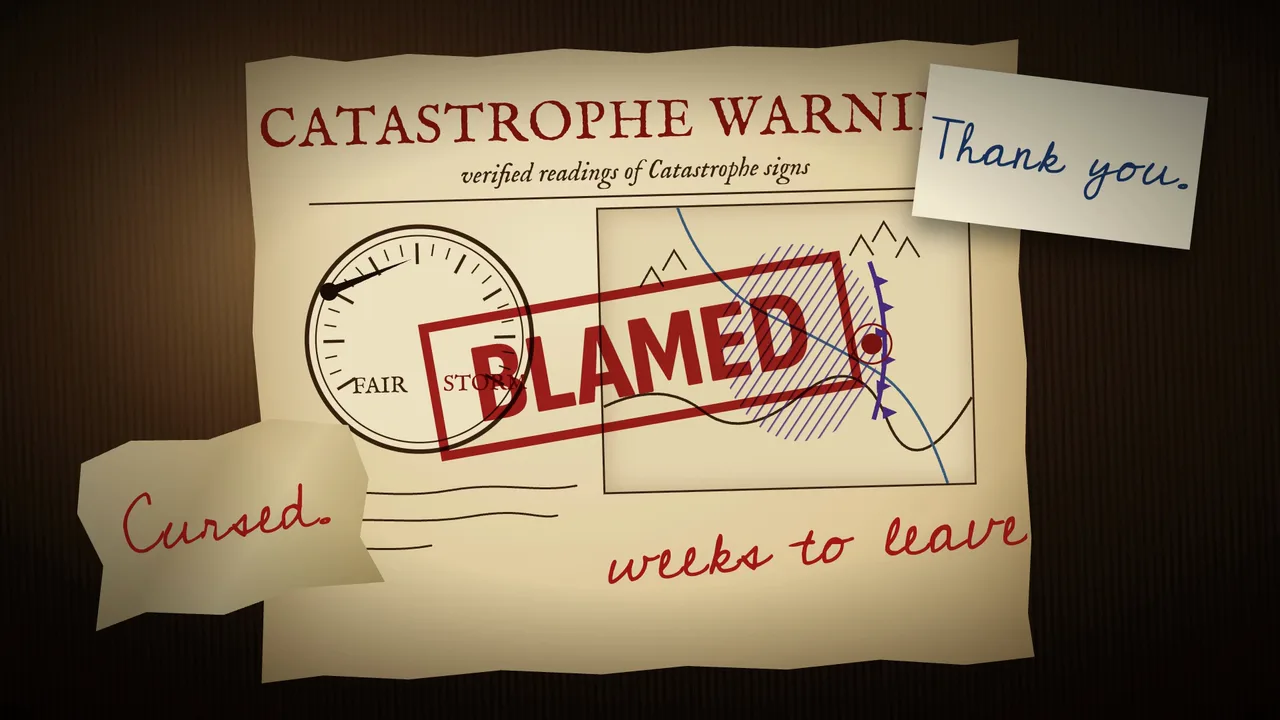
His story is careful about what he was: “He was not a savior. The only thing he could do was to warn people of the ‘impending footsteps of annihilation’. Some were grateful, while others bore grudges. He suffered more than a few wounds, vile curses, as well as cold, hateful gaze over the years, and witnessed grave sacrifices as well. Suffocating depression constantly loomed over his soul.”
Falken was not a rare hero. Terra had a whole profession of these people, and Arknights operators talk about it:
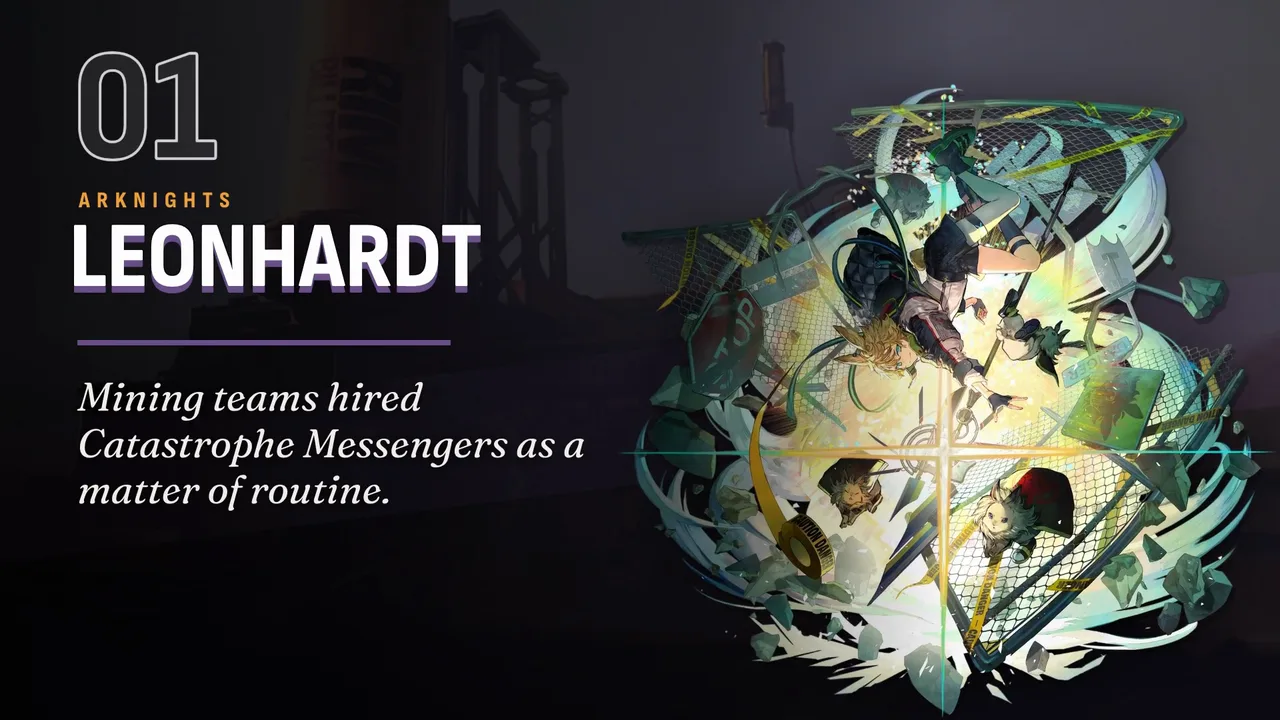
- Leonhardt: “It’s common for mining teams to hire Catastrophe Messengers.”
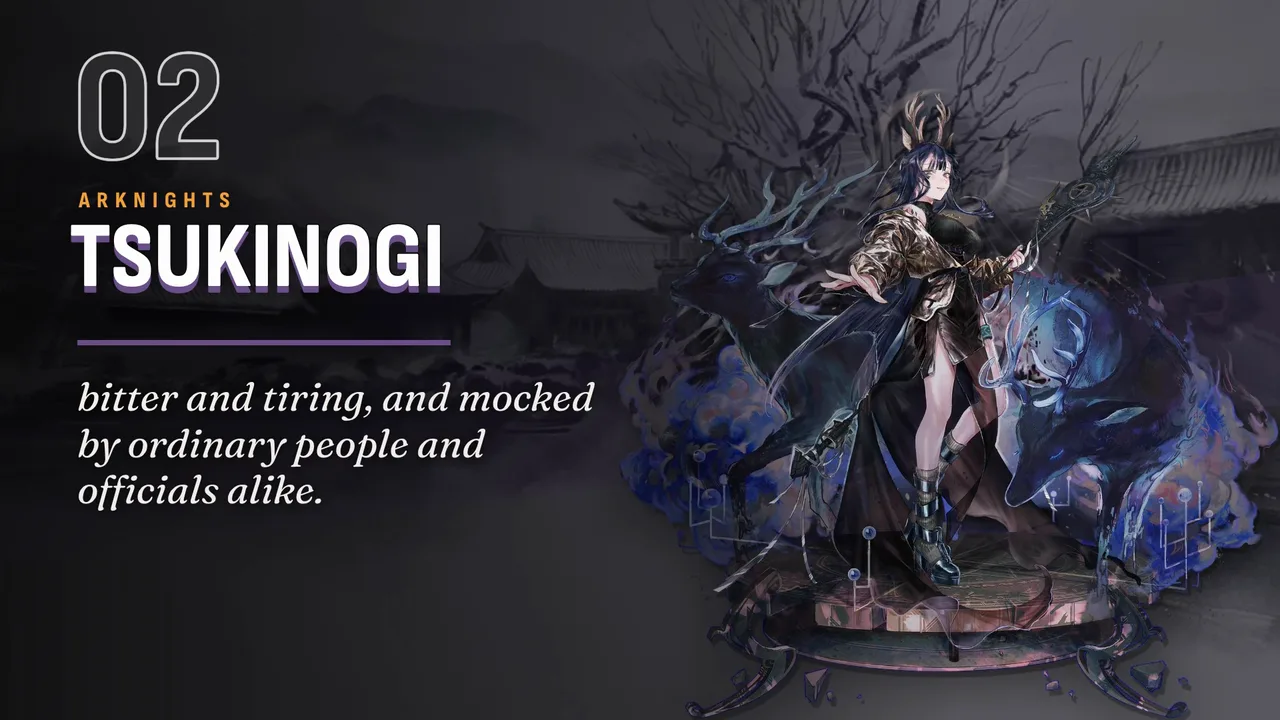
- Tsukinogi, from Higashi: “Those who chase Catastrophes are called ‘Yakumeguri’, or as they say here, ‘Catastrophe Messengers.’ The job is bitter and tiring, and we are often ridiculed by ordinary civilians and bureaucrats alike.”
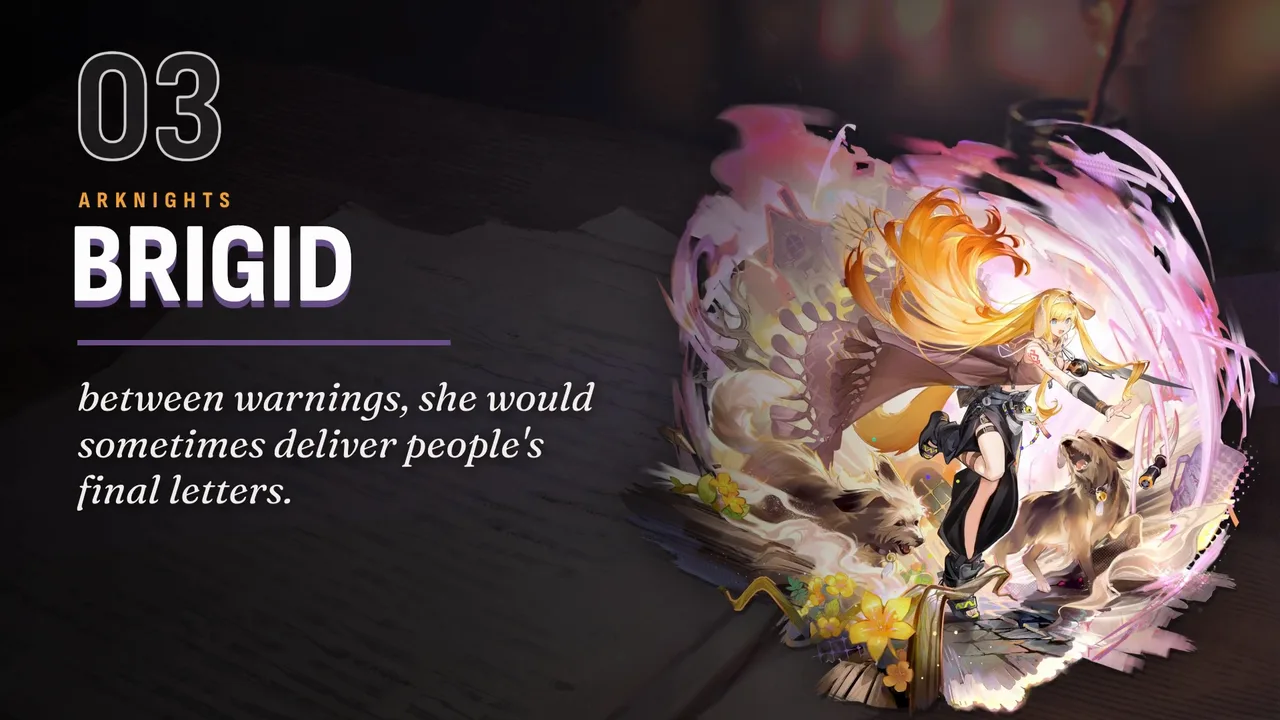
- Brigid: “I’d be tearin’ about warnin’ folk of Catastrophe, maybe deliverin’ some final letters along the way.”
Behind the messengers came the rescue teams. Provence searches for Catastrophe survivors: “I rarely find any survivors though…” Mulberry explains the price: “The rescue team has to deal with the Catastrophes a lot, so it’s only a matter of time for us before we become infected.” She doesn’t mean sick. On Terra, Infected describes a class of people (more on that below). And even the bravest had no answer. Provence again: “Stopping Catastrophes is still beyond me. We might not have a real solution for decades, even centuries.”
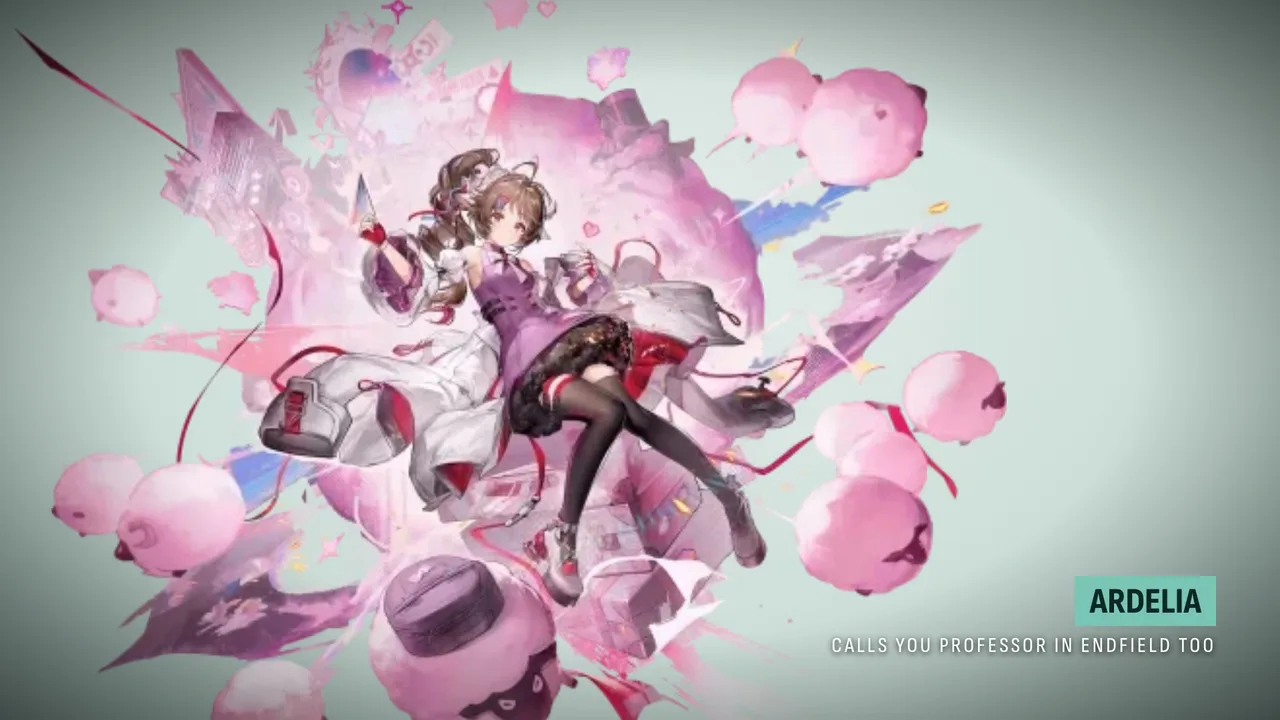
Some studied them instead. Eyjafjalla calls the Doctor Professor because “you’re an expert on Catastrophe studies, so you’re like a professor.” If that sounds familiar, Ardelia calls you Professor in Endfield too. Others explained them however they could. Saga remembers her head priest leading her people over the mountains to escape them: “He said that Catastrophes are the wrath of the devas.”
And still, Terrans found beauty in them. Jieyun: “Sometimes you see the clear night sky after a Catastrophe has passed in the distance. Wind blows toward the horizon, and the stars seem so close you could touch them.”
What Is Originium?
Here is the strangest part. When a Catastrophe was over, it left something behind. “A mineral called Originium can usually be found in the area after a Catastrophe is over.” Originium is a semi-transparent black crystal, and Terran scientists have a chilling theory about it: “Studies indicate that Catastrophes may be actually serve as vectors for the spread of Originium.” The disaster may not be random at all. It may be delivery.
The crystal holds an enormous amount of energy, and Terra used it twice:
- Arts. Terra’s word for magic. The glossary defines Originium Arts as “a technique that can alter matter or consciousness by stimulating the energy inside Originium”. Arts work without Originium, but far worse; it is the base material and the catalyst for almost all of them.
- Machines. “The birth of the Originium engine made it possible to industrialize Originium, and that was when people started to build larger and larger vehicles. The concept of nomadic cities was realized after vehicles became large enough to move entire cities.”
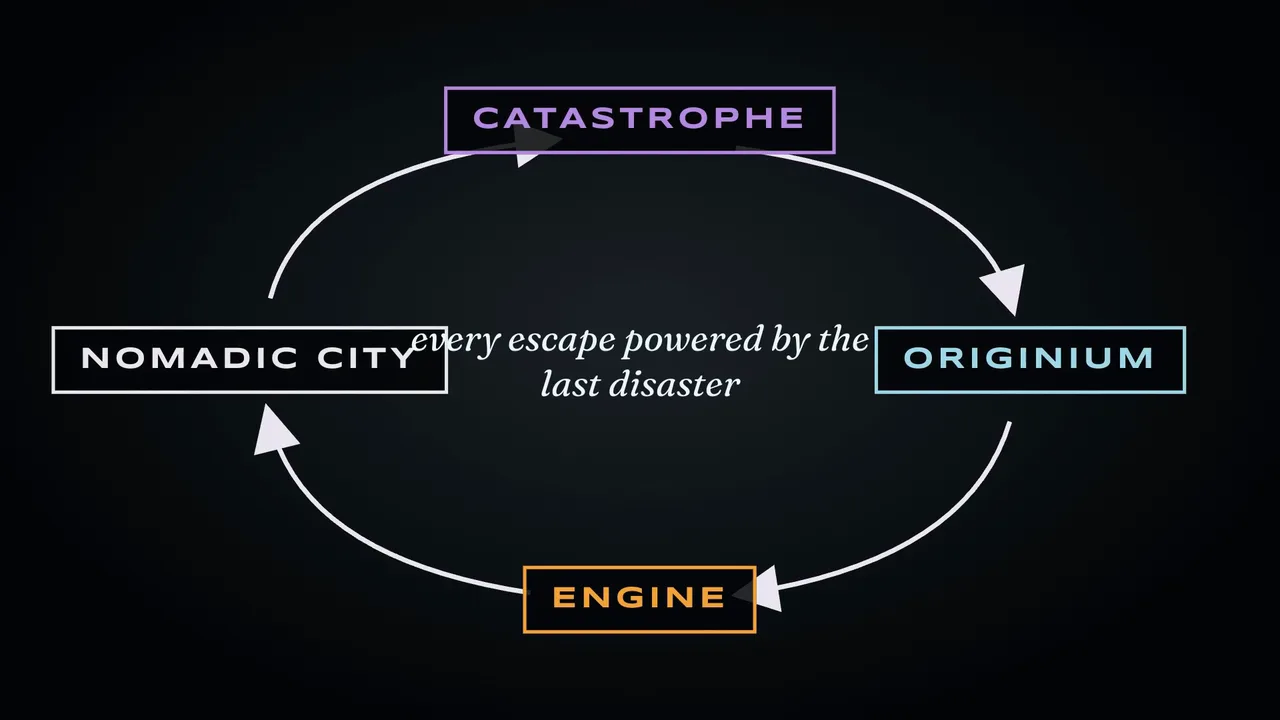
Think about what that means. The crystal the disasters left behind became the engine that let people run from the disasters. Every city fleeing a Catastrophe was powered by the leftovers of the last one.
It looked like the perfect deal. It wasn’t.
What Is Oripathy, and Who Are the Infected?
“People have found that long-term exposure to Originium and its industrial derivatives makes it more likely to be infected by an incurable disease called Oripathy, whose patients are called ‘The Infected.’” Over time, Originium spreads inside the body, and the body itself starts to crystallize.
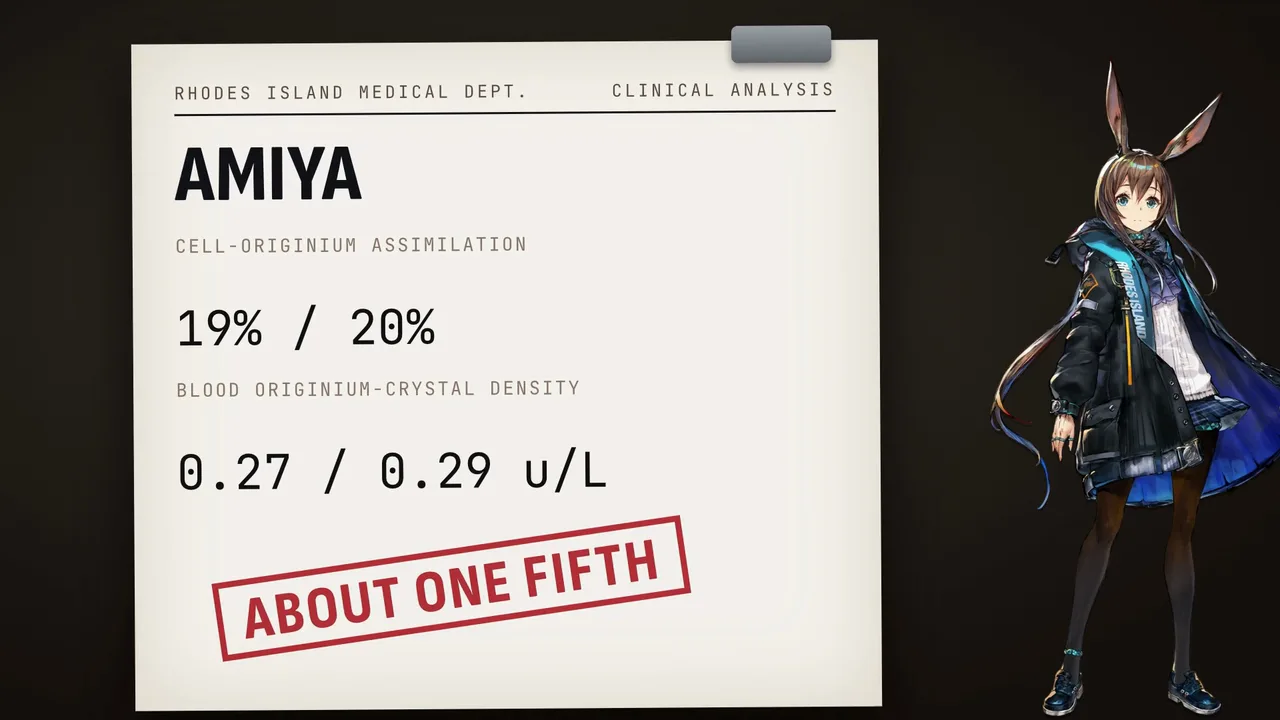
Arknights shows this in its clinical files. Each one gives two numbers: how much of the body’s cells the crystal has taken over (Cell-Originium Assimilation) and how much crystal is in the blood (Blood Originium-Crystal Density). Amiya, the young leader of Rhodes Island, sits at 19% and 20% across her two files, with a blood density of 0.27 and 0.29 u/L. About one fifth.
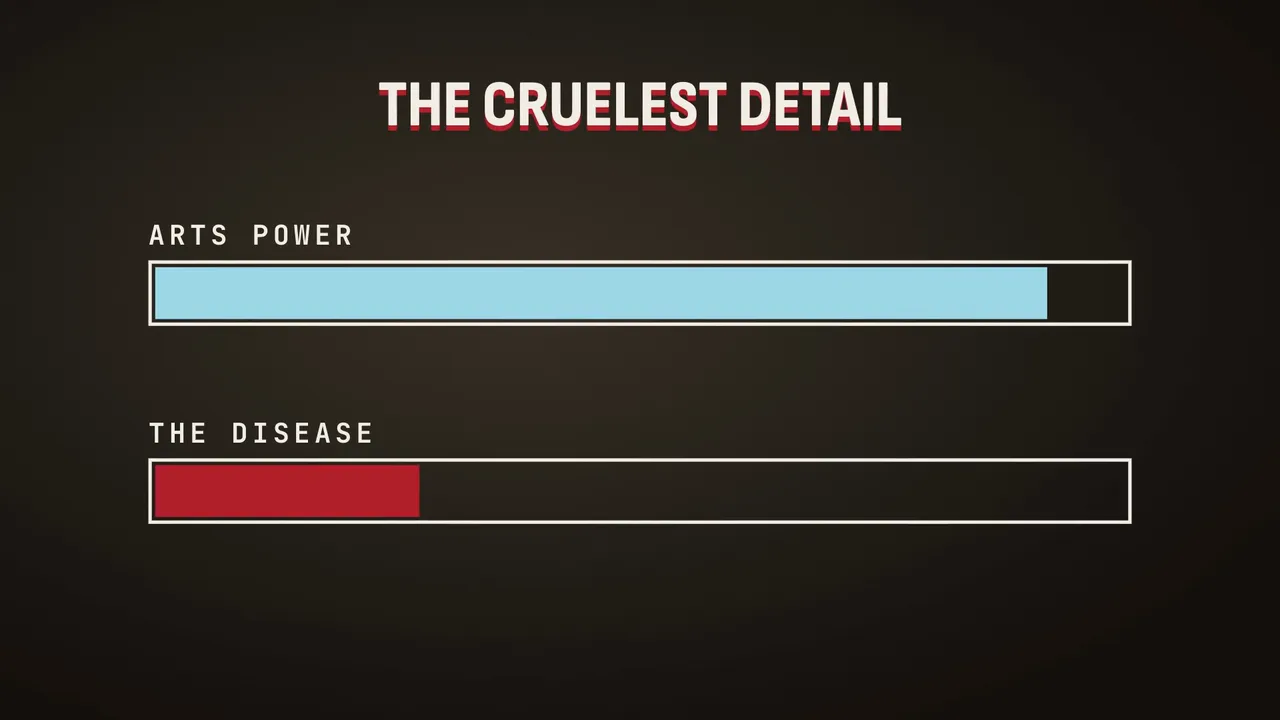
The cruelest detail is this: “Oripathy can increase the patient’s Arts power in a dangerous way, but tapping into this power will hasten the deterioration process and eventually lead to death, at which point the body becomes a new source of infection.” The strongest fighters on Terra were often the ones dying fastest, and even death did not end it.
You can guess how the healthy treated the Infected after that. They were feared, shut out and hunted. Some fought back: Reunion, an armed Infected movement, rose against the societies that persecuted them, and in the first game it used a coming Catastrophe as cover to tear a city apart. On the other side was Rhodes Island, a pharmaceutical company that hired the Infected, treated them, and kept looking for the cure nobody had found. (For the full Rhodes Island story, see What Happened to Rhodes Island in Endfield?.) Reunion’s leader, Talulah, and the one line Endfield keeps about the movement are covered in Who Is Talulah? Reunion and Chi Xiao.
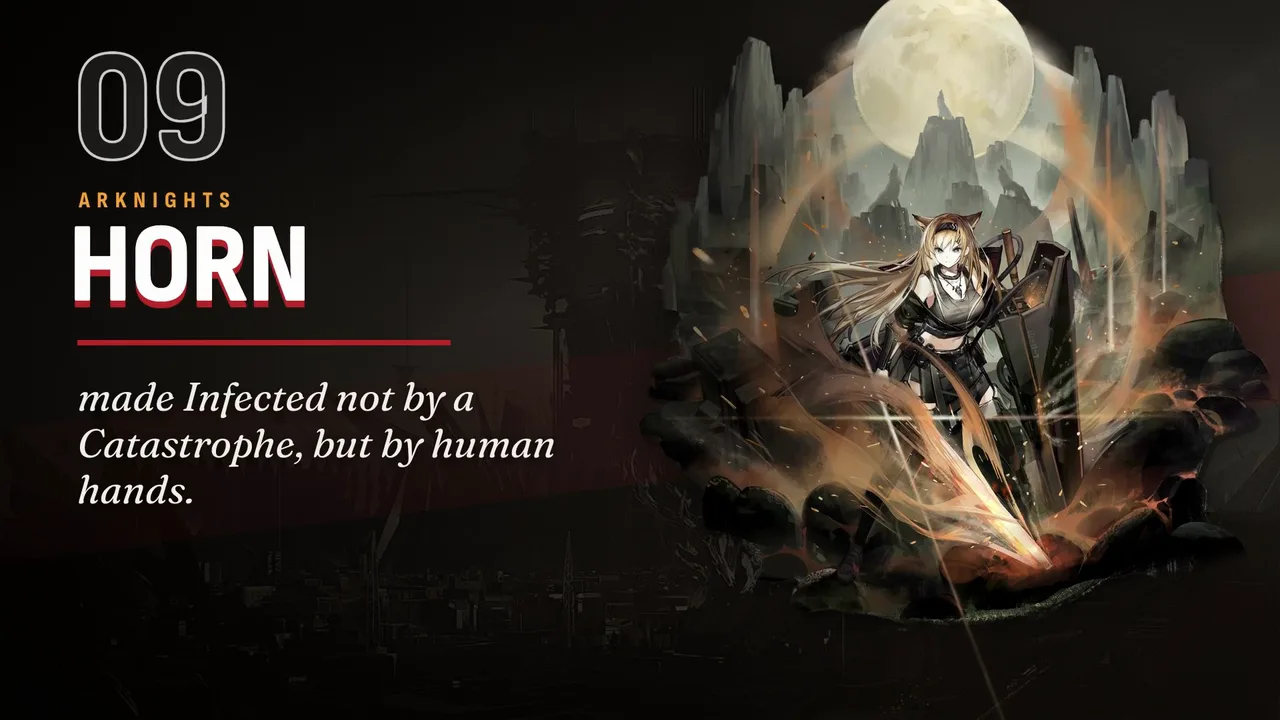
Not every Infected person got sick from the sky. Horn: “As that city spat great black crystals from its gaping wounds, I thought there could be no hope left for it… Is this place familiar with those made Infected not by Catastrophe, but by human hands, Doctor of Rhodes Island?”
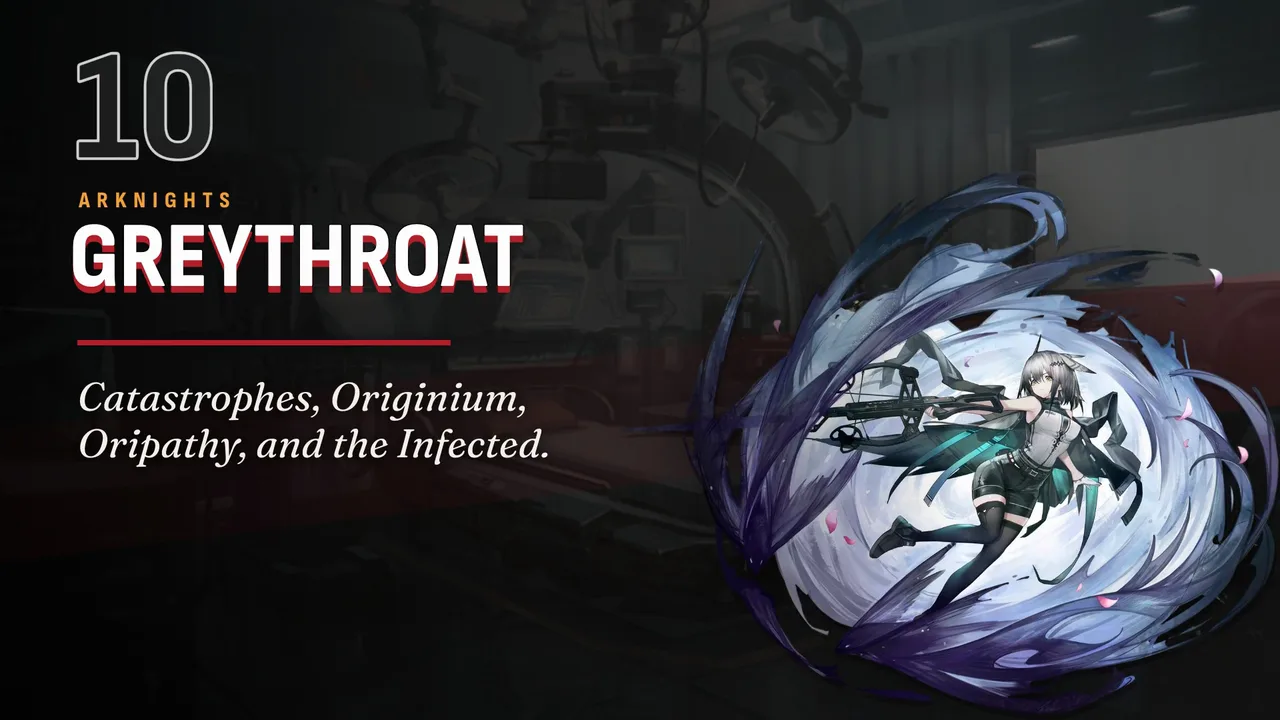
GreyThroat sums up Terra in one breath: “Catastrophes, Originium, Oripathy, and the Infected? Hm, I’m still plagued by nightmares even now.” That was life on Terra, in four words: disasters from the sky, a crystal that made the disasters survivable, and a sickness that came with the crystal. Then people found another planet.
Does Talos-II Have Catastrophes?
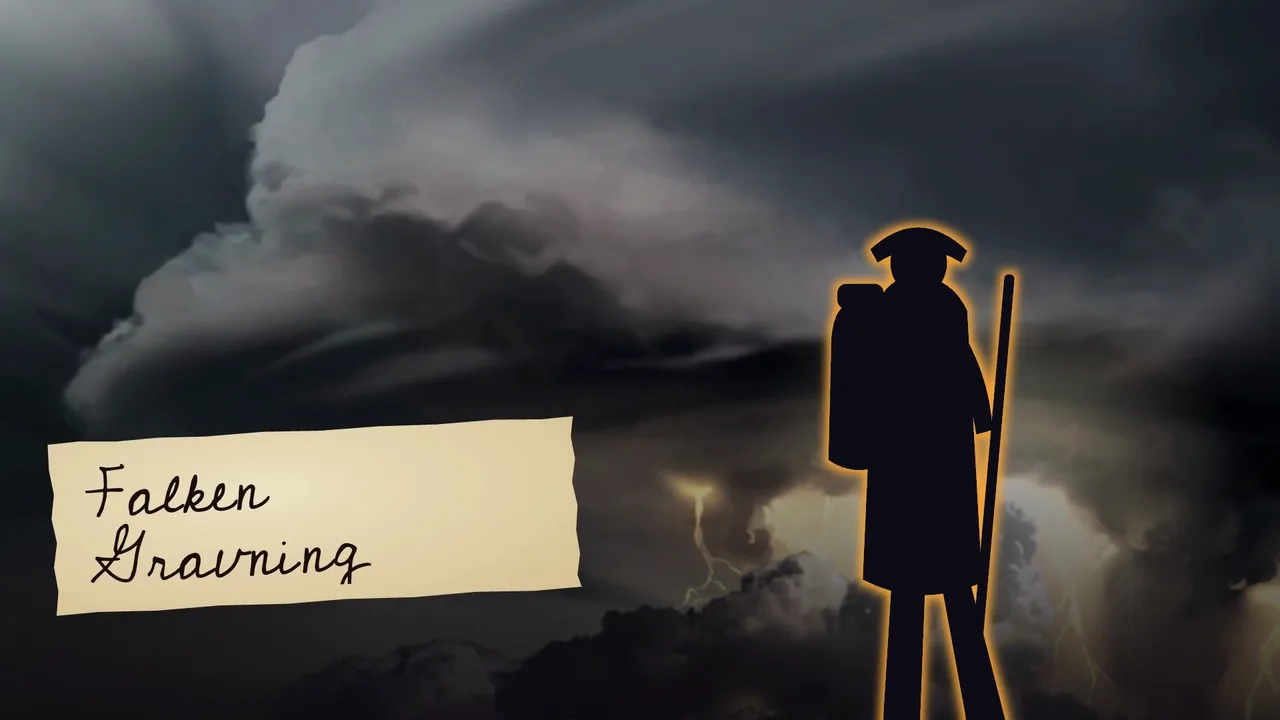
Talos-II is where Endfield takes place. “When he turned 53, [Falken] decided to leave his homeland behind and devote the final years of his life to the newly discovered planet.” On Terra, people called him a prophet of doom. “Here in the new world, he was no longer a ‘prophet of doom’ but a mere common messenger. For those few short years, the serene, open expanses of Talos-II was free from Catastrophes and the ever-present threat of destruction. A sense of long-absent peace filled Falken.”
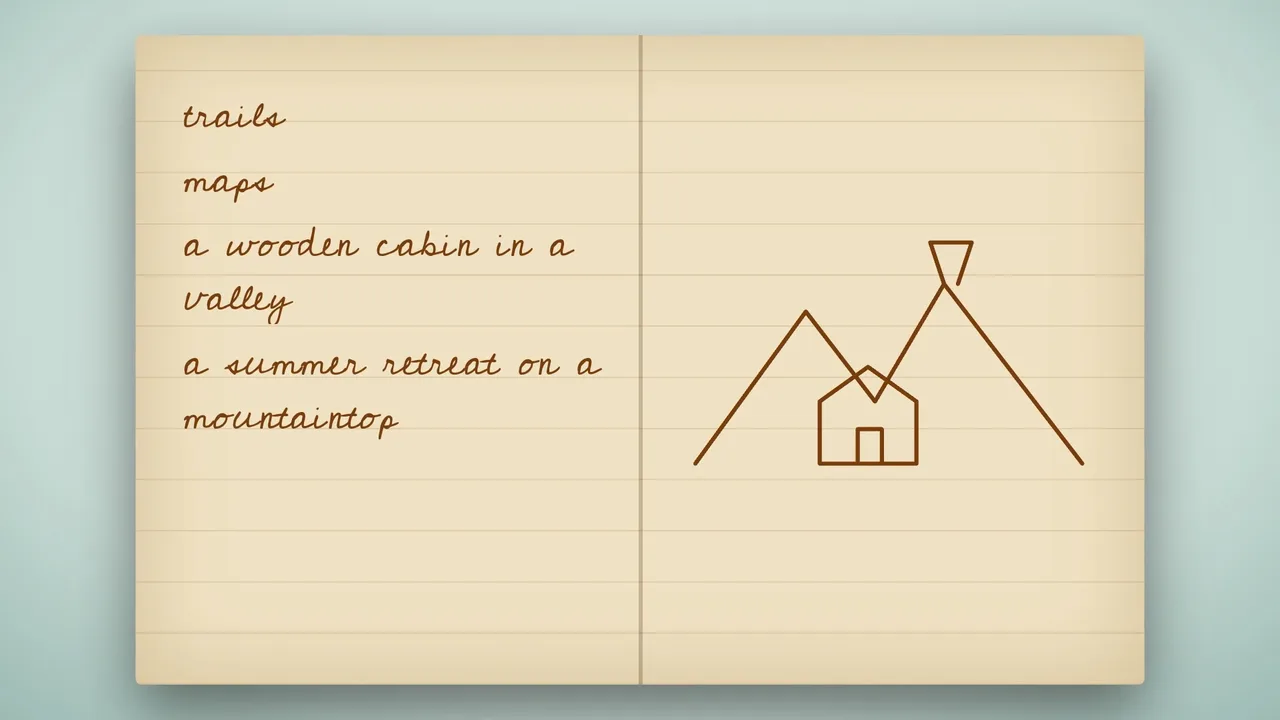
He carried letters, supplies and intel between the first pioneer bases, and in his spare time he kept wandering alone (an old Messenger habit; Brigid: “Even with an empty post bag and no Catastrophes on the horizon, I’d still be wanderin’”). “He even cobbled together several Originium devices to create a rudimentary aircraft.” For the first time his notebook was “filled with trails, routes, contour maps, and ideas for his ‘ideal home’”: a wooden cabin in some valley, and a mountaintop summer retreat.
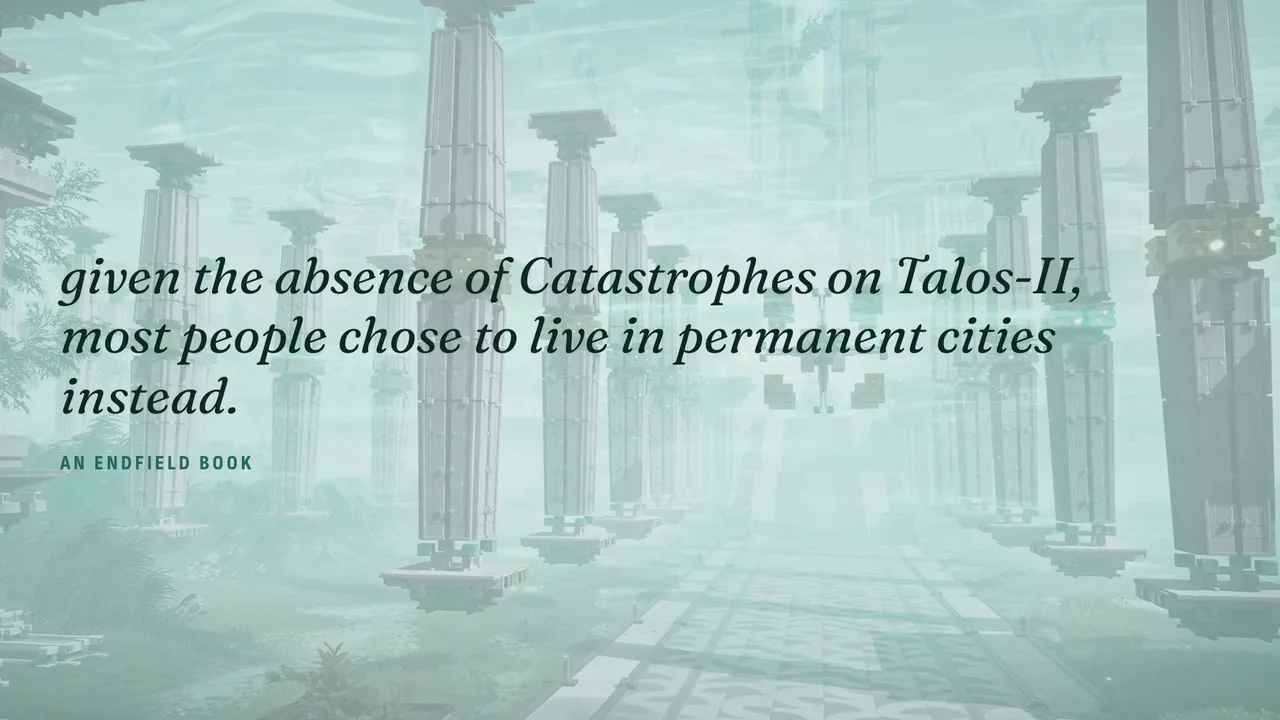
Falken wasn’t the only one who stopped running. One book in Endfield traces nomadic city technology from Terra to Talos-II, and its key line is this: “Given the absence of Catastrophes on Talos-II, most people chose to live in permanent cities instead and ushered in a new age of nomadic city technology. Though every faction maintains a sizable fleet of landships, hardly any additional city-scale ships have been built.” After centuries on treads, humans put their cities down. The famous exception is the Sarkaz city of Seš’qa, which flies, “made possible with essentially irreproducible technology.” (More on it in Seš’qa and the Sarkaz on Talos-II.)
What Is CORD, and Is Oripathy Cured in Endfield?
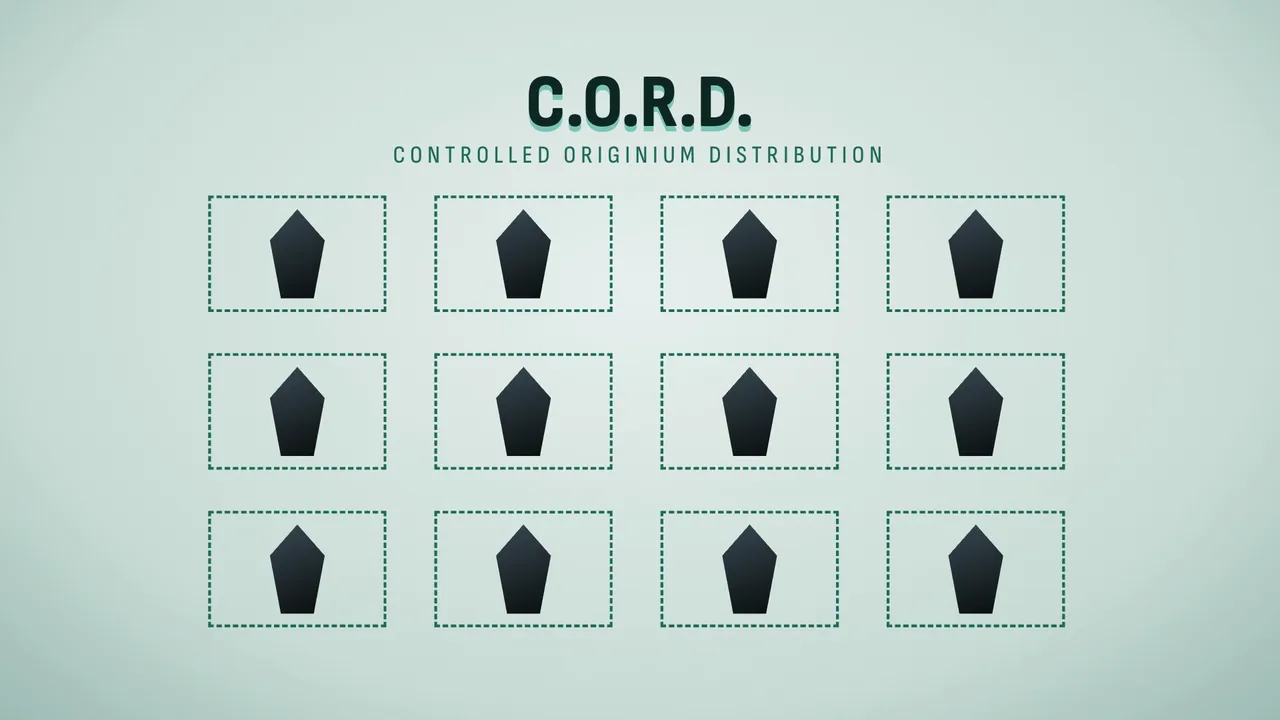
The people of Talos-II did not just get lucky with the sky. Endfield’s history says “the frontiersmates also chose to learn from the mistakes of the past and look for new solutions. The development of the Controlled Originium Distribution (CORD) technology gave a degree of control over the growth of Originium clusters and made it possible to ‘cultivate’ them in specific areas.”
On Terra, the crystal arrived with the disaster. On Talos-II, people farm it.
The same entry goes on: “CORD greatly reduced the likelihood of Catastrophes in Talos-II.” Notice the wording. Reduced, not removed. The book above says there are no Catastrophes, this says there are fewer; both fit if the danger is still out there and simply being managed.
The sickness got the same treatment: “Long-term Oripathy Treatment (LORIT) provided by Rhodes Island has been well-received by the Talosians. Preventive Oripathy Shots (PORIPS) and therapeutic suppressants were also developed. The Infected were no longer stigmatized in Talosian towns and villages now that treatment became readily available.”
You can see it in small details. One Endfield writer remembers Sarkaz workers eating rations outside their cabin: “All of them were typical Sarkaz, Oripathy-positive and capable of wielding the Arts.” Said as casually as their height. Another character says “I heard that Oripathy was far more dangerous in the past”, which nobody on Terra would have needed to hear secondhand. But it is still not cured: “There is no permanent cure for Oripathy, but regular use of the suppressants will keep most symptoms under control.”
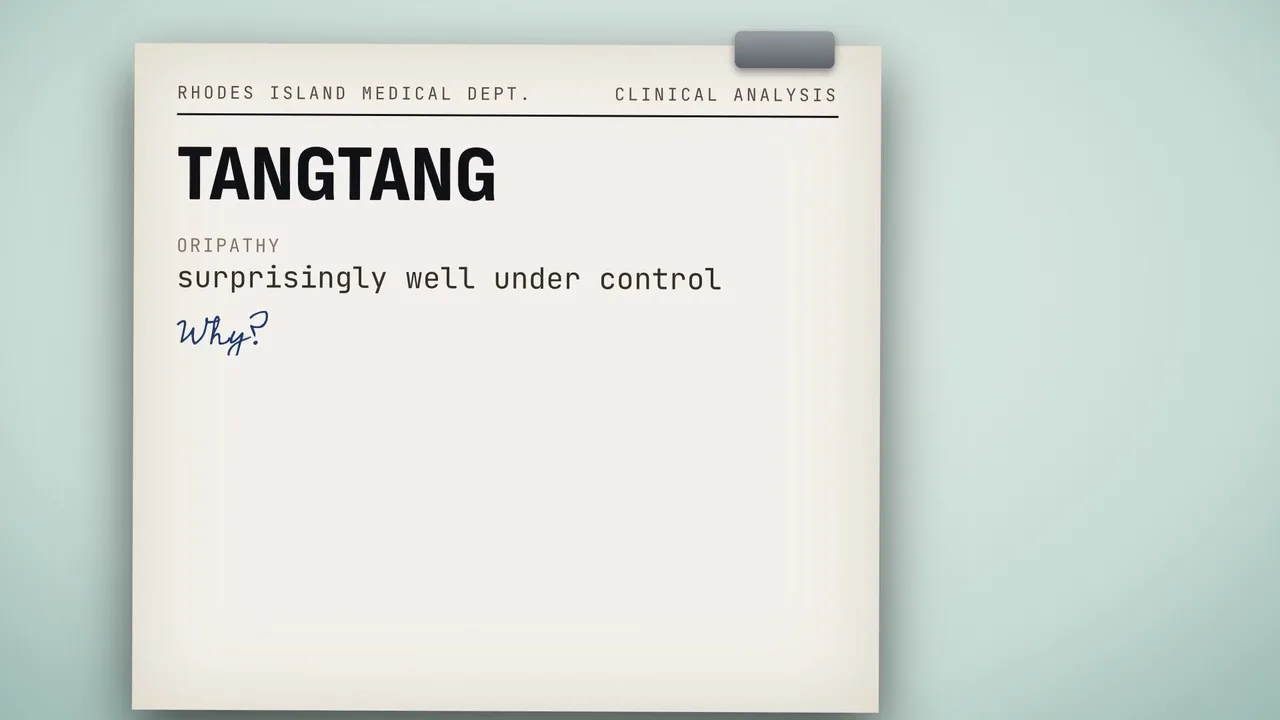
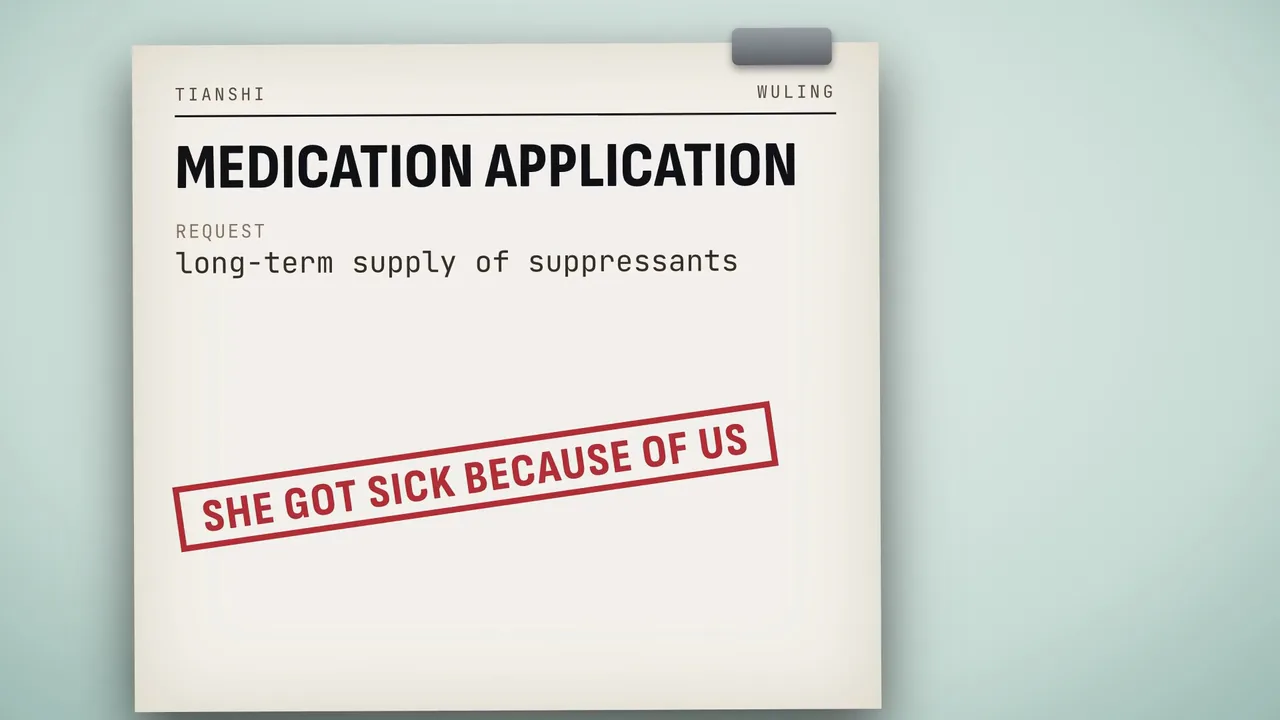
Outside the big cities, the old Terra still shows through. Tangtang of Qingbo Stockade caught Oripathy in a fight with Wuling and spent ten years on folk remedies. Her checkup finds her Cell-Originium Assimilation and Blood Originium-Crystal Density “remarkably well-controlled”, and she explains: “Everyone says I’m the River’s Daughter. The water washes the sickness away.” The doctor’s note answers: “Could natural bodies of water truly cure Oripathy? The answer is evident: it’s impossible.” Then a Tianshi files a form for a long-term supply of suppressants, because “She contracted it because of us. We have an obligation to treat her.” (Her full story: Tangtang’s lore.)
So the crystal became a crop, and the plague became a condition you manage. That was the plan. Then Talos-II showed what kind of power humans were really farming.
What Happened to the Great Originium Oak?
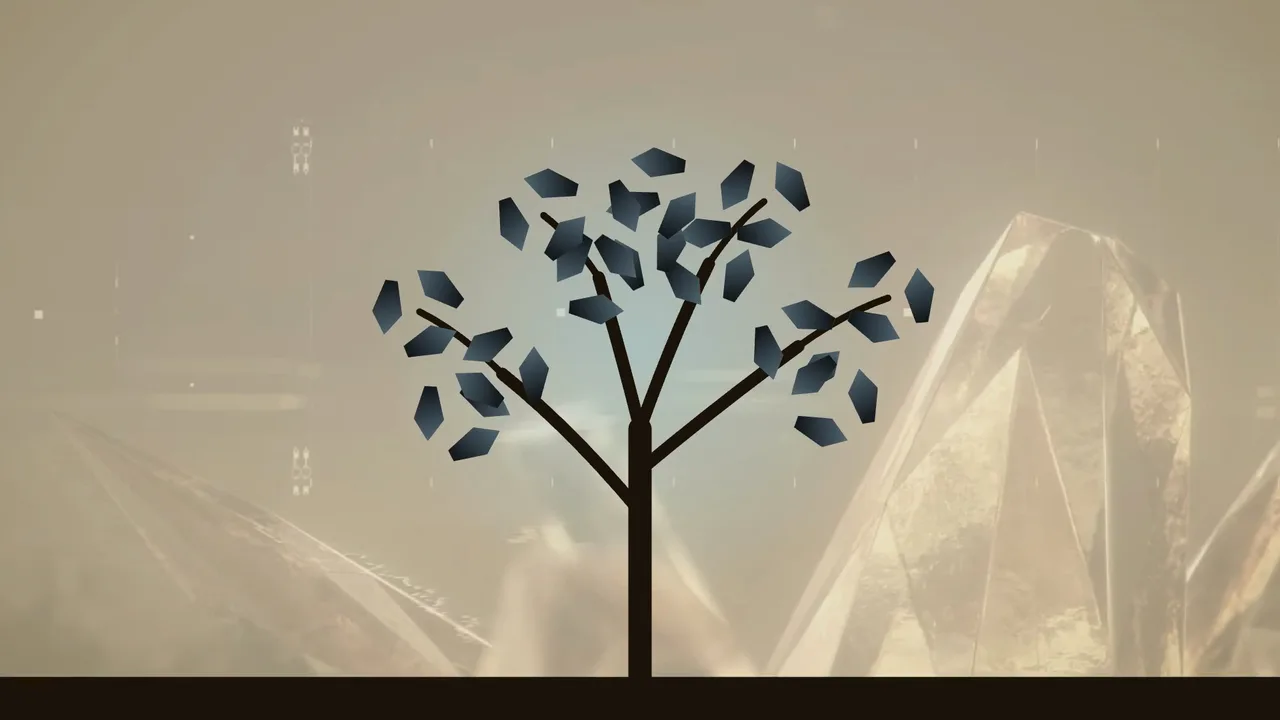
“During Valley IV’s initial development phase, severe energy shortages threatened the colonization effort. The Endministrator addressed this by planting the Great Originium Oak, a creation of the Originium Arts, in the Origin Lodespring region. People harvested branches and foliage from this arboreal marvel to establish the territory’s first power plant and quarry, initiating a positive cycle for expansion.”
A tree made of the crystal that once rode in on disasters, feeding a whole valley.
Then, about twenty years ago, something came for the valley. “Astarron is the name we gave this Aggelos that attacked Valley IV… this entity was at least 100 meters in height. It was called the Astarron as it resembled crude rock paintings of the sun made during ancient times in Terra. Astarron featured over a thousand ‘spokes’ that twist and rotate like a great circular vortex. When Astarron advanced, it covered the land with an ominous shade of dark red generated by the Æther flowing in its immense form, a deathly zone for all living beings within.”
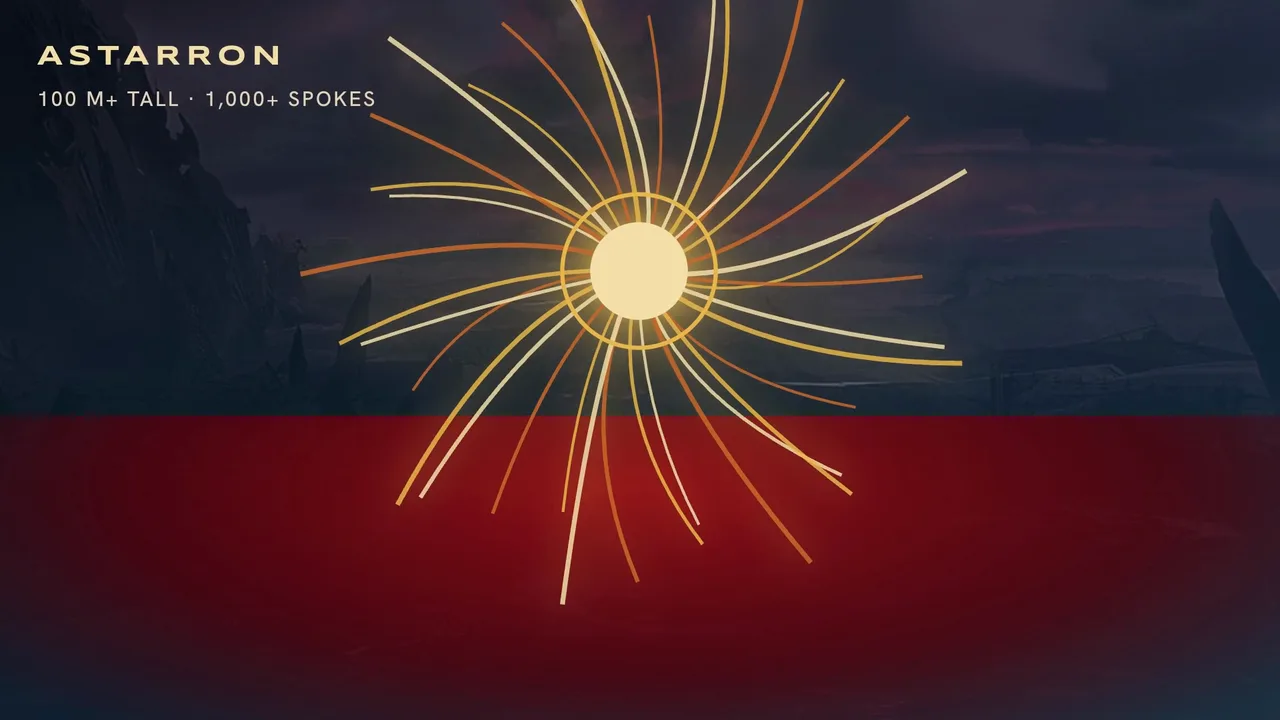
“When the Giant Aggelos ‘Astarron’ assaulted the valley and all countermeasures failed, the UWST made the fateful decision to detonate the Great Originium Oak. The catastrophic energy release obliterated ‘Astarron’.” On Terra, Originium was what the sky dropped on cities. On Talos-II, humans used it to drop a disaster on something else. It cost the valley dearly: regional development was paralyzed, which is how Endfield Industries came to sign “a renewable ten-year lease agreement” and build the Hub Base you start the game in.
Nobody knows how the Oak bomb worked
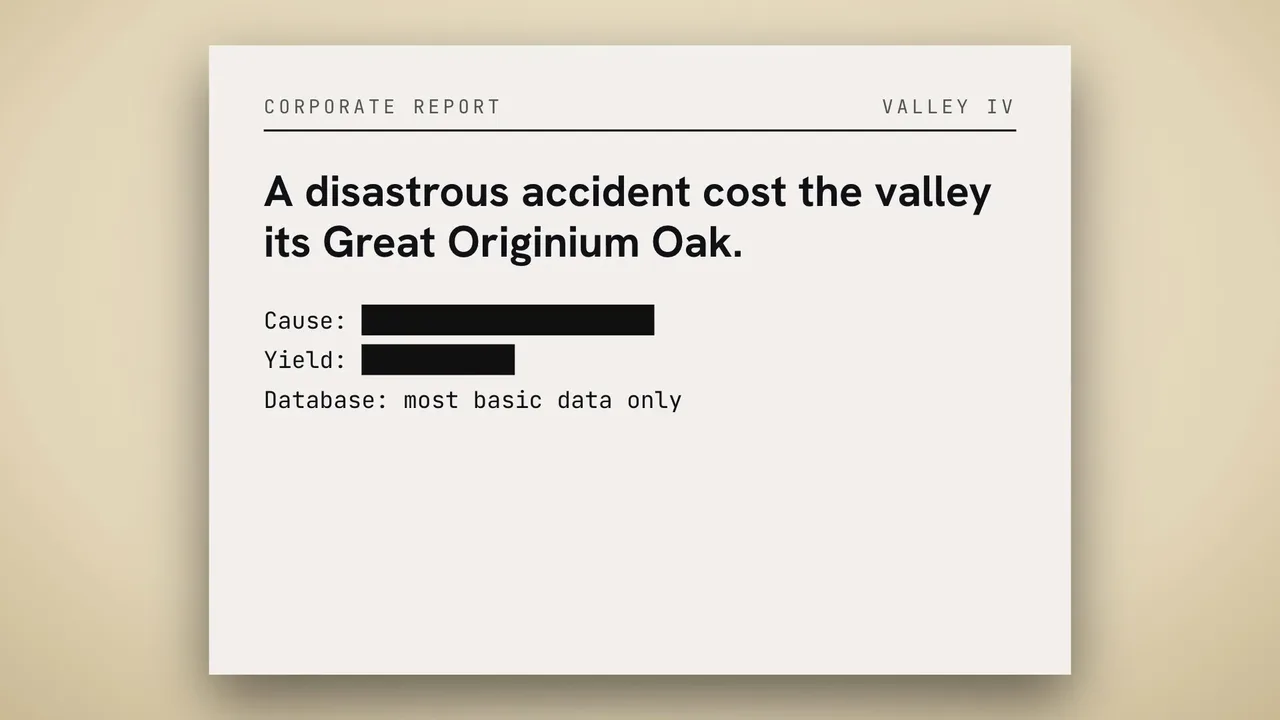
Not even Endfield’s researchers. One asks it outright: “Did they simply use the Oak as a bomb? The explosive yield of that amount of Originium would have completely devastated the whole of Valley IV… our database only contains the most basic of data about the Great Originium Oak.” The official version is softer still. A corporate report says only that “a disastrous accident deprived Valley IV of its Great Originium Oak.”
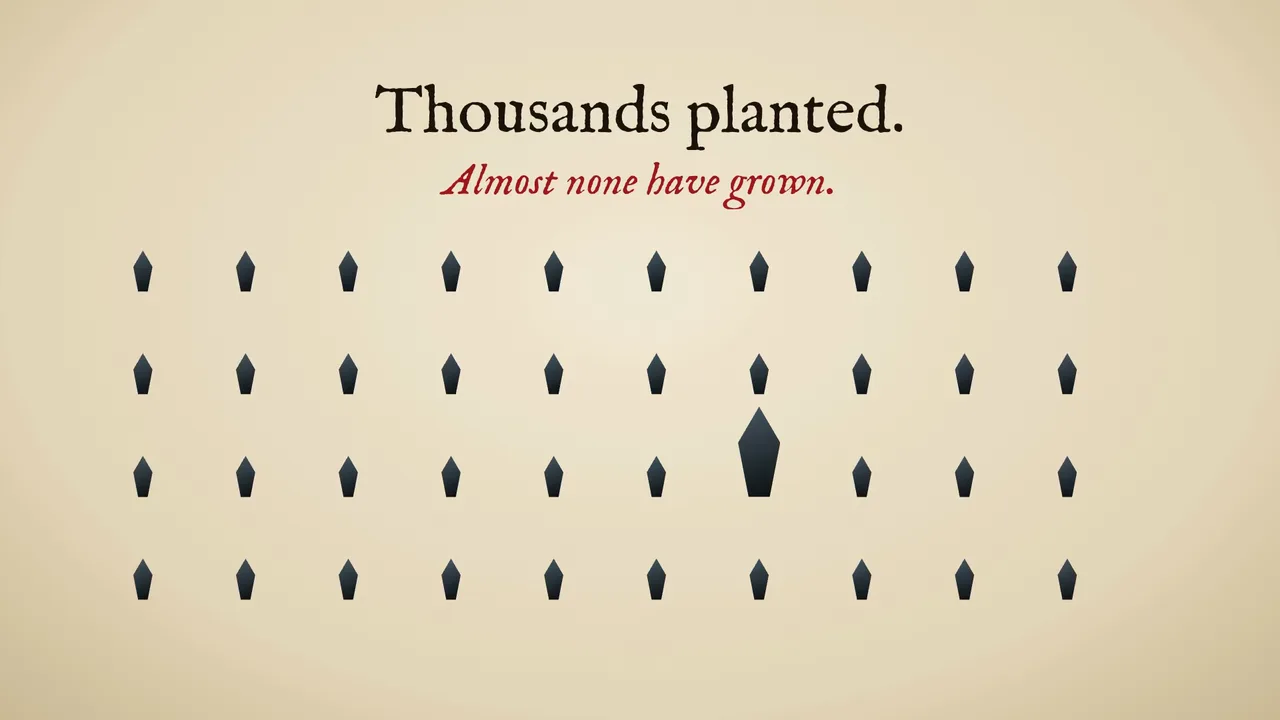
After the Oak, “the UWST began farming these saplings on a large scale. Each of them has a chance of growing into a new Oak. Though hardly any saplings showed any sign of growth, they remain highly sought after.” And one researcher’s notes reveal the real goal: not just regrowing a tree, but restoring Originium’s original activity, “Terra-levels of activity.” In other words, the Originium on Talos-II is less active than the old world’s, and scientists are trying to wake it back up. The game does not say why it went quiet.
For some, the loss still hurts. In one quest, Granny Jenner’s memory slips back in time, and “you must figure out a way to hide the fact from Jenner that the Great Originium Oak has been blown up.”
What Replaced the Catastrophes on Talos-II?
Astarron was not a one-off. It was an Aggelos, and Talos-II had already shown what those could do. Falken’s quiet years ended “the day when the Ankhors fell from the skies and the Aggeloi descended upon Civilization. People were once again forced to flee as they had done with Catastrophes struck.” Endfield’s war history: “Within the first twenty-four hours of the conflict, suddenly emerging Ankhor points allowed massive Aggeloi swarms to overwhelm and obliterate humanity’s earliest cities around the northern Cosmic Gate.”
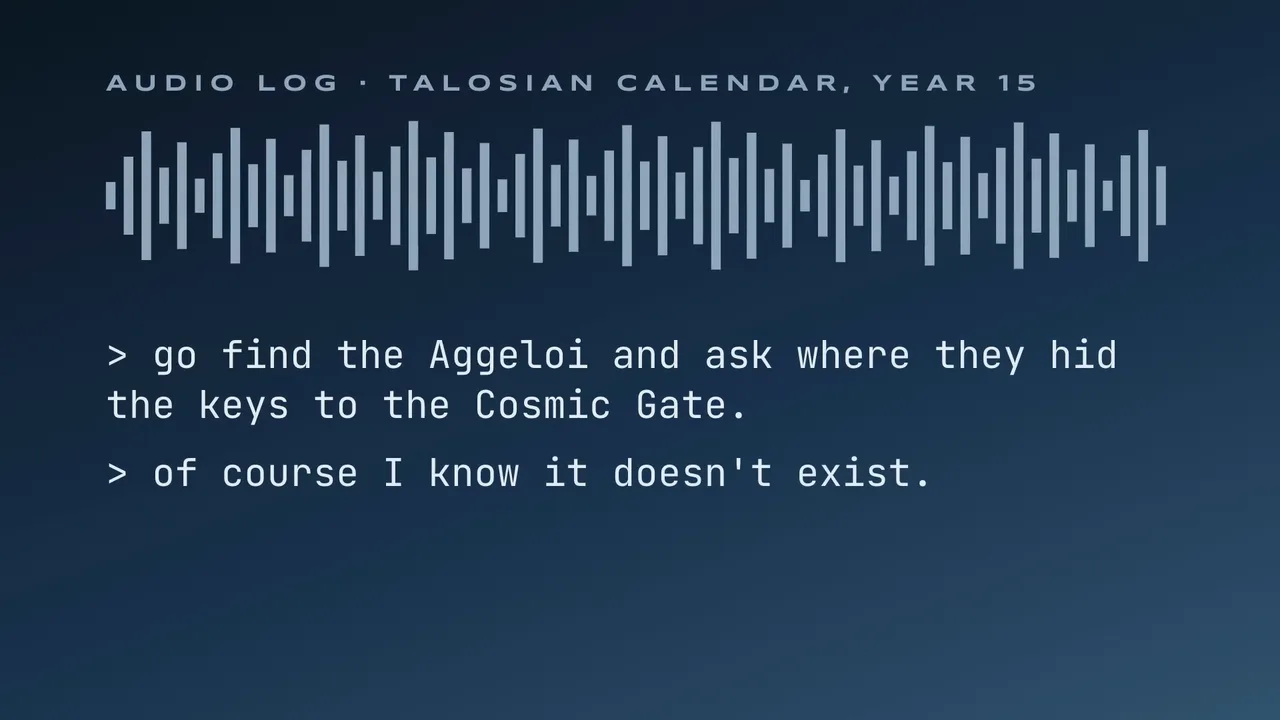
One survivor kept an audio log in Talosian Calendar Year 15. Day three in the temporary shelters: “clean towels are a luxury now.” Two weeks later, still no news of the friends they lost: “They told me the war is over but there’s no heading back to Terra.” And in the middle of it, a bitter joke about asking the Aggeloi “where his blighted kind hid the keys to the Cosmic Gate”, followed at once by “OF COURSE I KNOW IT DOESN’T EXIST.” Keep that gate in mind.
The Blight and Æther
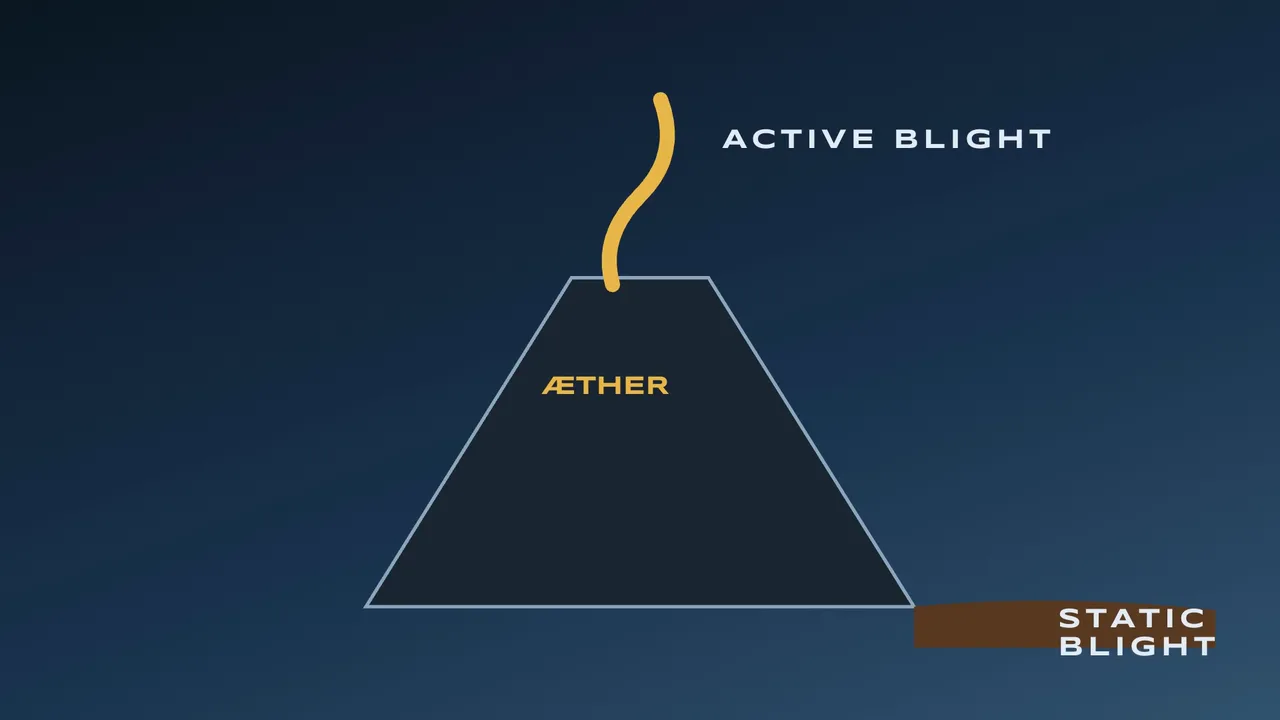
Talos-II also has its own version of the Catastrophes. “The Blight is a general term for describing hazardous subterranean, surface, atmospheric, and orbital phenomena of Talos-II.” It comes from Æther: “The Blight is a form of hazard caused by the Æther. Their relationship is like lava to a volcano.” Some of it flares up (Active Blight), and “Static Blight is often regarded as the residual remains left when an Active Blight episode has subsided.”
That should sound familiar: a disaster that leaves something behind where it hits. (Our parallel, not the game’s; the game never links the Blight to Originium or to Catastrophes.) And Æther is worse to handle than Originium ever was: “No human individual can make direct contact with the Æther safely.” It comes from the Ætherside, which “is currently overlapping with realspace. Flow of matter and energy between the two dimensions has been verified as a feasible possibility.” (For the creatures it breeds, see the Blightshade bestiary.)
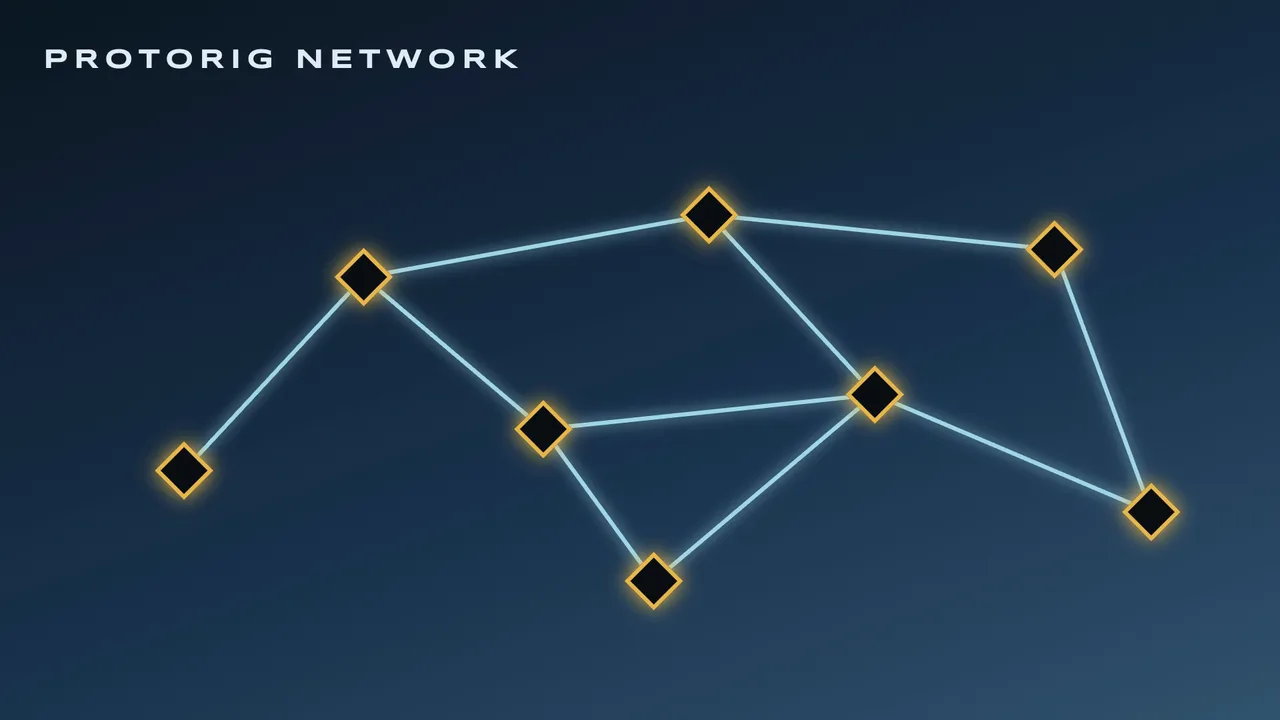
Here is the twist. “Shortly after arriving at Talos-II, many scientific research teams noticed the interactions between Originium and Æther energy.” Endfield built on that: it “created the special Protocol-Originium (Protorig), and identified a means of utilizing multiple Protorigs to create a tele-protocol (TP) network.” That is the teleport network you use to cross the map. The crystal born from Terra’s disasters is now the tool humans use to handle Talos-II’s.
It doesn’t solve everything. There is now an illness called Ætherside Syndrome, and one character says it out loud: “We may not have a cure for Ætherside Syndrome.” (The game does not say what causes it. Purrchena’s story touches it: Purrchena’s lore.)
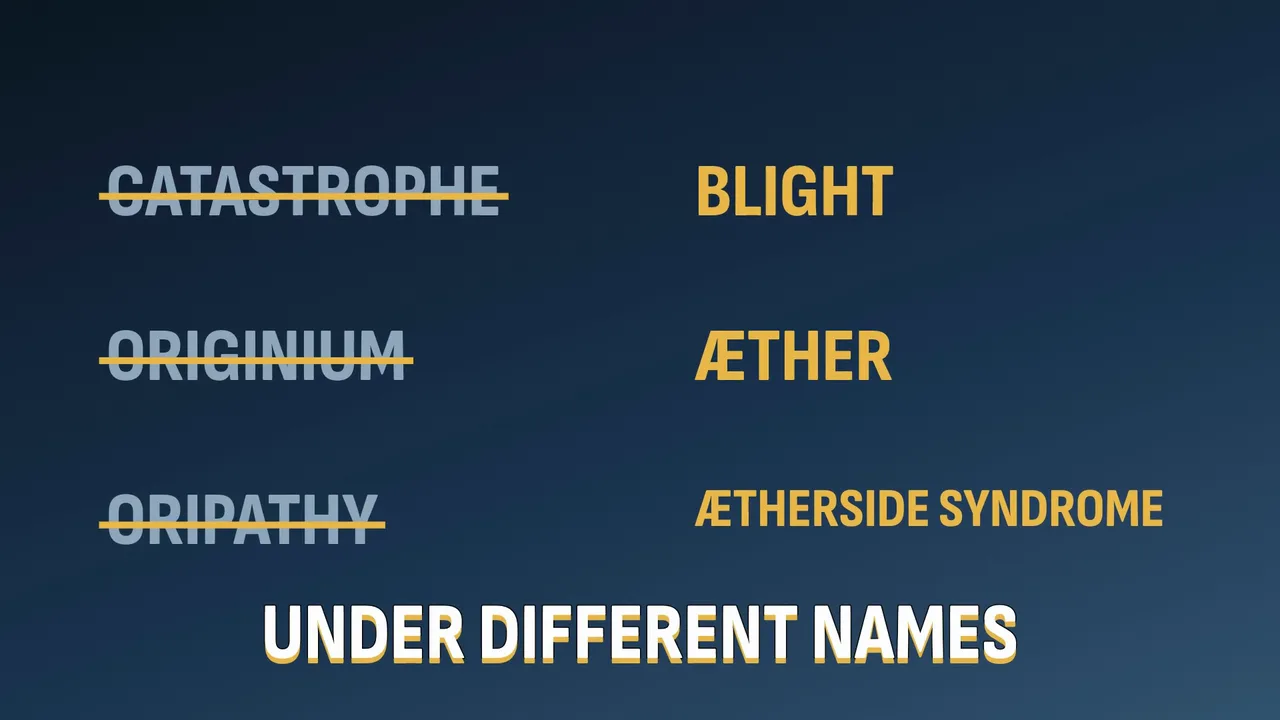
A disaster, an energy source, and an illness with no cure. Humanity crossed space and found the same three things waiting under different names.
What Happened to Falken Gravning?
When the Aggeloi came, Falken went back to his old job. “He became the most reliable guide and led the survivors in a desperate southbound trek of survival.” He flew his ramshackle aircraft into the storm and came back badly hurt. “Numerous outposts, villages, and towns were founded thanks to his way markers or verbal directions. Without Falken as their guide, many would fail to reach the Civilization Band alive.”
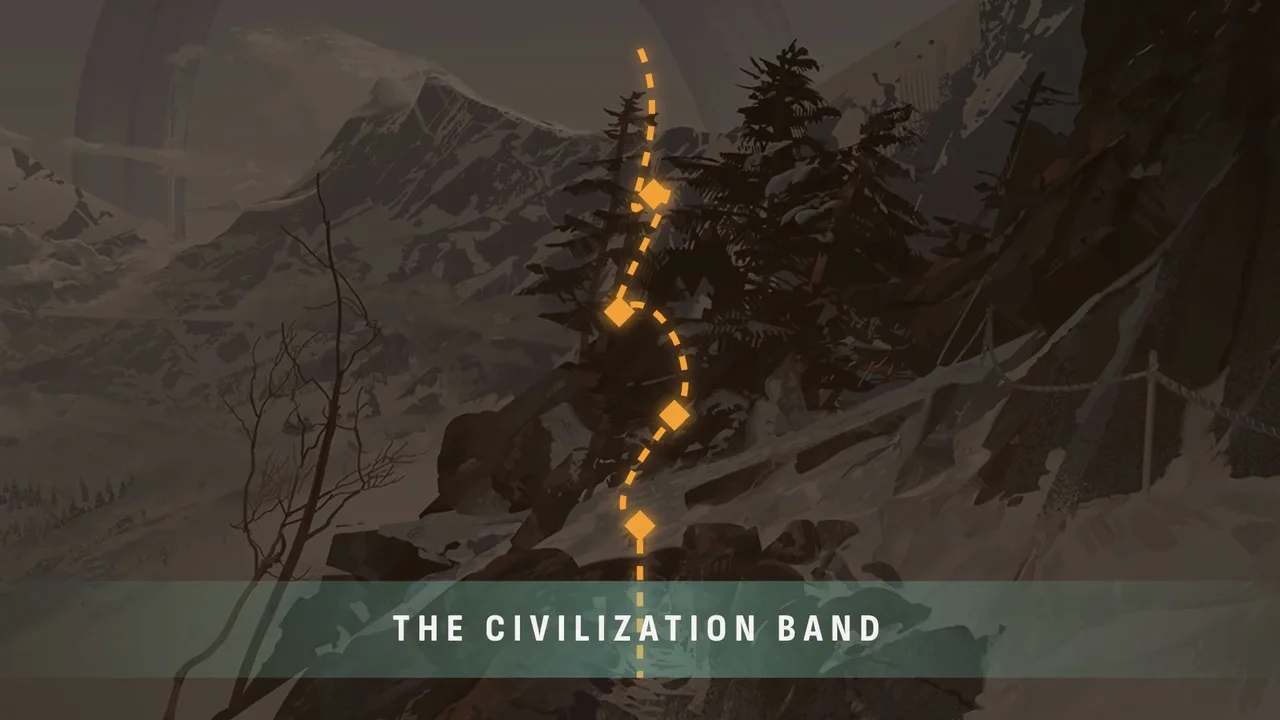
In his last years he kept going south, across the mountains and the whole Band, “until he finally arrived at the edge of the great ocean. Legend then claimed that Falken built a ship at that very place and sailed off to find a place even further south. And Falken was never seen again after that.”
Falken’s story in Endfield is told twice over: once as a Mieszko Industries promotional tale, then by someone introducing a “latest paper” with a theory: “Falken Gravning kept going south because of his belief that another undiscovered Cosmic Gate may exist in the south pole of this world.” Nobody can prove or disprove it. “He might have found a way home at the end of the sea, or simply disappeared beneath the waves.” But if the theory is right, the man who left Terra to escape the Catastrophes spent his last days trying to get back to it. In the researcher’s words: “He wanted to go home.”
So did humanity get away? From the Catastrophes, mostly. From the running, never.
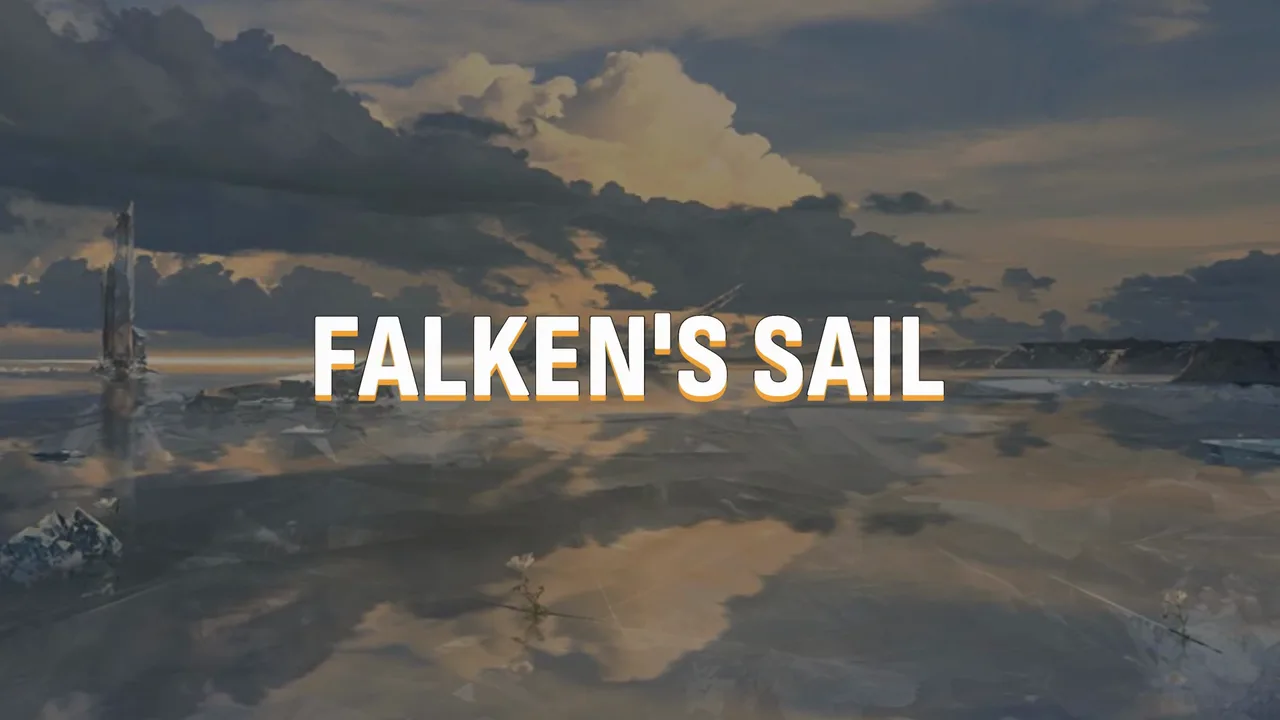
But Talos-II remembers Falken kindly. “Should one see a cloud, shaped like a raised mast with full sails at the place where the oceans and heavens meet, that would be ‘Falken’s Sail’, and that would be tidings for good weather.” On a world that once taught everyone to fear the sky, that cloud means one thing: good weather ahead.
Sources
- Arknights (original game): the in-game glossary entries for Catastrophes, nomadic cities, Originium, Originium Arts, the Originium engine and Oripathy; Amiya’s clinical files; operator voice lines from Leonhardt, Tsukinogi, Brigid, Provence, Mulberry, Eyjafjalla, Saga, Jieyun, Horn and GreyThroat.
- Arknights Endfield: the Falken Gravning entry, the nomadic city book, the CORD and Oripathy history entry, the Great Originium Oak, Astarron and Hub Base lease entries, the Oak researcher’s notes, the Originium sapling item, Tangtang’s clinical file and the Tianshi medication form, the Aggeloi war entry, the Talosian Calendar Year 15 audio log, the Blight, Æther and Ætherside entries, and the Protorig entry, all from the available game data in English.
- Our reading: that both Endfield accounts of Catastrophes fit “reduced, not removed”; the Blight-as-Catastrophe parallel; “about one fifth” as a summary of Amiya’s two files.
Take a Break
Available on desktop