ARE ARCANE AND LIFENG RELATED? ENDFIELD LORE
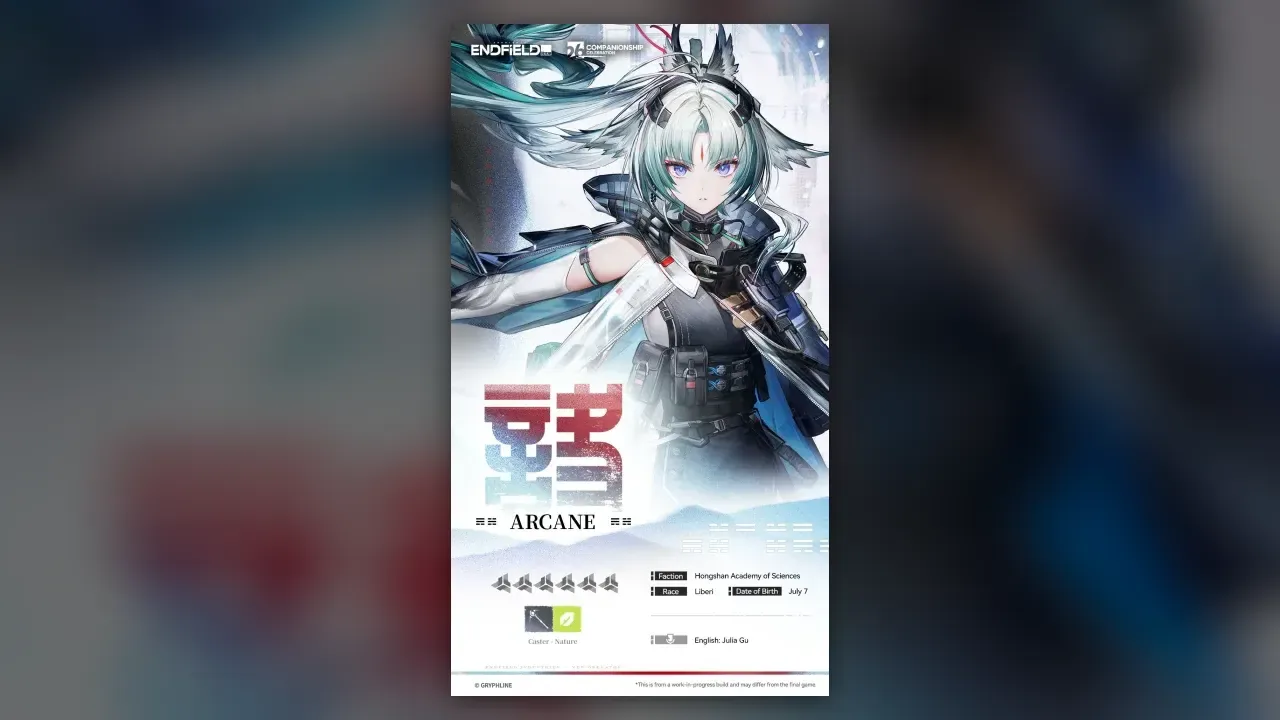
Table of Contents
Version 1.4 gives Arcane and Lifeng two very different homecomings. Arcane, real name Li Zhiyan, returns from the Ink Scroll sacrifice that nearly emptied her of everything. Lifeng, born Bai Yong, is pulled toward the family history he has spent most of his life carrying in silence. One story moves north, into Yinglung Pass and the dead left behind by the Rift. The other turns inward, toward the Great Wall incident, old residential records, and the people who may still remember what happened.
The game never says Arcane and Lifeng are relatives. It does something more interesting. It places two survivors from Wuling’s defensive system beside each other and asks what duty looks like after that system takes almost everything from you. Arcane becomes the officer who keeps walking into the Exclusion Zone (her kit and build data live on her operator page if you came here from the gameplay side). Lifeng becomes the cheerful apprentice who refuses to let loss decide what kind of person he will be.
This is a full-spoiler lore analysis of their stories through Patch 1.4, Homecoming. It separates confirmed events from interpretation, because the family mystery is still deliberately unfinished.
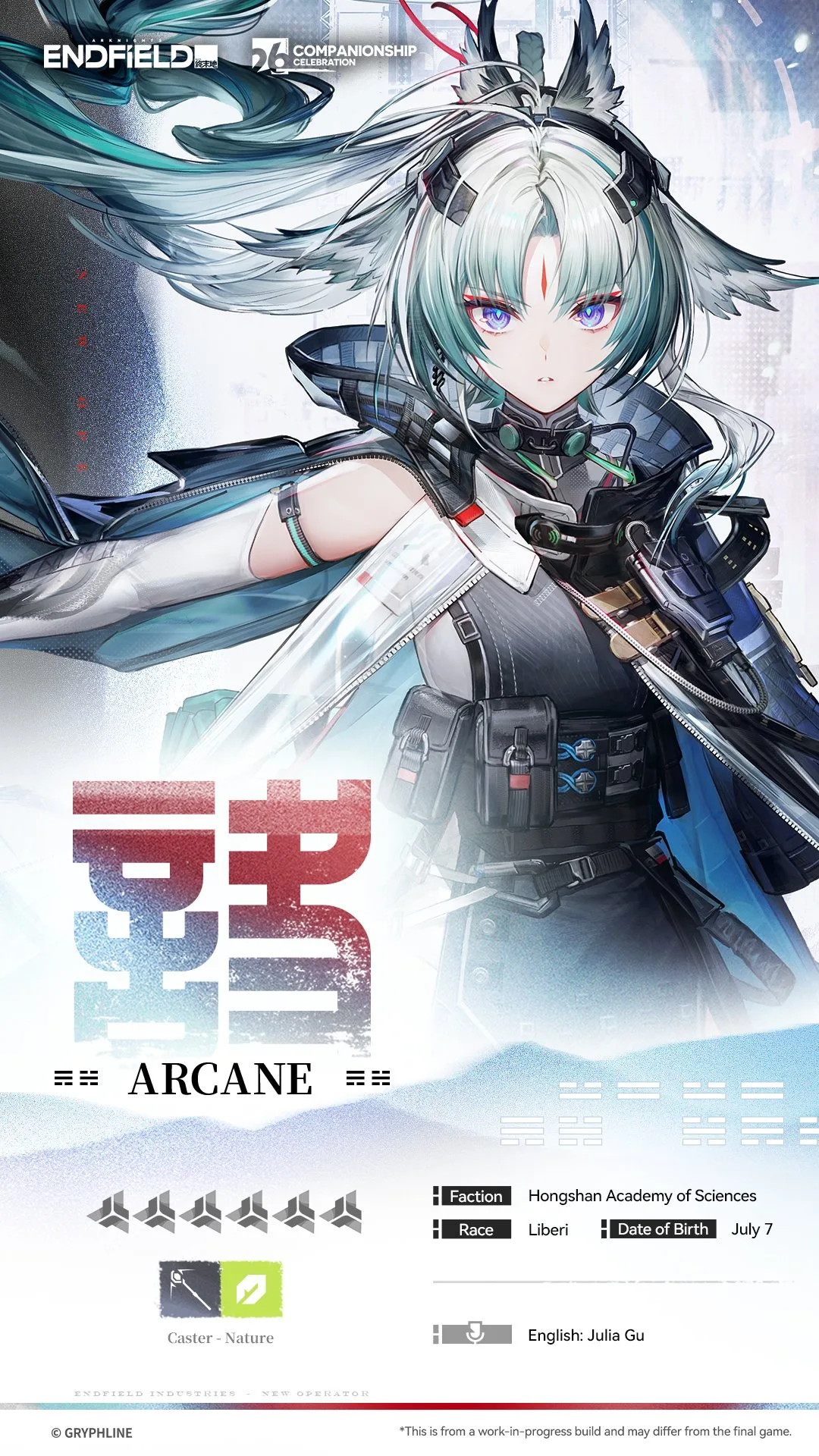
Arcane returns in Version 1.4 as a YSTF task leader on special leave with Endfield Industries.
TL;DR - Key Points
- Arcane and Lifeng are not confirmed relatives. Their connection is thematic and institutional, built around Wuling, the Tianshi, the Great Wall, and the cost of guarding a city from the Rift.
- Arcane is Li Zhiyan, a Liberi officer who graduated from Tanjian Hall and joined the Yinglung Special Task Force to protect her home.
- Her Chapter II sacrifice still defines her. She sealed herself and Ardashir inside the Ink Scroll, survived, and entered a long recovery after exhausting her Arts.
- Patch 1.4 gives Arcane a second life. She returns as a playable Nature Caster and partners with Endfield Industries while on special leave from the YSTF.
- Lifeng is Bai Yong, a 16-year-old Anasa whose parents died in the Great Wall incident when he was six.
- The same disaster cost Lifeng his right arm. His chrome prosthetic is not a character-design flourish. It is a physical record of Wuling’s buried history.
- Lifeng’s 1.4 story follows family clues. Localized mission data confirms that Lian Xiaowu helps trace the families of Lifeng and Ah Sheng before the group heads to an old residential area.
- Their stories ask the same question. When institutions fail to protect their own people, do the survivors reject duty, inherit it, or rebuild it into something better?
Why Arcane and Lifeng Belong in the Same Story
On the surface, Arcane and Lifeng could hardly be more different. Arcane is controlled, formal, and already carrying command responsibility. Lifeng is young, openly earnest, and still introduces himself as someone with a lot to learn. She fights with the precision of a career officer. He learned the foundations of spear-fighting from hundreds of recordings of folk festivals and traditional plays that his mentor bought from an antique shop.
Their shared ground is Wuling’s system of protection.
Arcane serves in the Yinglung Special Task Force, the unit stationed at the quarantine line between Wuling and the Very Large Rift. Lifeng is the child of two Tianshi connected to the construction of Wuling’s defensive infrastructure. Arcane chose the institution after graduating from Tanjian Hall. Lifeng was wounded by the consequences of that institution’s work before he was old enough to understand it.
Arcane represents the person who sees a dangerous system and decides to stand inside it, hoping she can make it save more lives. Lifeng represents the family left behind when the system fails. Patch 1.4 lets them approach the same wound from opposite directions.
Arcane inherits the duty. Lifeng inherits the cost. Homecoming asks whether either inheritance can become a future rather than a sentence.
The Timeline: From the Great Wall to Homecoming
The exact dates around Wuling’s older disasters remain incomplete, but the order of events is clear enough to map.
| Story period | Arcane | Lifeng |
|---|---|---|
| Roughly ten years before the present | Her early life is not fully documented in the localized records | Six-year-old Bai Yong loses both parents and his right arm in the Great Wall incident |
| Training years | Graduates from Tanjian Hall and chooses the YSTF as her career | Is raised and trained by Da Pan, studying traditional forms through more than 600 recordings |
| YSTF entrance period | Enters alongside Chen Qianyu, passes after their confrontation, and rises rapidly | Grows into the cheerful polearm trainee later recruited by Endfield Industries |
| Chapter II | Reinforces the Marker Stone operation and seals herself with Ardashir inside the Ink Scroll | Continues serving as an Endfield intern, with most of his family history still buried |
| After the Ink Scroll | Is recovered alive but with her Arts depleted, beginning an extended recovery | Keeps presenting the capable, optimistic identity of Lifeng rather than living only as Bai Yong |
| Version 1.4 | Takes special leave, joins Endfield, and returns to the Yinglung and Exclusion Zone story | Follows new clues about his and Ah Sheng’s families to an old residential area |
This timeline also explains why the patch title Homecoming fits both characters. Arcane’s homecoming is professional and geographic. She returns to the field and to the northern line that shaped her career. Lifeng’s is personal. He returns to the history of a family and neighborhood that existed before he became the Operator everyone calls Lifeng.
Arcane Before 1.4: The Officer Who Chose the Line
Arcane’s own explanation for joining the YSTF is simple: after graduating from Tanjian Hall, she believed the task force would let her help more people and defend her home. That sentence is the cleanest key to her character. She does not describe the YSTF as a path to rank or recognition. She treats it as the place where usefulness and responsibility meet.
Her history with Chen Qianyu shows the cost of that mindset. They entered the YSTF selection process together, but a confrontation during the entrance exam split their paths. Chen was rejected as emotionally immature. Arcane passed, advanced quickly, and became the youngest task leader in YSTF history. The two women emerged from the same moment carrying opposite scars: Chen with the shame of being left outside, Arcane with the expectation that she would always be composed enough to remain inside.
That is why their reunion in Chapter II feels so tense even before the crisis begins. Chen repeatedly slips between the distant codename Arcane and the personal name Li Zhiyan. The name is an intimacy she remembers. The codename is the wall Arcane now wears.
Our earlier Arcane story profile covers that relationship in detail, but Patch 1.4 changes the most important fact around it. Arcane is no longer suspended at the point of sacrifice. She has to live after it.
The Ink Scroll: Arcane’s Sacrifice Was a Choice
When Ardashir threatens the Marker Stone, Arcane responds exactly as her life has trained her to respond. The Stone is one of the structures holding back catastrophe beneath Wuling. If it fails, the danger does not stop with the soldiers in the room. It reaches the city.
Arcane seals both herself and Ardashir inside the Ink Scroll. The decision removes the immediate threat and gives everyone else a way out, but it burns through her Arts so completely that she is recovered unconscious and apparently empty of power. Si’s intervention eventually brings her back, yet survival does not reduce the severity of what she chose. If the mechanics of that rescue never quite landed for you, our primer on what a Feranmut is and how the Sui proxies work explains why Si could reach into the scroll at all.
This scene is easy to romanticize as proof that Arcane is simply braver than everyone else. A better reading is that it exposes her most dangerous habit. Arcane has spent her adult life turning herself into the answer whenever the institution around her has no good option left. The YSTF praises exactly that kind of reliability. Wuling survives because people like her make impossible decisions before anyone can stop them.
Version 1.4 lets the story question that pattern. Her character profile says injuries from an operation in the North Wuling Exclusion Zone forced an extended recovery, after which she took special leave to partner with Endfield Industries. She has not abandoned duty, but she is no longer locked into the same chain of command. That creates room for an Arcane who can protect Wuling without treating herself as disposable equipment. How she copes with that leave, from texting the Endmin that having nothing to do is what bothers her to giving a borrowed fowlbeast military training, is in our Arcane lore post on why she can’t take a break.
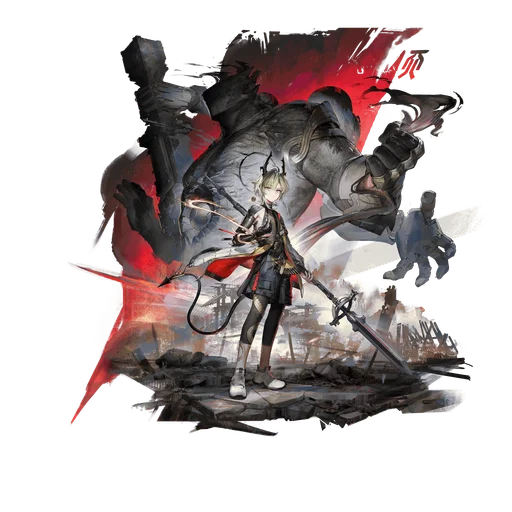
Lifeng’s optimism sits beside, rather than erases, the family tragedy he survived as Bai Yong.
Lifeng Before 1.4: The Boy Behind the Codename
Lifeng’s real name is Bai Yong. He was six when the event recorded as the Great Wall incident killed both of his parents and crushed his right arm. His parents were Tianshi involved with Wuling’s defensive construction. His younger sister, Bai Yuan, is part of the family history that his public, cheerful persona rarely places at the center.
The chrome prosthetic arm makes the past visible even when Lifeng does not discuss it. Every polearm form, every training session, and every promise to become strong enough for more difficult missions is performed with a body literally rebuilt after institutional catastrophe.
Then there is Da Pan. Faced with a curious child and apparently no idea how to raise one, Lifeng’s future mentor bought more than 600 recordings of traditional plays and folk festivals from a Hongshan antique shop. Lifeng watched them closely enough to draw real martial fundamentals from staged performance. What could have been a grim revenge origin becomes something stranger and warmer: a boy reconstructs a fighting tradition from art, then a mentor helps him make it real. That mentor has his own buried history: Da Pan was once Tianshi Pan Yuan, who left the Hongshan Academy after it voted to stop searching for the Science Station dead (see our Da Pan lore post).
Lifeng’s own profile records (the flowers he keeps for his parents’ tombs, Mi Fu’s sweets and why the Blight Tide sent him away) are collected in our Lifeng lore post.
That detail prevents Lifeng from becoming a generic tragic orphan. His fighting style is not built only from anger. It is built from memory, performance, patience, and an adult’s awkward attempt to give a child something worth loving.
His Anasa identity deepens the same idea. Lifeng’s dark halo is a racial trait, not a sign that the story considers him holy. His iconography draws from eastern religious and martial traditions, while his behavior remains refreshingly ordinary. He wants to improve, impress his seniors, and be trusted with difficult work. The ancient imagery and teenage enthusiasm are meant to coexist.
Lifeng’s Patch 1.4 Family Trail
The most important Patch 1.4 clue in the localized mission data is modest but precise. After Lian Xiaowu shares her story, the Tianshi helps the group deduce further leads concerning Lifeng’s and Ah Sheng’s families. They contact Ah Sheng and arrange to meet in the old residential area.
That summary confirms four things.
- Lifeng is actively investigating his family past. The tragedy is no longer confined to an operator file.
- Ah Sheng’s family belongs to the same line of inquiry. The two histories intersect in a way the story has not fully explained.
- Lian Xiaowu can interpret the clues as a Tianshi. This pulls the investigation back toward the institution connected to Lifeng’s parents.
- The old residential area matters as evidence. The story is returning to the lived community around the disaster, not only official archives or military reports.
It is important not to race beyond that evidence. The summary does not identify a hidden parent, confirm a surviving relative, or establish a blood relationship between Lifeng and Ah Sheng. It opens a door. The responsible lore read is that Patch 1.4 moves Lifeng from carrying an inherited tragedy to investigating it.
Lifeng has built a life around forward motion: train harder, help more people, become capable enough for the next mission. Following the family trail asks him to stop and look backward. Strength cannot solve that problem by itself.
Two Survivors, Two Ways of Carrying Wuling
Arcane and Lifeng make a useful pair because their coping mechanisms are almost opposites.
| Story axis | Arcane | Lifeng |
|---|---|---|
| Public identity | Formal YSTF codename and rank | Bright, approachable Operator codename |
| Private identity | Li Zhiyan, exposed most clearly through Chen’s familiarity | Bai Yong, the child behind the Great Wall records |
| Relationship to Wuling’s defenses | Chose to serve inside the YSTF | Lost his parents and arm to defensive construction |
| Response to danger | Takes responsibility immediately, even at personal cost | Trains toward future responsibility without surrendering his warmth |
| Key emotional risk | Believing usefulness requires self-erasure | Believing strength requires leaving grief unexamined |
| Patch 1.4 movement | From recovery back toward chosen service | From chosen service back toward buried family history |
Arcane’s problem is not that she lacks a self. It is that she is extremely good at compressing that self into a role. Lifeng’s problem is not that he hides behind fake happiness. His cheerfulness appears genuine. The danger is that constant forward motion can become its own kind of avoidance.
Homecoming pushes both of them out of those safe patterns. Arcane survives and must decide what service looks like when sacrifice is no longer the ending. Lifeng gains a lead and must decide whether he can meet Bai Yong’s past without losing the Lifeng he built afterward.
The Institutions Behind Both Tragedies
Three institutions connect these arcs: the Tianshi, Tanjian Hall, and the Yinglung Special Task Force.
The Tianshi are scholars, practitioners, and engineers embedded in Wuling’s defenses. Lifeng’s parents belonged to that world, while Lian Xiaowu’s role in reading the family clues shows that the institution also holds knowledge the survivors need. The story presents them as people capable of building wonders, making fatal mistakes, and helping the next generation understand the consequences.
Tanjian Hall turns talented young people into candidates for that protective system. Arcane graduated from it before choosing the YSTF. The 1.4 Blightshade material also points back toward people raised at the Hall, making education itself part of the road that leads north.
The YSTF is where the human cost becomes impossible to ignore. Yinglung Pass is a quarantine line, and several of the Blightshades encountered there are reverberations of dead YSTF personnel. The task force protects Wuling by repeatedly sending people through the Exclusion Gate toward a region saturated with death and memory. Arcane commands within that machine.
For the environmental side of this story, the Yinglung Pass Blightshade bestiary explains why those enemies are not random monsters. They are the afterimage of a defense force that kept paying in bodies.
The combined Arcane and Lifeng story is therefore not “institutions are evil.” It is a harder argument: institutions can be necessary, honorable, and still leave children and soldiers carrying debts they never agreed to pay.
What Different Players Should Notice
If you played Chapter II recently, watch how Patch 1.4 changes Arcane’s sacrifice. Her special leave with Endfield gives her a life beyond being the officer who saved everyone by disappearing.
If you are returning for Homecoming, remember that Lifeng’s light personality does not mean his past was resolved off-screen. His side story reopens the oldest wound in his profile.
If you came from the original Arknights, focus on institutional memory. The writing uses a familiar pressure point: necessary systems become morally legible through the people they fail.
If you mostly skip story, retain two facts. Arcane is alive and serving with Endfield after recovery. Lifeng’s family investigation remains unresolved.
Common Misreadings and Lore Pitfalls
- “Arcane and Lifeng are siblings or cousins.” Nothing in the available story data confirms a blood relationship. Their histories intersect through Wuling’s institutions, not an established family tree.
- “Li Feng is Lifeng’s full name.” The official localization is Lifeng, written as one name. “Li Feng” is a common search spelling, but his birth name is Bai Yong.
- “Arcane died in the Ink Scroll.” She survived, underwent extended recovery, and returns in Version 1.4.
- “Arcane joined Endfield because she quit the YSTF.” Her profile frames the arrangement as special leave and a partnership, not a confirmed resignation.
- “Lifeng’s happiness is an act.” The story gives him real grief without declaring his optimism false. Both can be genuine.
- “The Patch 1.4 family clue solves the mystery.” It advances the investigation to Ah Sheng and the old residential area. It does not identify every relative or culprit.
- “The Great Wall incident and the Marker Stone crisis are the same event.” They are separate disasters. Their narrative connection is the recurring cost of Wuling’s defensive systems.
- “The Tianshi are solely responsible for everything.” Lifeng’s parents were tied to the defensive project, and a Tianshi helps investigate the aftermath. The full chain of responsibility remains open.
Watch List: What Could Change This Reading
- The identity of Lifeng’s and Ah Sheng’s relatives. A confirmed family link could turn the shared investigation into a much more personal conflict.
- A complete account of the Great Wall incident. We know what it cost Lifeng. We still do not know every cause, decision, or cover-up behind it.
- Arcane’s standing inside the YSTF. Whether special leave becomes a permanent transfer will reveal how much distance she can create from the role that nearly consumed her.
- The past behind the YSTF Blightshades. Blitzcrash and the unidentified pale figure appear positioned to make Arcane confront specific people rather than an abstract tragedy.
- Chen Qianyu’s response to Arcane’s return. Their unresolved entrance-exam history remains one of the clearest routes into Arcane’s private self.
- Lifeng speaking as Bai Yong. The moment he chooses his birth name in conversation, rather than having it supplied by a record, will tell us whether the investigation has become reconciliation.
Final Read: Home Is the Wound They Choose to Defend
Arcane and Lifeng are not linked by a surprise family reveal, at least not on the evidence we have. They are linked by Wuling’s habit of turning protection into inheritance.
Arcane inherits a uniform, a command, and the belief that defending home means being ready to spend herself. Lifeng inherits a prosthetic arm, unanswered questions, and a martial tradition rebuilt from whatever fragments Da Pan could place in front of him. One becomes formidable by controlling every feeling. The other becomes resilient without surrendering his.
Patch 1.4 moves them in opposite but complementary directions. Arcane comes back from the edge and learns that survival can be part of service. Lifeng walks toward the past and learns that growth is not only a matter of becoming strong enough for the next fight.
That is the quiet achievement of their shared story. Homecoming is not just returning to a place. It is deciding what part of that place deserves to continue through you. Arcane and Lifeng both choose Wuling, but neither story is finished asking what Wuling owes them in return.
For each operator’s kit, stats and full profile records, see the Lifeng operator page and the Arcane operator page.
Frequently Asked Questions
Are Arcane and Lifeng related?
No blood relationship is confirmed. The story connects them through Wuling, the Tianshi, defensive infrastructure, and the human cost of protecting the city.
What is Arcane’s real name?
Arcane’s real name is Li Zhiyan. Arcane is the English codename she uses as a YSTF officer and Operator.
Is Lifeng’s name Li Feng?
No. Lifeng is the official localized spelling of his codename, while his birth name is Bai Yong. “Li Feng” is a common informal spelling used in searches.
What happened to Lifeng’s parents?
Both parents died in the Great Wall incident roughly ten years before the present story. They were Tianshi involved with Wuling’s defensive infrastructure, and the same incident cost six-year-old Bai Yong his right arm.
Did Arcane die inside the Ink Scroll?
No. She was recovered alive after sealing herself and Ardashir inside the scroll, but her Arts were depleted and she required an extended recovery.
Why is Arcane working with Endfield in Patch 1.4?
Her current profile says she took special leave after recovering from injuries sustained in the North Wuling Exclusion Zone. She then partnered with Endfield Industries rather than simply returning to her previous routine.
What does Lian Xiaowu reveal about Lifeng?
The localized mission summary says she helps deduce more clues about Lifeng’s and Ah Sheng’s families. The group then contacts Ah Sheng and heads to an old residential area, but the summary does not resolve the family mystery.
What is the connection between Arcane and Chen Qianyu?
They entered the YSTF selection process together and fought during the entrance exam. Arcane passed while Chen was rejected, leaving both with unresolved feelings that become visible whenever Chen slips from Arcane’s codename to Li Zhiyan.
Why are Blightshades important to Arcane’s story?
Several Blightshades are reverberations of dead YSTF personnel from the northern line Arcane served. They turn the task force’s losses into enemies she must confront physically, making Yinglung Pass a graveyard that can fight back.
Is Lifeng’s family story finished in Version 1.4?
No. Patch 1.4 advances the investigation by connecting Lifeng, Ah Sheng, Lian Xiaowu, and the old residential area. The identities of every relative and the complete truth behind the Great Wall incident remain open.
Take a Break
Available on desktop