WHO WAS JAKUB MEISSEN? GOLDEN AGE LORE
Table of Contents
If your only exposure to the Landbreakers is the Bonekrushers screaming at you in Valley IV, the name reads as a joke. Version 1.4’s Golden Age polearm quietly fixes that. Jakub Meissen was a decorated Aggeloi War hero who tried to secede from the Civilization Band and take his people back to Terra, and the Golden Age weapon archive is the first text to state that goal in his own followers’ words. Not raiding for its own sake. A return.
That single reframe changes how the Civilization Band reads and how Endfield Industries’ partnership with it reads. It also raises a question the game has not answered: if the original Landbreakers wanted exactly what Endfield wants, why is Endfield standing next to the faction that killed them?
This piece separates what the archive states, what our game-text records already corroborate, and what is community inference. Terminology stays canon-first throughout.
Heads up: this covers weapon archive text from Version 1.4 and background material from the Valley IV and Wuling arcs, including how the original Landbreakers ended. If you want to hit that reveal cold, bookmark this.
TL;DR - Key Points
- Jakub Meissen founded the Landbreakers in Year 90 after the Terrans reached Talos-II, and in-game records title him the Warlord of the Wilds and a former hero of the Aggeloi War.
- The Golden Age archive states his goal plainly. One of his followers says the dream was to go back to Terra and let the Golden Age return again. Jakub’s own phrase, as his men repeat it, was “an even greater city”.
- He tried politics first. Game dialogue confirms his negotiations with the Civilization Band fell apart before he and his loyalists were destroyed, which kills the pure-warlord reading.
- The Band Accord forbids self-declared nation-states outright. A breakaway state was not a policy disagreement, it was a charter violation, and Band Residents are over 90 percent of the planet’s population.
- His goal and Endfield’s goal are nearly identical. Both want to reunite with Terra. The Civilization Band’s stated purpose is survival and self-actualization on Talos-II, which is not the same thing.
- The successor clans inherited the name, not the plan. The Pack hunted his loyalists and called themselves clannibals for it, and the Bonekrushers only think they inherited his ideals.
- The archive scene is set in the aftermath, not the present. Two sworn brothers with the same mentor and identical swords, one of whom joined Jakub, finish their argument on a rooftop after his death.
The Golden Age Archive, In Order
The Golden Age polearm’s Description panel carries a self-contained short story. Three community captures cover most of it, and they are easier to read in sequence than in the order they were posted. The panel header appears on the first, which is how the order below was reconstructed.
Worth flagging up front: the phrase “Golden Age” as a piece of in-universe language returns zero hits in our current game-text records. This archive is newer than the text dump the rest of this post relies on, so the transcriptions below are the primary source for it.
Panel one: the rooftop
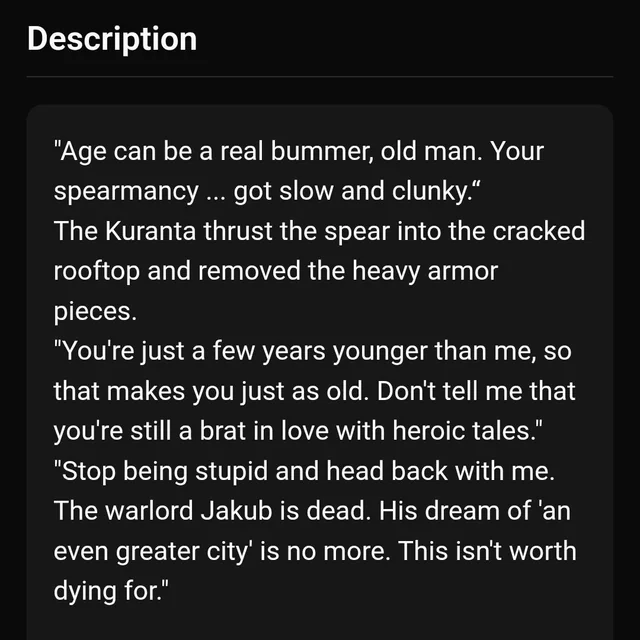
The top of the Golden Age Description panel. The archive never names either character, identifying them only by race.
“Age can be a real bummer, old man. Your spearmancy … got slow and clunky.”
The Kuranta thrust the spear into the cracked rooftop and removed the heavy armor pieces.
“You’re just a few years younger than me, so that makes you just as old. Don’t tell me that you’re still a brat in love with heroic tales.”
“Stop being stupid and head back with me. The warlord Jakub is dead. His dream of ‘an even greater city’ is no more. This isn’t worth dying for.”
The Kuranta grounds the spear and strips his armor. He is agreeing to a sword duel on even terms, which only makes sense once you reach the third panel.
Panel two: the creed
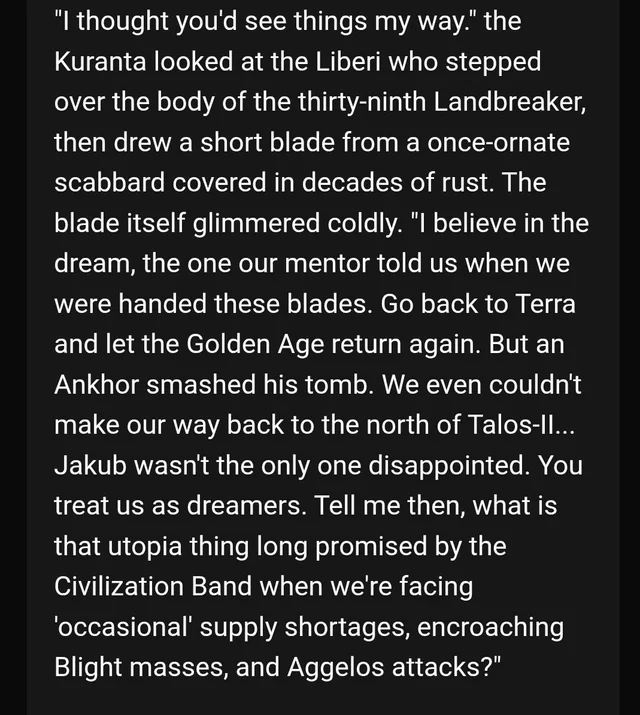
The Kuranta states the Landbreaker creed and challenges the Civilization Band’s promises in the same breath.
“I thought you’d see things my way.” the Kuranta looked at the Liberi who stepped over the body of the thirty-ninth Landbreaker, then drew a short blade from a once-ornate scabbard covered in decades of rust. The blade itself glimmered coldly. “I believe in the dream, the one our mentor told us when we were handed these blades. Go back to Terra and let the Golden Age return again. But an Ankhor smashed his tomb. We even couldn’t make our way back to the north of Talos-II… Jakub wasn’t the only one disappointed. You treat us as dreamers. Tell me then, what is that utopia thing long promised by the Civilization Band when we’re facing ‘occasional’ supply shortages, encroaching Blight masses, and Aggelos attacks?”
Two details in there do a lot of work. “The thirty-ninth Landbreaker” implies the united Landbreakers used ordinal ranks, which nothing else in our records mentions. And “an Ankhor smashed his tomb” means an Aggeloi Ankhor came down on the grave of the man who taught both of them, which is a bleak joke at the expense of two Aggeloi War veterans.
Panel three: the duel
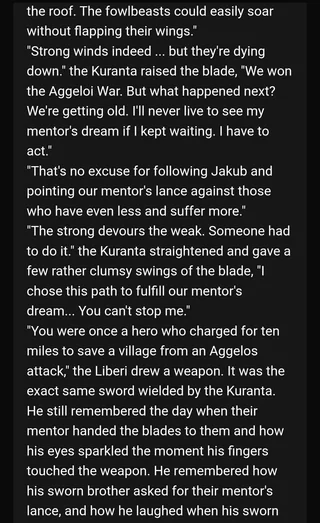
The closing section, cut off mid-sentence. The Liberi draws the twin of the Kuranta’s blade.
the roof. The fowlbeasts could easily soar without flapping their wings.
“Strong winds indeed … but they’re dying down.” the Kuranta raised the blade, “We won the Aggeloi War. But what happened next? We’re getting old. I’ll never live to see my mentor’s dream if I kept waiting. I have to act.”
“That’s no excuse for following Jakub and pointing our mentor’s lance against those who have even less and suffer more.”
“The strong devours the weak. Someone had to do it.” the Kuranta straightened and gave a few rather clumsy swings of the blade, “I chose this path to fulfill our mentor’s dream… You can’t stop me.”
“You were once a hero who charged for ten miles to save a village from an Angelos attack,” the Liberi drew a weapon. It was the exact same sword wielded by the Kuranta.
That last line is the reveal. They are sworn brothers, trained by the same mentor, holding matching blades. The Kuranta also carries the mentor’s lance, which the Liberi throws back at him as an accusation. He asked for it, years ago, and the archive remembers his eyes lighting up when his fingers touched the weapon.
Who Jakub Meissen Actually Was
Strip the archive away and the Nexus-level record is already more interesting than the Valley IV raiders suggest. The concept of Landbreaking is unique to Talos-II, and its origins trace to the 90th year after the Terrans first arrived. Jakub Meissen, the Warlord of the Wilds, named his massive bandit army the Landbreakers. He was a former hero of the Aggeloi War, he occupied a large Originium cultivation site, and he founded what our records call the most dangerous raider organization in the history of Talos-II.
He also brought something out of Seš’qa. The Denstack is described as a witchcraft device that absorbs Blight and disperses it in mist form, and Jakub is the one who brought it to the Landbreakers while the movement was still united. That is not the profile of a bandit chief. That is a man who won a war, decided the winners had been cheated, and went looking for the tools to build an alternative.
| When | What happened |
|---|---|
| Before Year 90 | The First Aggeloi War. Jakub fights in it and comes out a decorated hero. |
| Year 90 | He occupies a large Originium cultivation site and names his army the Landbreakers. |
| While united | He brings the Denstack out of Seš’qa, giving the movement Blight-clearing capability. |
| Unpinned | Negotiations with the Civilization Band fall apart. |
| Unpinned | The Band destroys the organization. Jakub dies. The Pack purges his loyalists. |
| Year 139 | The Second Aggeloi War begins as the exiles return. |
| Present day | Landbreaker survives as a generic label for organized armed criminals. |
One honest caveat on that table. Our records name the First and Second Aggeloi Wars but never state which one the archive’s two veterans fought in. What the surrounding dates allow is still fairly tight. Tinned rations from the end of the First Aggeloi War are described as more than a century old, the Wuling disaster is dated to Year 142, and the Very Large Rift that 1.4 finally seals happened ten years before the present. That puts the game’s present somewhere past Year 150.
Work backwards from there and the archive fits cleanly: the rooftop scene happens in the aftermath of the crackdown, decades before the present day and before the Second Aggeloi War of Year 139. Two First Aggeloi War veterans who backed a warlord founded in Year 90 can plausibly still be standing on that roof calling each other old men. Nothing in the text pins it, but nothing in the dates fights it either.
The Dream: “An Even Greater City”
Here is what the archive genuinely adds, because it is easy to overstate.
What the archive states. The dream came from the mentor, not from Jakub: go back to Terra and let the Golden Age return again. Jakub’s version of it, in the words of a man arguing against him, was “an even greater city”. His followers included aging war heroes who chose him deliberately, not desperate opportunists.
What our records corroborate. That Jakub was a war hero, that he turned his back on the Civilization Band rather than never belonging to it, and that his organization was totally destroyed by that Band.
What nobody has. Jakub’s own words. Every line quoted above is a follower or an opponent characterizing him. We still have no primary text from the man himself, and no statement of how he intended to reach Terra with the Aethergate down.
The scale here matters. “An even greater city” is a modest phrase for a movement that got labelled the most dangerous raider organization in Talosian history. It implies a founding project, a place to live, not a campaign of extraction. And “go back to Terra” puts the original Landbreakers in the same ideological bracket as the Returnist positions that surface elsewhere on Talos-II, the ones various public figures loudly deny holding.
Why Seš’qa Backed Him So Quickly
This is the part where the community reading is strong, so it gets labelled as one.
The thread argument runs like this: Jakub is read as Sarkaz, and the Sarkaz are the Terran culture most defined by attachment to a homeland. Kazdel is not a nostalgic detail for them, it is the organizing principle of ten thousand years of history. A Sarkaz population stranded on a world where the gate home is broken would fracture along exactly one line, between those who accept the new world and those who refuse to. A man promising to go back would not need to build support in Seš’qa. He would only need to name what was already there.
The pointed observation attached to it: the Sarkaz city on Talos-II was never named Kazdel. Read one way, that is a refusal to call this place home.
What our records actually support is narrower but real. Jakub’s connection to Seš’qa is confirmed through the Denstack, which is explicitly described as Seš’qa witchcraft that he brought forth. His race is not stated in any string we currently hold. Our Sarkaz identity crisis piece covers what Seš’qa has become in the meantime, which is roughly the opposite of a homeland reclamation project.
The Negotiation That Failed
The single most load-bearing line in our whole text dump on this subject comes from Pack dialogue, and it is not about Jakub’s ideology at all. It is about his method.
“Guessing the details of your meeting wasn’t hard… Jakub’s negotiations with the Civilization Band fell apart. He and his loyalists will be torn apart…”
He negotiated. There was a meeting, a process, and a collapse, and the destruction came after. That ordering matters because the popular framing of Jakub is a warlord who took what he wanted, and the record does not support it. He asked, was refused, and then acted.
The crackdown that followed was not limited to Jakub’s own men. The Pack, one of the three clans that would inherit his name, was told what compliance would cost:
“Wolves will be killing Wolves. The Clan will be forced to do housekeeping. Those who stand with Jakub will be eliminated. Even the Wolves who made their ‘names’ in the Civilization Band by raiding and killing will be bled dry and left to die in the wildlands.”
So the Landbreakers were not only defeated from outside. They were made to purge themselves from inside, and the clan that did the purging survived. That is the fact the Bonekrushers’ cheerful savagery distracts from.
There is one more record worth putting next to this. A UWST Bureau history notes the Bureau was founded not long after “that inglorious war” concluded, while “the scent of blood still hung heavy in the air”, and that its work ensured any voices contradicting the Band Accord’s principles vanished into the shadows of back alleys. The game wrote that down. It is not a community theory.
What the Band Accord Actually Forbids
The Civilization Band, or the Civ Band as community threads shorten it, is usually described on this site in economic terms. Its charter text is blunter than that:
The Civilization Band comprises various sized factions, coalitions, and organizations. Bound by Accord restrictions, it does not accept self-declared “nation-states” as members. Using the Accord as its foundational framework, it promotes technical specialization and autonomy among members, sustains humanity’s basic survival on Talos-II, and strives for human self-actualization on this world.
Three things fall out of that paragraph.
- The nation-state ban is structural. Jakub was not asking for a policy change, he was asking for the one thing the Accord is built to refuse. Member factions are Accordatories, and Band Residents are over 90 percent of Talos-II’s total population.
- The stated mission is Talos-II, twice. Survival “on Talos-II” and self-actualization “on this world”. Reunification with Terra is not in the charter, and its absence is doing work.
- The rule is not applied evenly. The Hongshan Academy of Sciences “continues to call itself an R&D institution of Yan and govern its territories as such”, establishing its own ministries for livestock and crops, and answers criticism by pointing at its Accord compliance. A faction openly governing as the administrative organ of a Terran nation is inside the tent, while a movement that wanted to found a city is outside it.
If you want the economic machinery this sits on top of, our stock bills and Band Accord economy explainer covers how the Accordatories actually hold the planet together.
Why Endfield Backs the Band Anyway
Endfield Industries wants to reclaim the North and reunite with Terra. The original Landbreakers wanted to go back to Terra. The Civilization Band’s charter commits to human flourishing on this world. Line those three up and the awkwardness is obvious: the faction Endfield partners with does not share Endfield’s objective, and the faction Endfield fights the remnants of did.
The realist case for the partnership is still overwhelming, and it is worth stating properly rather than treating the Band as a villain reveal.
- Population and industry. Over 90 percent of Talosians are Band Residents. Every foundry, farm, rail line, and security agency that a northern push depends on sits inside Accordatory territory.
- Supply, not power. The bottleneck on reunification is not a cosmic threat, it is logistics. An Endministrator with extraordinary personal capability still cannot manufacture a supply chain, and Endfield’s whole industrial buildout exists because the resource problem is real.
- The Foundation is live. The threat that actually needs handling now requires the same partners, and Nefarith is being tracked through the security agencies of the Band Accordatories rather than around them.
- Persuasion has limits. Nothing in the Endministrator’s toolkit changes what 90 percent of a planet believes it wants. Going it alone means isolation, which is exactly the position that got Jakub killed.
There is a community reading attached to this that is worth flagging as exactly that. Threads point to a moment in Camille’s story quest where Char argues that cooperation is the wiser and more lucrative option, and read it as an old Landbreaker recognizing that Endfield and Jakub’s movement were pointed at the same horizon. It is a satisfying fit. What we can verify is thinner: Char’s affiliation is not stated in any game string currently datamined, and our Camille story quest breakdown covers what the English text does and does not confirm about him, including the unexplained “special link” he has with the Endministrator. Treat the Landbreaker connection as a reading, not a fact.
What Became of His Followers
When Jakub’s organization was destroyed, his legacy was inherited by three major clans, plus numerous smaller clans and warbands. None of them inherited the plan.
| Clan | Stance | In-game footprint |
|---|---|---|
| Bonekrushers | Believe they inherited Jakub’s ideals. Records call them mad and bloodthirsty pillagers in truth. | The Valley IV antagonists, Pyromancers and Ambushers included, still running raiding tactics unchanged since Jakub’s era. |
| The Pack | Never shared his views. Purged his loyalists under Band pressure and called themselves clannibals for it. | Wulfgard is a Pack mercenary. Classified records track the clan from the shattering of Jakub’s ambitions to the present. |
| Sandreavers | Loosely organized, made their name with a single bergantin. | Suspected in-universe of printing illegal books that vilify Band heroes. |
| Grayscars | Minor clan. | Tattoo their entire bodies with Binding Verses. |
| Shadowskulls | Minor clan. | Assassins, and nobody crosses them after sunset. |
Two individual threads are worth holding onto. Chacha’s grandfather served Jakub personally as an enforcer, which puts a living memory of the united Landbreakers inside the current story rather than in a history file. And the Bonekrusher Pyromancers are explicitly described as relying on traditional raiding tactics from Jakub’s era, resistant to change. They kept the tactics and lost the point, which is the whole tragedy in one enemy description.
For the operator side of the Pack, our Rossi, Wulfperl and Luppino guide covers the three Landbreaker-affiliated units currently on the roster.
Pursuit: Great Hero, Read as Lore
Weapon design in Endfield is usually mechanical first, but this one lines up too neatly to skip.
Golden Age is a 6-star Polearm from Version 1.4 with 485 base ATK, a Will substat of +156, and Treatment Efficiency of +46.43 percent. Its weapon skill is called Pursuit: Great Hero, and it grants Electric DMG, gives the wielder Treatment Efficiency when its combo skill deals damage, and buffs the entire team’s Arts DMG when that skill heals allies.
A polearm named for a lost golden age, whose skill is named for the pursuit of a great hero, and whose payoff clause only fires when you heal your allies. The archive’s counter-argument to the Kuranta is that he was once a hero who charged ten miles to save a village. The weapon rewards the version of him that saved people and does nothing special for the version that raided them.
Whether the Golden Age polearm literally is the mentor’s lance is not stated. The archive is the lance’s story or the movement’s story, and the text stops short of labelling the object. For who should actually equip it, our Junction Point and Golden Age weapon breakdown has the operator-by-operator math.
Common Mistakes and Misreadings
- “Landbreaker means Bonekrusher.” Landbreaker was Jakub’s name for a united army. After the Band destroyed it, the word decayed into a generic label for any organized armed group that disregards Talosian law. Bonekrushers are one successor out of at least five.
- “Jakub never tried politics.” He negotiated with the Civilization Band and the negotiations collapsed. The violence came after the refusal, not instead of the request.
- “The Civilization Band is unified on Terra.” Hongshan governs its territory as an organ of Yan while claiming Accord compliance. Whatever the Band’s collective position is, it is not one position.
- “The Band Accord ban is a technicality.” It is the charter’s own wording, and it covers over 90 percent of the planet’s population. There is no version of Jakub’s plan that is not a membership violation.
- “The Landbreakers were only beaten from outside.” The Pack purged Jakub’s loyalists internally under Band pressure. Read the clan records before assuming the crackdown was a clean external victory.
- “Aggelos, Aggeloi and Angelos are different things.” All three spellings appear in the archive text itself for the same enemy faction. That is a localization inconsistency, not three factions.
- “An Ankhor smashed Jakub’s tomb.” The nearest antecedent is the mentor’s tomb, not Jakub’s. The archive is ambiguous and the popular reading picks the more dramatic option.
Watch List: What Would Change This Reading
- A Seš’qa region or story arc. Everything above about why the movement caught on there is inference. A Seš’qa chapter would either confirm the homeland reading or replace it.
- Nefarith’s Landbreakers versus Jakub’s. The current Landbreakers under Nefarith are a different animal, and how much of the original ideology she is actually using is unestablished. If she is invoking the return to Terra, the plot converges hard.
- Any primary Jakub text. A Nexus Files entry, an archive, or a recovered document in his own voice would settle whether “an even greater city” was a founding vision or a recruitment slogan.
- Why the Band leans on the nation-state ban so hard. The charter states the rule but never justifies it. The UWST Bureau record hints the enforcement has a history worth hiding.
- The Aethergate’s condition. If the break was ever shown to be deliberate, every faction’s stance on reunification becomes a motive rather than a preference.
- Hongshan’s self-description. The Yan framing is currently presented as an eccentricity. Formalized, it becomes the precedent Jakub was denied.
Final Read
The Landbreakers had a terrible introduction. Bonekrushers as comic-relief junkies, a Nefarith reveal that landed softer than intended, and a faction name that mostly meant “the enemies in this region”. The Golden Age archive is the game going back and telling you the name used to mean something, and that the people who carried it first were war heroes who could not accept the peace they had won.
That is the reframe worth holding onto. Jakub Meissen was not a threat because he was violent. Talos-II has plenty of violent people. He was a threat because he made an argument that over 90 percent of a planet’s governing framework has no answer to, then asked politely, then acted when politely failed. The Civilization Band’s response was total, and the surviving record of it includes a line about dissent disappearing into back alleys.
Endfield is standing on the winning side of that fight while pursuing the losing side’s objective. The game has not called that out yet. When it does, the Golden Age archive is the document it will be pointing back at.
FAQ
Who was Jakub Meissen in Arknights Endfield?
Jakub Meissen was a decorated hero of the Aggeloi War who turned his back on the Civilization Band, occupied a large Originium cultivation site, and named his army the Landbreakers in the 90th year after the Terrans arrived on Talos-II. In-game records call him the Warlord of the Wilds and credit him with founding the most dangerous raider organization in Talosian history.
What did Jakub actually want?
The Golden Age weapon archive states it through one of his followers: go back to Terra and let the Golden Age return again. Combined with the phrase his men attribute to him, “an even greater city”, this frames the original Landbreakers as a secessionist and Returnist movement rather than a raiding cult. They wanted out of the Band and back to the homeworld.
Why did the Civilization Band destroy the Landbreakers?
The Band Accord does not accept self-declared nation-states as members, so a breakaway state was a charter-level violation rather than a policy dispute. In-game dialogue confirms Jakub negotiated with the Civilization Band first and that those negotiations fell apart, after which he and his loyalists were destroyed.
Was Jakub Sarkaz?
The community reads him as Sarkaz and points to how quickly Seš’qa backed him, plus his use of the Denstack, a Seš’qa witchcraft device that absorbs Blight and disperses it as mist. The in-game text confirms the Seš’qa connection and the Denstack. It does not spell out his race in any string currently datamined.
Does Jakub’s goal match Endfield’s goal?
On the surface, yes. Endfield Industries wants to reclaim the North and reunite with Terra, and the original Landbreakers wanted to go back to Terra. The Civilization Band’s charter, by contrast, commits only to survival and self-actualization on Talos-II. That mismatch is the sharpest unresolved tension in the setting’s politics right now.
Then why does Endfield work with the Civilization Band?
Arithmetic. Band Residents are over 90 percent of the Talos-II population, which means the Band holds nearly all of the planet’s industry, food supply, and military capacity. Endfield needs Accordatory logistics to push north at all, and the Foundation is the live threat that requires those same partners.
What happened to the Landbreakers after Jakub died?
His legacy split three ways, into the Bonekrushers, the Pack, and the Sandreavers, plus numerous smaller clans and warbands such as the Grayscars and the Shadowskulls. The Pack never shared Jakub’s views and hunted his loyalists, describing themselves as clannibals for it. The Bonekrushers believe they inherited his ideals but are written as bloodthirsty pillagers.
Is the Golden Age polearm the mentor’s lance from the archive?
That is the natural reading and it is not stated outright. The archive describes a mentor handing twin swords to two sworn brothers, with the lance going to the one who later joined Jakub. The weapon is a 6-star Polearm whose skill is named Pursuit: Great Hero, which matches the story’s heroic framing, but no line in the text labels the lance as this specific weapon.
Do Landbreaker and Bonekrusher mean the same thing?
No. Landbreaker was Jakub’s own name for his united army, and after the Band crushed it the word decayed into a generic label for any organized armed group that ignores Talosian law. The Bonekrushers are one successor clan out of several, which is why the Valley IV raiders you fight early on are a poor representation of what the name originally meant.
Related Reading
- Sarkaz identity crisis on Talos-II — what Seš’qa became after the movement that wanted to go home was destroyed.
- Camille’s story quest and Char — what the English text confirms about Char, and what the community has added to it.
- The Foundation and the Exiles — the threat that keeps Endfield tied to Accordatory partners.
- Stock bills and the Band Accord economy — the machinery that makes 90 percent of a planet hold together.
- Junction Point and Golden Age weapon breakdown — who should actually equip the polearm this archive belongs to.
- Nefarith’s return and Ardashir’s vessel — what the Landbreaker name is being used for now.
Source: community analysis of the Golden Age weapon archive (credit: u/OrangeIllustrious499 and commenters on r/Endfield). Archive text transcribed from in-game Description panels shared to the subreddit. Supporting quotations are drawn from in-game records and dialogue.
Note: Lore details reflect content through Version 1.4 Homecoming. Community theories are labelled as such. Please refer to in-game Nexus Files and weapon archives for canonical text.
Take a Break
Available on desktop